Compaction of Soils


Compaction of Soils
Compaction is the application of mechanical energy to a soil so as to rearrange its particles and reduce the void ratio. It is commonly used to improve the engineering properties of natural soils or placed fills for works such as embankments, road bases, runways, earth dams, reinforced earth walls and building platform preparation. During compaction there is usually no change in the size of the individual soil particles; however the arrangement of particles and the volume of voids change. The water content of the soil strongly influences the effectiveness of compaction.
Objectives of Compaction
- To increase soil shear strength and therefore its bearing capacity.
- To reduce subsequent settlement under working loads.
- To reduce soil permeability and make it more difficult for water to percolate through the soil mass.
- To improve stability of slopes and embankments and to provide a uniform, stable working surface during construction.
Laboratory Compaction Tests
Laboratory tests determine the relationship between dry density and water content for a specified compactive effort. These tests identify the maximum dry density (MDD) that a soil can attain and the corresponding optimum moisture content (OMC) for that compactive effort. Standard procedures used are:
- Indian Standard Light Compaction Test (similar to Standard Proctor Test)
- Indian Standard Heavy Compaction Test (similar to Modified Proctor Test)
Indian Standard Light Compaction Test
Soil is compacted into a 1000 cm3 mould in three equal layers. Each layer receives 25 blows from a rammer weighing 2.6 kg dropped from a height of 310 mm onto the soil. The test is repeated on samples prepared at different water contents to produce the dry density-water content curve.
Indian Standard Heavy Compaction Test
The Light Compaction Test (Standard Test) does not reproduce the higher densities obtained under heavier field compactive efforts. The Heavy Compaction Test (Modified Test) uses the same mould but increases compactive effort by compacting the soil in five equal layers and using a rammer weighing 4.9 kg dropped from a height of 450 mm. Each layer receives 25 blows. The Modified Test therefore produces higher maximum dry densities and typically lower OMC values for the same soil.
Dry Density - Water Content Relationship
To assess the degree of compaction, the dry unit weight (or dry density) is used because it indicates how much solid material is present in a given volume of soil. In practice the bulk (wet) unit weight and the moisture content are measured in the laboratory and the dry unit weight is calculated from them.

where

= bulk density, and w = water content.
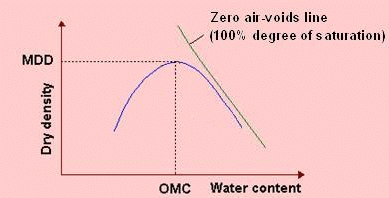
A series of specimens compacted at different water contents gives a plot of dry density versus water content that usually has a distinct peak for cohesive soils (soils containing fines). These inverted-V plots are known as compaction curves.
Dry density can be related to water content and degree of saturation (S) as shown below.
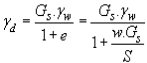
From these relations, an increase in dry density implies a decrease in voids ratio and a more compact soil. Dry density can also be related to percentage air voids (na) as follows:
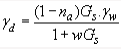
The theoretical relation between moisture content and dry unit weight for a fully saturated soil is the zero air-voids line. In practice it is not feasible to expel all air from a soil by compaction, so measured compaction curves always lie below this line.
Effect of Increasing Water Content
At low moisture contents, adding water lubricates particle contacts and makes it easier for particles to move past one another under compacting energy. Particles pack more closely, voids reduce and dry density increases. As water content continues to increase, water begins to occupy space that would otherwise be occupied by soil solids, and additional water hinders closer packing. Thus dry density decreases beyond a certain moisture content.
The peak dry density on the compaction curve is called the maximum dry density (MDD) and the corresponding moisture content is the optimum moisture content (OMC).
Effect of Increasing Compactive Effort
Different compactive efforts produce different compaction curves. Increasing the compactive effort generally increases the MDD and reduces the OMC. The influence of compactive effort is greatest when the soil is compacted at moisture contents drier than the OMC. For moisture contents greater than the OMC, increasing compactive effort gives only small increases in dry density.
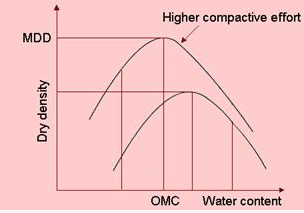
Because the compaction curve depends on the compactive effort, values of MDD and OMC must always be reported with the specification of the test procedure used (Standard or Modified/Light or Heavy).
Factors Affecting Compaction
- Soil plasticity - Soils with higher clay content and plasticity generally require more water and energy to achieve compaction, and their compaction curves are broader.
- Water content - Determines ease of particle rearrangement (lubrication) and the eventual packing; leads to the concept of OMC and MDD.
- Compactive effort - Magnitude and type of applied energy (static, impact, vibratory) change MDD and OMC.
Compaction of Cohesionless Soils
Cohesionless soils (sands and gravels with little or no fines) behave differently from cohesive soils. Standard mould compaction tests are less suitable for these soils. Effective methods for field compaction include vibration and water-assisted densification. Vibration helps particles rearrange into a denser packing; watering and subsequent vibration allow seepage forces to aid particle movement, but large quantities of water may be required.
For cohesionless soils a common control parameter is relative density (ID), expressed as a percentage. Relative density indicates how close a given in-situ density is to the theoretical loosest and densest states obtainable in the laboratory. If e is the current void ratio (or gd is the current dry density) then relative density is defined by the relations below.
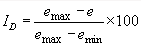
or
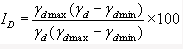
In the definitions above, emax and emin are the maximum and minimum void ratios obtained from standard laboratory tests, and gdmin and gdmax are the corresponding minimum and maximum dry densities.
Classification by Relative Density
- < 15% - Very loose
- 15-35% - Loose
- 35-65% - Medium
- 65-85% - Dense
- > 85% - Very dense
Relative density alone does not give the dry density; the actual dry density depends on particle gradation, angularity and mineralogy which control the maximum and minimum achievable densities.
Field Compaction: Methods and Quality Control
Common field compaction methods and equipment:
- Sheepsfoot (padfoot) rollers - Effective for compacting cohesive soils (clays) by kneading and pressure.
- Smooth-wheeled rollers - Used for granular soils and finishing of layers.
- Pneumatic-tyred rollers - Provide kneading action and are useful for mixed soils and asphalt bases.
- Vibratory rollers - Provide dynamic compaction and are effective for cohesionless (granular) soils.
- Tamping rammers and plate compactors - Used for localized compaction, trenches and small areas.
- Water-assisted compaction - Controlled wetting followed by compaction; useful for some non-cohesive soils.
Field quality-control tests to assess compaction and moisture include:
- Sand replacement test (ASTM/CODE equivalent) - Determines in-situ dry density by replacing excavated soil volume with calibrated sand.
- Core cutter method - Direct determination of in-situ unit weight from a core sample of known volume.
- Nuclear densometer - Rapid, non-destructive measurement of in-situ dry density and moisture content (requires calibration and safety procedures).
- Plate bearing test / vane shear - Secondary checks on strength and stiffness where relevant.
Field compaction specifications commonly require that compacted fills achieve a specified percentage of laboratory MDD (e.g., 95% of MDD by Standard Proctor for many earthworks), together with control limits on moisture content (typically within ±2% of OMC). The selected target depends on the purpose of the fill and the type of structure.
Notes and Applications
- For foundations and structural fills, achieving the required density reduces settlements and improves bearing capacity.
- For earth dams and impermeable cores, higher compaction at near-optimum moisture content reduces permeability and seepage risks.
- For pavement subgrades and road bases, adequate compaction prevents rutting and increases long-term serviceability.
- Compaction procedures, equipment and acceptance criteria should be specified in contract documents to ensure uniform construction practice and verifiable quality control.
Summary
Compaction is a fundamental ground-improvement operation that reduces voids and rearranges particles to improve strength, stiffness and reduce permeability. Laboratory compaction tests establish the relationship between dry density and water content for specified compactive efforts and provide MDD and OMC values used for field control. The effectiveness of compaction depends on soil type, water content and compactive effort. Cohesive soils exhibit a clear MDD-OMC peak, while cohesionless soils are often controlled by relative density and mechanical vibration. Field selection of rollers and testing methods ensures that specified compaction criteria are met for safe and durable earthworks.
FAQs on Compaction of Soils
| 1. What is soil compaction in civil engineering? |  |
| 2. Why is soil compaction important in civil engineering? | |
| 3. What are the factors affecting soil compaction? | |
| 4. What are the common methods used for soil compaction? | |
| 5. What are the consequences of inadequate soil compaction? | |