Civil Engineering (CE) Exam  >  Civil Engineering (CE) Notes  >  Transportation Engineering  >  Characteristics of Road Transport Jayakar Committee Recommendations & Implementation

Characteristics of Road Transport Jayakar Committee Recommendations & Implementation | Transportation Engineering - Civil Engineering (CE) PDF Download

Characteristics of Road Transport

Road transport refers to movement of people and goods on land by motor vehicles, animal-drawn vehicles and human-powered vehicles using a network of roads. It is the most flexible mode of surface transport and serves a wide range of trip purposes from short local trips to inter-city travel. The principal characteristics are:

  1. Mixed vehicle usage: Roads accommodate a variety of vehicles - cars, buses, trucks, two- and three-wheelers, pedal cycles and animal-drawn vehicles - unlike railways, waterways or airways which are restricted to their own specialised vehicles.
  2. Low capital outlay and decentralised investment: Construction and maintenance cost of roads, and purchase cost of motor vehicles, are relatively low compared with the capital required for railways, ports or airports. This makes road transport easier to provide at local and provincial levels.
  3. High operational flexibility: Road users can change lane, direction and route, vary speed and make door-to-door deliveries. This flexibility allows routing according to need and convenience, and is particularly useful for last-mile connectivity.
  4. Efficiency for short distances: For short trips and door-to-door movements, road transport typically saves time and reduces handling when compared with other modes that require transshipment.
  5. Speed, dispersion and safety trade-off: Higher vehicle speeds increase journey time savings but also raise accident severity. Wide dispersion in speeds among mixed traffic (for example slow moving cycles and fast cars on the same carriageway) increases the probability of accidents and reduces overall road safety.
  6. Universal accessibility: Road transport serves the whole community alike - urban and rural - providing access to markets, schools, hospitals and other services where other modes may not reach.

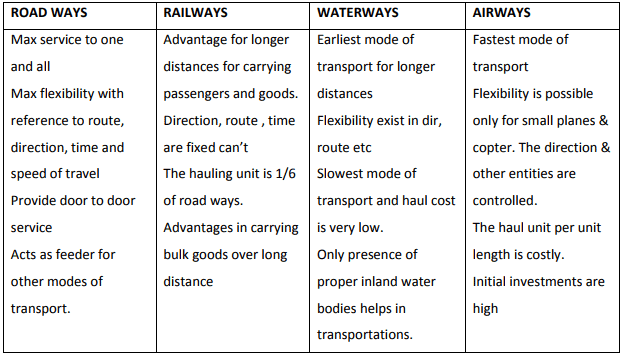
Comparison of Different Modes

Comparison of Different Modes
Question for Characteristics of Road Transport Jayakar Committee Recommendations & Implementation
Try yourself:
Which of the following is an advantage of road transport?
View Solution

The following sections present concise advantages and disadvantages of the four principal transport modes: roadways, railways, waterways and airways.

Roadways

Road transport is characterised by door-to-door service and high route flexibility; it is the dominant mode for passenger travel and for freight over short to medium distances.

Advantages:

  • Flexibility of movement and routing; supports door-to-door service.
  • Relatively low initial investment and lower construction cost compared with railways, ports and airports.
  • Provides universal access and serves the whole community.
  • Time-efficient for short-distance travel and last-mile delivery.
  • Accommodates diverse vehicle types and trip purposes.

Disadvantages:

  • Higher accident risk, particularly where there is large dispersion in vehicle speeds and mixed traffic without segregation.
  • Generally not the most economical option for very long-distance heavy freight.
  • Power required (fuel consumption) per tonne of freight tends to be higher than rail for the same distance and load.

Railways

Rail transport is best suited to bulk and long-distance freight and for high-capacity passenger movements on fixed corridors.

Advantages:

  • Can move heavy loads over long distances efficiently.
  • Lower power (energy) required per tonne of freight compared with road transport.
  • Generally lower accident rate per unit of traffic because of guided tracks and controlled operations.

Disadvantages:

  • Fixed entry and exit points; requires transshipment for door-to-door deliveries.
  • Limited freedom of movement; operations require signalling and centralised control systems.
  • Higher capital cost for establishment and maintenance of tracks, stations and rolling stock.

Waterways

Water transport is the most economical mode for very large and heavy consignments over long distances, especially bulk commodities.

Advantages:

  • Lowest cost per tonne-kilometre in most cases; very economical for bulk freight.
  • Very high load-carrying capacity for ships and barges.
  • Promotion of port and related industrial development along coasts and rivers.

Disadvantages:

  • Slow transit times compared with other modes for many cargoes.
  • Operations are dependent on weather and navigational conditions.
  • Loading/unloading and transit may be affected by tides and water levels.
  • Navigation routes can be circuitous and may require transshipment to reach inland destinations.

Airways

Air transport is the fastest mode and essential for time-sensitive passenger and cargo movements over long distances and between continents.

Advantages:

  • Highest speed among transport modes; reduced travel time.
  • Enables rapid intercontinental and long-distance travel.
  • Continuous routes over land and sea without the need for intermediate transshipment in most cases.

Disadvantages:

  • Highest operating cost per tonne and per passenger; expensive for bulky or heavy cargo.
  • Lowest load carrying capacity among the modes.
  • Operations are strongly weather-dependent and must follow strict flight rules and air traffic control.

Jayakar Committee - Recommendations and Implementation

With the rapid growth of motor vehicles after the First World War, existing roads in India faced increasing demand from mixed traffic. The flexibility and variety of motor vehicles required a more organised approach to road development, finance, technical standards and research. In this context the Government of India appointed the Jayakar Committee in 1927 to study road problems; the committee submitted its report in 1928 with the following key recommendations.

Recommendations

  1. National priority: Road development should be considered a matter of national interest because provincial and local authorities generally lacked sufficient financial and technical capacity to plan and construct a modern road network.
  2. User taxation for funding: Additional charges or taxes should be levied on road users to create a dedicated fund for road construction and maintenance.
  3. Creation of a semi-official technical body: A central technical body should be established to collect and pool technical knowledge from across the country and to act as an advisory organisation on road engineering and policy.
  4. National research organisation: A national research institution should be set up to undertake road research and development and to provide technical consultation to road authorities.
Question for Characteristics of Road Transport Jayakar Committee Recommendations & Implementation
Try yourself:
According to the Jayakar Committee recommendations, what was the proposed solution for funding road development in India?
View Solution

Implementation

Most of the Jayakar Committee's recommendations were accepted and implemented progressively by the Government of India. Important institutions set up in response include:

  • Central Road Fund (CRF) established in 1929 - to provide a pooled source of finance for road works funded from specific road user taxes and levies.
  • Indian Roads Congress (IRC) constituted in 1934 - formed as a technical body to develop standards, specifications and codes of practice for road planning, design and construction in India.
  • Central Road Research Institute (CRRI) established in 1950 - as a national centre for research and development in pavement materials, traffic engineering, bridge engineering and related fields, and to provide technical assistance to road agencies.

Notes on Road Safety and Management (Practical Implications)

Because road transport supports mixed traffic and flexible movement, planning and engineering measures are necessary to improve safety and efficiency. Typical measures include:

  • Traffic segregation and lane discipline to reduce speed dispersion between different vehicle classes.
  • Design standards for geometric alignment, sight distance and cross-section to reduce accident risk.
  • Speed limits, enforcement and traffic calming measures in urban and residential areas.
  • Investment in pavement quality, drainage and maintenance to reduce vehicle operating costs and improve reliability.
  • Road user education and licensing standards to improve driver behaviour and reduce accidents.

The Jayakar Committee laid the foundation for institutional, financial and technical structures that shaped modern road development in India. Together, policy (funding), standards (technical bodies) and research (R&D institutes) form the three pillars necessary for systematic and safe road transport planning and delivery.

The document Characteristics of Road Transport Jayakar Committee Recommendations & Implementation | Transportation Engineering - Civil Engineering (CE) is a part of the Civil Engineering (CE) Course Transportation Engineering.
All you need of Civil Engineering (CE) at this link: Civil Engineering (CE)
27 videos|124 docs|58 tests

FAQs on Characteristics of Road Transport Jayakar Committee Recommendations & Implementation - Transportation Engineering - Civil Engineering (CE)

1. What are the recommendations of Jayakar Committee regarding road transport?
Ans. The Jayakar Committee recommended the following for road transport: 1. Establishment of a separate department for road transport. 2. Construction of new roads and maintenance of existing ones. 3. Improvement of road safety measures. 4. Regulation of public transport and private vehicles. 5. Implementation of a road development plan.
2. What are the characteristics of road transport according to the article?
Ans. According to the article, the characteristics of road transport are: 1. Flexibility: Road transport can reach any corner of the country. 2. Affordability: Road transport is relatively cheaper than other modes of transport. 3. Accessibility: Road transport is accessible to everyone, including rural areas. 4. Convenience: Road transport offers door-to-door service. 5. Speed: Road transport is faster than rail and water transport for short distances.
3. What is the role of civil engineering in road transport?
Ans. Civil engineering plays a significant role in road transport by designing and constructing roads and bridges. Civil engineers are responsible for ensuring the safety and sustainability of roads, as well as maintaining and upgrading them as needed.
4. What are the benefits of implementing the Jayakar Committee's recommendations?
Ans. The benefits of implementing the Jayakar Committee's recommendations include: 1. Improved road infrastructure and safety measures. 2. Better regulation of public and private transport. 3. Establishment of a separate department for road transport. 4. Implementation of a road development plan. 5. More efficient and affordable transportation options.
5. What are some frequently asked questions about road transport?
Ans. Some frequently asked questions about road transport are: 1. What are the advantages and disadvantages of road transport? 2. How is road transport regulated in India? 3. What is the future of road transport in India? 4. How can road safety be improved in India? 5. What role do tolls play in financing road infrastructure?
Related Searches

Previous Year Questions with Solutions

,

MCQs

,

Important questions

,

Characteristics of Road Transport Jayakar Committee Recommendations & Implementation | Transportation Engineering - Civil Engineering (CE)

,

Characteristics of Road Transport Jayakar Committee Recommendations & Implementation | Transportation Engineering - Civil Engineering (CE)

,

shortcuts and tricks

,

Free

,

pdf

,

Extra Questions

,

Sample Paper

,

past year papers

,

video lectures

,

Characteristics of Road Transport Jayakar Committee Recommendations & Implementation | Transportation Engineering - Civil Engineering (CE)

,

Objective type Questions

,

mock tests for examination

,

Summary

,

Semester Notes

,

practice quizzes

,

ppt

,

Exam

,

study material

,

Viva Questions

;