Units & Scales of Pressure Measurement


Pascal (N/m2) is the SI unit of pressure.
Pressure is commonly expressed with reference to a specified datum pressure. Two references widely used are a complete vacuum (absolute zero pressure) and the local atmospheric pressure. The choice of reference determines whether a pressure is reported as an absolute value, a gauge value or, when lower than atmosphere, as a vacuum pressure.
Types of Pressure
- Absolute pressure: This is the pressure measured relative to a perfect vacuum (absolute zero pressure). Numerically, if p denotes the absolute pressure then pabs = p - 0 = p.
- Gauge pressure: This is the pressure measured relative to the local atmospheric pressure. If p denotes the absolute pressure and patm the local atmospheric pressure then the gauge pressure is pgauge = p - patm. Gauge pressure is the usual reading of many instruments (pressure gauges, tyre gauges, etc.).
- Vacuum pressure: If the absolute pressure is less than atmospheric, the gauge pressure becomes negative; this negative gauge value is often called the vacuum pressure. Note that in fluids, hydrostatic pressure is compressive in nature (acts inward on a surface).
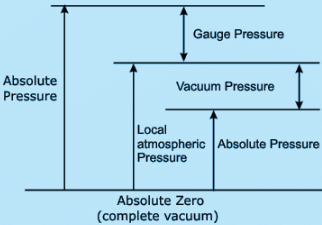
Standard atmospheric pressure at sea level is commonly taken as patm = 101.32 kN/m2 ( = 1.0132 × 10⁵ Pa). Atmospheric pressure varies with elevation, temperature and weather conditions; instruments and calculations often use the local atmospheric value.
Piezometer Tube
The static pressure in a liquid of constant density can be visualised as an equivalent vertical column of the same liquid. The vertical height, h, of this column that corresponds to a pressure p is called the pressure head and is given by
h = p / (ρ g)
For a liquid in a closed pipe, if a small open tube (a piezometer tube) is connected at a point, the liquid will rise in that tube to a height h above the point such that the hydrostatic pressure at the point equals the hydrostatic head of that column. Thus the piezometer gives a direct visual measure of the gauge pressure at the connected point.
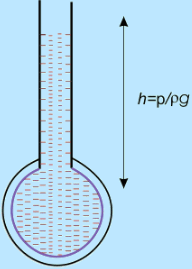
If the piezometer tube is closed at the top and the space above the column is a perfect vacuum, the height of the column would correspond to the absolute pressure at the base. The same hydrostatic principle is used by the mercury barometer to determine the local atmospheric pressure.
The Barometer
A barometer measures the local atmospheric pressure. Mercury is commonly used in a simple barometer because its high density produces a reasonably short column for typical atmospheric pressures and mercury has a very low vapour pressure at ordinary temperatures. Low vapour pressure keeps the space above the mercury column close to vacuum (the Torricellian vacuum).
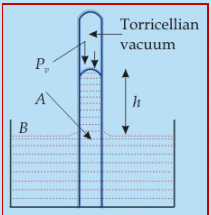
In the barometer (Fig. 4.3) the pressure at the open reservoir at B is the atmospheric pressure patm. Equating pressures at the same horizontal level gives the hydrostatic relation
patm = pv + ρ g h (4.1)
where pv is the vapour pressure of mercury (the pressure due to mercury vapour occupying the space above the column), ρ is the density of mercury and h is the height of mercury column. For most practical purposes pv is very small compared with atmospheric pressure and may be neglected; hence patm ≈ ρ g h.

For precision, small corrections are required to allow for variation of density with temperature, thermal expansion of the scale and surface tension effects. If water were used instead of mercury, the corresponding column height at sea level would be about 10.4 m assuming a perfect vacuum above the water. In practice the vapour pressure of water at ordinary temperatures is appreciable and would reduce the actual column height (for example, the column at 15°C would be about 180 mm less than 10.4 m), and surface tension becomes important for narrow tubes (diameters less than about 15 mm).
Manometers - measuring gauge and vacuum pressure
Manometers employ columns of liquid to determine pressure differences between two points or between a point and atmosphere. They are essentially extended, often U-shaped, piezometers and are used for both small and large pressures depending on geometry and fluid choices.
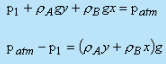
A simple U-tube manometer consists of a U-shaped transparent tube partly filled with a manometric fluid (liquid B) which is immiscible with and heavier than the working fluid (fluid A) whose pressure is to be measured. One limb is connected to the pipe or container with fluid A and the other is open to atmosphere. At equilibrium the pressures at points in the same horizontal plane inside the continuous liquid B are equal; applying hydrostatic relations gives the required pressure relation.
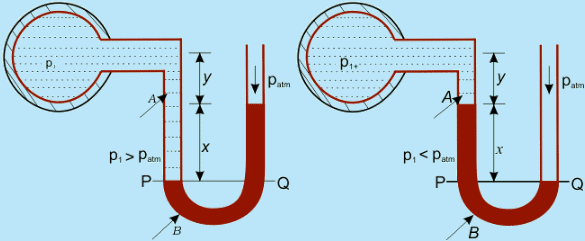
For the common arrangement where one limb is connected to a fluid of absolute pressure p1 (centre line of the pipe) and the other limb is open to atmosphere patm, the hydrostatic balance leads to
p1 - patm = (ρm - ρA) g h (4.2)
where ρm is the density of the manometric fluid, ρA is the density of the fluid A (in the pipe) and h is the measurable vertical difference of manometric-fluid levels. When the fluid in the container has pressure less than atmosphere, the levels shift accordingly and the sign of h is taken to satisfy equation (4.2).


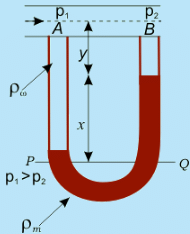
Manometer to measure pressure difference in a flowing pipe
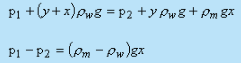
A manometer is frequently employed to measure the pressure difference across a restriction or between two points A and B on a pipe. The connecting tubes should be normal to the flow and have smooth edges to avoid local disturbances. By applying hydrostatic equilibrium between convenient points P and Q in the manometric liquid we obtain
p1 - p2 = (ρm - ρw) g Δh (4.3)
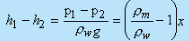
where p1 and p2 are the absolute pressures at the centres of the pipe at A and B, ρw is the density of the working fluid in the pipe and Δh is the difference of manometer-fluid columns measured appropriately. Expressing the pressure difference in terms of head gives
(p1 - p2)/(ρw g) = (ρm/ρw - 1) Δh (4.4)
Inclined-tube Manometer
When accurate measurement of a small pressure difference is required, an inclined-tube manometer provides magnification of liquid displacement. Instead of a vertical limb, a transparent tube is set at an angle θ to the horizontal. A small vertical change x corresponds to a meniscus movement s along the tube given by
s = x / sin θ
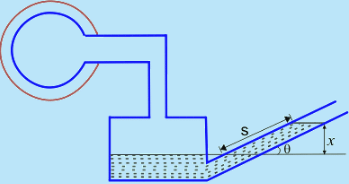
- For small θ the movement s along the tube is much greater than the corresponding vertical change x, giving good sensitivity.
- Angles less than about 5° are usually not satisfactory because it becomes difficult to locate the exact meniscus position.
- One limb is often made with a much larger cross-section so its surface movement is negligible compared with the narrow limb; only the narrow limb needs to be transparent in many practical designs.
Inverted-tube Manometer
An inverted U-tube manometer is useful for measuring small pressure differences in liquids. In this arrangement the working liquid occupies both limbs and an inverted tube of air (or other gas) forms a pocket. The pressure of the gas pm in the inverted limb is less than the liquid pressure pw. The hydrostatic balance taken at the level of the higher meniscus PQ gives the relation in terms of piezometric pressure.
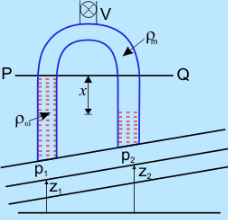

Here the piezometric pressure p* is defined as p* = p + ρ g z, where z is the vertical elevation of the point from a chosen datum. For a horizontal pipe (z1 = z2) the difference in piezometric pressures reduces to the difference in static pressures. If the gas pressure pm above the working fluid is very small compared with the liquid pressure, the relation simplifies and a large x (displacement) may be obtained for a small applied pressure difference.

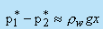
Air may be pumped through a valve at the top of the inverted manometer until the menisci reach a convenient operating level.
Micromanometer
A micromanometer uses an additional gauge liquid in a U-tube arrangement so that a very small pressure difference produces a large difference in manometric levels, giving high sensitivity suitable for measuring minute pressure differences.
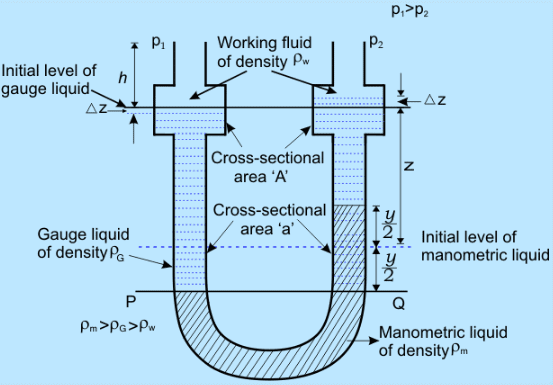
Writing hydrostatic equilibrium at two convenient horizontal points PQ gives relationships involving the densities of the working fluid, the gauge liquid and the manometric liquid. Denoting these densities by ρw, ρG and ρm respectively, the equilibrium yields

Continuity of the gauge liquid in the limbs gives relations between the displacements and the cross-sectional areas; if the small area a moves by y and the larger area A changes negligibly, then

(4.6)

(4.7)
If a is very small compared with A then
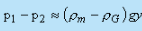
(4.8)
With a suitable choice of manometric and gauge liquids so that their densities are close (ρm ≈ ρG), a reasonable displacement y can be obtained for a very small pressure difference, improving sensitivity while keeping the instrument practical to read.
Practical notes and applications
- Selection of manometric fluid: The manometric liquid should be immiscible with the working fluid, chemically compatible, have a well-defined meniscus and an appropriate density to obtain measurable displacements for the expected pressure range.
- Use of mercury: Mercury gives compact instruments for atmospheric and high-pressure measurements because of its high density; however, for toxicity and environmental reasons many modern instruments avoid mercury where possible.
- Surface tension and capillarity: For narrow tubes, capillary rise and surface tension alter the effective column height and corrections must be applied for accurate measurements.
- Temperature effects: Thermal expansion of scale, change of liquid density with temperature and vapour pressures affect precision; corrections or controlled temperatures are required for high accuracy.
- Applications: Piezometers are used in open-channel flow and pipe flow to read pressure heads; barometers determine atmospheric pressure for meteorology and altimetry; manometers are used in laboratory measurements, calibration and where simple, reliable pressure difference readings are required.
- p, p1, p2 - absolute pressures (Pa)
- patm - local atmospheric pressure (Pa)
- pgauge - gauge pressure = p - patm (Pa)
- pv - vapour pressure (Pa)
- ρ, ρw, ρm, ρG, ρA - densities of fluids (kg/m3)
- g - acceleration due to gravity (≈ 9.81 m/s2)
- h, Δh, x, s - vertical or inclined displacements (m)
- z - vertical elevation from datum (m)
Summary: Pressure may be reported as absolute, gauge or vacuum depending on reference. Hydrostatic principles relating pressure to vertical head (p = ρ g h) underpin piezometers, barometers and manometers. Choice of manometric fluid, geometry (U-tube, inclined, inverted) and corrections for temperature and surface effects determine instrument sensitivity and accuracy.
FAQs on Units & Scales of Pressure Measurement