Gates and Valves for Flow Control (Part - 4)

Classification of gates based on the type of flow passage with which connected and its location
Gates are a part of most of the openings provided in any water resources project. They may be used to regulate flow through spillways, sluices, intakes, regulators, ducts, tunnels, etc., to name a few. The following list provides classification of gates based on its association with a particular water passage. The gates associated with hydropower have only been briefly described here. They are described in more detail in the next module.
1. Crest gates A gate mounted on a crest for the purpose of controlling the discharge flowing over the crest of the spillway of a dam or a barrage (Figure 20). As mentioned in Section 4.10.1, it is common to find radial gates to regulate flow over dam crests and vertical lift gates for barrage spillways.
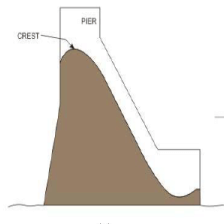
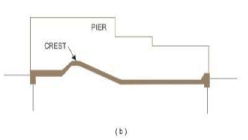
Figure 20. Spillway Bays Showing Crests of (A) Daw and (B) Barrage Showing Crests
2. Sluice gates These are gates which controls or regulates flow through an opening or sluice in the body of the dam where the upstream water level is above the top of opening as shown for gates at the entry to the penstock of a hydropower intake in Figure 21.
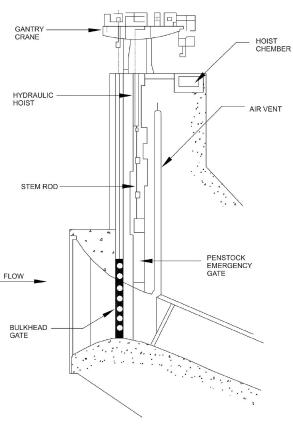
Figure 21. Penstock Emergency Gate
3. Depletion sluice gates A gate located at lowest level in the body of the dam to deplete the reservoir in the event of distress. It may be either wheel mounted type or sliding type.
4. Construction s luice gates This gate is meant for closing a construction sluice which is normally plugged after construction.
5. Diversion tunnel gates This gate is meant for making diversion tunnel dry, when it has to be plugged after construction (Figure 22). Service gates are lowered for plugging the diversion tunnel and emergency gates are provided to take care of any eventuality resulting from malfunctioning of the service gates. Usually, such gates are meant for one time operation while plugging the tunnel.
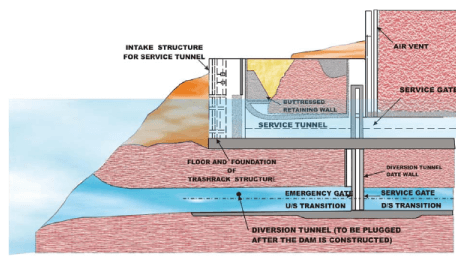
Figure 22. Diversion on Tunnel and Gate, Which Control, Flow during Diversion
6. Head regulator and Cross regulator gates The Head regulator gates are used for regulating water from reservoir to main canal. These are generally wheel mounted vertical lift gates. The Cross regulator gates are used in an irrigation channel for the purpose of raising the water level. Usually, vertical lift gates are commonly used, but radial gates are also being adopted.
7. Desilting chamber gates / Silt flushing gates These gates are located at the exit of desilting chamber of a hydroelectric plant to flush out accumulated silt.
8. Head race tunnel gates A gate installed at the entrance of head race tunnel of hydroelectric project. It is generally a wheel mounted gate.
9. Surge shaft gates Surge shaft gate is used for inspection of tunnel / penstock and is located in the vicinity of surge shaft and tunnel junctions.
10. Penstock gates / Intake gates A gate provided at the upstream end of the penstock.
11. Draft tube / Tail race gates A bulkhead gate used to permit dewatering of the draft tubes for inspection and repair of turbine parts and draft tubes.
12. Navigation lock gates These are gates provided on navigation locks. Commonly used in India is the Mitre gate, which is a lock gate comprising of two hinged symmetrical leaves which meet at the centre of the lock channel when in the closed position and fit into recesses in the side walls of the channel when open (Figure 23).
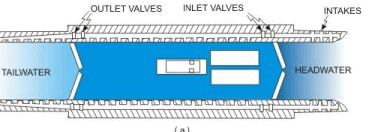
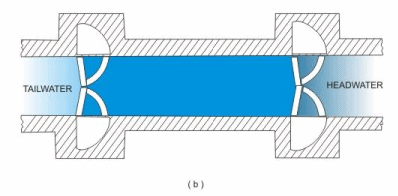
Figure 23. Plan of Navigation Lock
13. Balancing gates A gate used for the purpose of balancing water levels on either side.
Classification of gates based on other criteria
The Bureau of Indian Standards code IS: 13623-1993 "Criteria for choice of gates and hoists" has recommended certain selection criteria for gates under specific conditions, since this has a great impact on the safety of the structure and effective control of water flow. Further, a designer has to plan a gate and its hoisting arrangement together. Separate planning may sometimes lead to unsatisfactory installation. Though the choice for the gates and hoists depends upon several factors, primarily safety, ease in operation as well as maintenance and economy are the governing requirements. Some of the salient points, taken from IS: 13623 - 1993 are presented below.
Classification based on head over Sill
- Low head gate: head less than 15 m
- Medium head gate: head between 15 m and 30 m
- High head gate: head more than 30 m
Classification based on operational requirements
- Service gates (main gate): To be used for regulation and routine operation such as main gate for regulation of flow through spillway sluices, outlets, etc.
- Emergency closure gates: To close the opening in flowing water condition in case of emergency such as emergency penstock gate.
- Maintenance gate: Bulkhead gate, emergency gate, stop-logs, which are used for maintenance of service gates.
- Construction gates: Required to shut off the opening during construction or to finally close the opening after construction such as construction sluice gates, diversion tunnel gates, etc.
Classification based on material used in fabrication
- Steel gates
- Wooden gates
- Reinforced concrete g ates
- Aluminium gates
- Fabric (plastic) gates/Rubber gate
- Cast iron gates.
Classification based on mode of operation
- Regulating gates: Operated under partial openings. Generally the main regulating gates are the service gates.
- Non-regulating gate: Gates not suitable as well as not intended for operation under partial gate openings.
Classification based on shape
- Hinged gates: Such as radial gates, Sector gates, hinged leaf gates, falling shutters.
- Translatory gates: Rolling gates such as fixed wheel gate, Stoney gate, slide type gate, etc.
Classification based on discharge through the gate
- Free discharging gate: Flow past the gate is in open air that is the tail water level is below the sill level of the gate and there is no submergence.
- Gates for submerged flow: Where the tail water level is above the sill level of the gate such as deep radial gate.
Classification based on location of seal
- Upstream seal gate,
- Downstream seal gate, and
- Seals both upstream and downstream.
Classification based on the location of skin plate
- Gates with upstream skin plate, and
- Gates with downstream skin plate.
Classification based on closing characteristics
- Self closing gates
- Gate requiring positive thrust for closure
Classification based on drive to operate
- Manually operated gates
- Electrically operated gates
- Semi automatic gates
- Automatic gates, like:
- Float operated gate,
- Water powered automatic gates
- Solar powered gate
- Computer controlled gates
FAQs on Gates and Valves for Flow Control (Part - 4)
| 1. What are the different types of gates used for flow control in civil engineering? |  |
| 2. How do gates help in flow control? | |
| 3. What are the key factors to consider when selecting a valve for flow control? | |
| 4. How do valves differ from gates in terms of flow control? | |
| 5. What are some common applications of valves and gates in civil engineering projects? | |

