Mechanical Engineering Exam  >  Mechanical Engineering Notes  >  Engineering Mechanics  >  Summary: Equilibrium of Rigid Bodies (Coplanar Concurrent System)

Summary: Equilibrium of Rigid Bodies (Coplanar Concurrent System)

Types of Forces

Forces that act on a body can be divided into two general categories-

  • Applied forces (action)
  • Reactive forces (or, simply reactions)

Reaction

Reaction is the opposing force that a support offers whenever it is acted upon by external or inherent forces.

Free Body Diagram

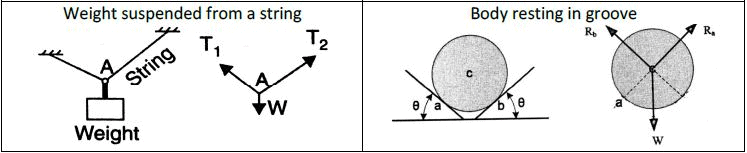
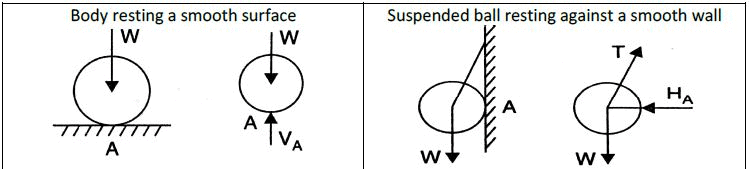
Free body diagram is a diagram in which a rigid body is isolated from the system and all active forces applied to the body and reactive forces as a result of mechanical contact are represented.

Examples
Summary: Equilibrium of Rigid Bodies (Coplanar Concurrent System)

Summary: Equilibrium of Rigid Bodies (Coplanar Concurrent System)

Steps for Drawing Free Body Diagram
1. A sketch of the body is drawn assuming that all supports (surfaces of contact, supporting cables, etc.) have been removed.
2. All applied forces (including weight) and support reactions are drawn and labeled on the sketch.
3. Apply the weight of the body to its center of gravity (if it is uniform, then apply it to the centroid). If the sense of a reaction is unknown, it should be assumed


A. EQUILBRIUM OF RIGID BODIES

A rigid body is said to be in equilibrium if the resultant of all external and reactive forces and moments acting on it is zero.

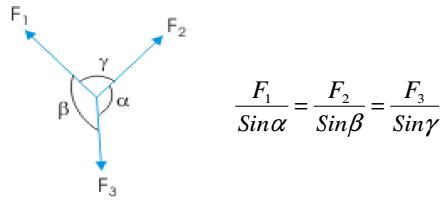
Lami's Theorem

If three coplanar concurrent forces acting on a body keep it in equilibrium, then each force is proportional to the sine of the angle between the other two"
Summary: Equilibrium of Rigid Bodies (Coplanar Concurrent System)

Note: Lami's theorem is applicable only to 3 coplanar concurrent forces in equilibrium

Proof

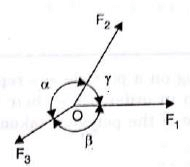
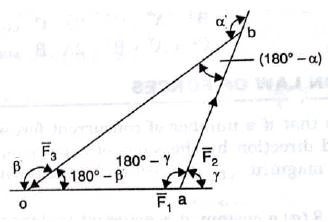
By applying polygon law of forces, draw triangle OAB representing the system of forces shown with external angles as indicated
Summary: Equilibrium of Rigid Bodies (Coplanar Concurrent System)Summary: Equilibrium of Rigid Bodies (Coplanar Concurrent System)

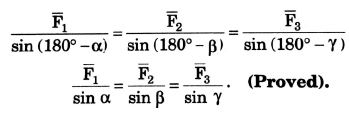
Applying Sine Law

Summary: Equilibrium of Rigid Bodies (Coplanar Concurrent System)


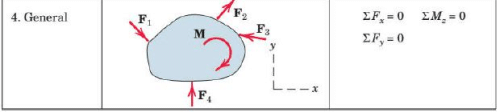
General Equations of Equilibrium

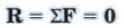
1. The algebraic sum of all forces in a force system is zero.
Summary: Equilibrium of Rigid Bodies (Coplanar Concurrent System)

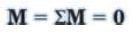
2. The algebraic sum of all moments in a force system is zero.
Summary: Equilibrium of Rigid Bodies (Coplanar Concurrent System)


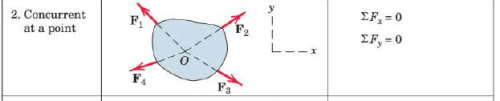
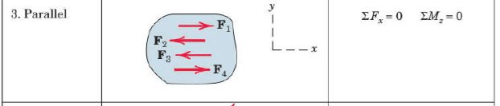
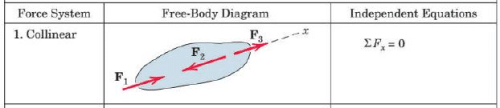
Equations of Equilibrium For Coplanar Systems
Summary: Equilibrium of Rigid Bodies (Coplanar Concurrent System)

Summary: Equilibrium of Rigid Bodies (Coplanar Concurrent System)


Summary: Equilibrium of Rigid Bodies (Coplanar Concurrent System)

Summary: Equilibrium of Rigid Bodies (Coplanar Concurrent System)


Solving Equilibrium Problems

1. Draw proper Free- Body Diagram
2. Resolve all the forces into x and y components
3. Apply Equilibrium conditions along the x and y directions
4. Solve the resultant algebraic equations
In case of moments, try to select the point you take moments around such that the line of action of at least one unknown force passes through that point. This will eliminate one unknown from your moment equation and will result in simpler equations to work with.

The document Summary: Equilibrium of Rigid Bodies (Coplanar Concurrent System) is a part of the Mechanical Engineering Course Engineering Mechanics for Mechanical Engineering.
All you need of Mechanical Engineering at this link: Mechanical Engineering

FAQs on Summary: Equilibrium of Rigid Bodies (Coplanar Concurrent System)

1. What is the concept of equilibrium in rigid bodies?
Ans. Equilibrium in rigid bodies refers to a state where the body is at rest or moving with constant velocity, without any net force or torque acting on it. It implies that the forces and moments acting on the body are balanced, resulting in no acceleration or rotation.
2. What are coplanar concurrent systems of forces?
Ans. Coplanar concurrent systems of forces are a set of forces that lie in the same plane and act on a common point of application. These forces have lines of action that intersect at a single point, known as the point of concurrency.
3. How do you determine the equilibrium of coplanar concurrent systems?
Ans. To determine the equilibrium of coplanar concurrent systems, you need to ensure that both the forces and the moments acting on the body are balanced. This can be achieved by analyzing the vector sum of the forces and the algebraic sum of the moments about a chosen point.
4. What is the significance of resolving forces in equilibrium analysis?
Ans. Resolving forces in equilibrium analysis involves breaking down forces into their components along different axes. This is significant as it allows us to separate forces into their horizontal and vertical components, simplifying the analysis and facilitating the determination of equilibrium conditions.
5. Can a coplanar concurrent system of forces have a non-zero net moment and still be in equilibrium?
Ans. No, a coplanar concurrent system of forces cannot have a non-zero net moment and still be in equilibrium. For a system to be in equilibrium, both the forces and the moments acting on the body must be balanced. A non-zero net moment indicates an unbalanced torque, resulting in rotational motion rather than equilibrium.
Explore Courses for Mechanical Engineering exam
Get EduRev Notes directly in your Google search
Related Searches
Extra Questions, Viva Questions, Summary: Equilibrium of Rigid Bodies (Coplanar Concurrent System), study material, video lectures, MCQs, practice quizzes, Exam, Important questions, Summary: Equilibrium of Rigid Bodies (Coplanar Concurrent System), Previous Year Questions with Solutions, Objective type Questions, ppt, Summary, Semester Notes, Summary: Equilibrium of Rigid Bodies (Coplanar Concurrent System), shortcuts and tricks, Free, pdf , past year papers, mock tests for examination, Sample Paper;