Short Notes - The Making of the National Movement: 1870s

The period from 1870 to 1947 in India witnessed the fervent rise of national movements against British colonial rule. Marked by the establishment of the Indian National Congress in 1885 and propelled by leaders like Gandhi, Tilak, and Bose, the movement evolved from constitutional appeals to mass-driven calls for Swaraj. It encompassed not only political struggles but also socio-cultural revitalization, culminating in India's independence in 1947.
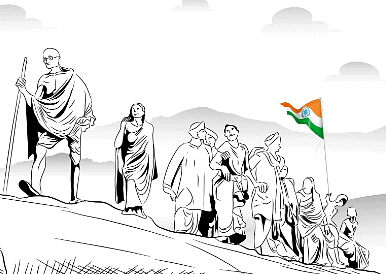 National Movement
The Emergence of Nationalism
The people in India began to wonder about the country's identity. They believed India belonged to everyone, no matter their class, color, caste, creed, language, or gender. The British controlled India's resources, and until that changed, India couldn't truly be for Indians. Political groups, led by educated professionals, expressed this idea, like the Poona Sarvajanik Sabha and the Indian National Congress.
The dissatisfaction with British rule intensified in the 1870s and 1880s because-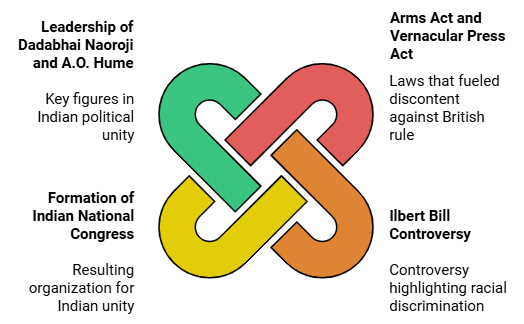
- Arms Act and Vernacular Press Act: People became upset with British rule in the 1870s and 1880s due to oppressive laws like the Arms Act and the Vernacular Press Act.
- Ilbert Bill Controversy (1883): The Ilbert Bill aimed for equal treatment between British and Indian judges, but its withdrawal due to white opposition revealed the British perspective on Indians.
- Desire for a United Organization: The withdrawal of the Ilbert Bill intensified the desire for unity among Indians, leading to the formation of the Indian National Congress in 1885.
- Leadership Roles: Key leaders like Dadabhai Naoroji and A.O. Hume played crucial roles in bringing together Indians from different regions under the Indian National Congress.
Try yourself: What was one of the main reasons for the dissatisfaction with British rule in India during the 1870s and 1880s?
A Nation in The Making
- The Congress, in its initial two decades, pursued "moderate" objectives and methods.
- During this period, it advocated for a greater Indian role in government, more representative Legislative Councils, and key administrative positions for Indians.
- These demands aimed at combating racism, breaking the monopoly of white officials, and reducing the economic drain on India to England.
- Economic concerns, such as poverty and famines caused by British rule, were also addressed.
- The Moderate leaders worked to develop public awareness of the unjust nature of British rule.
Freedom is Our Birthright
- By the 1890s, leaders like Bepin Chandra Pal, Bal Gangadhar Tilak, and Lala Lajpat Rai began exploring more radical objectives and methods.
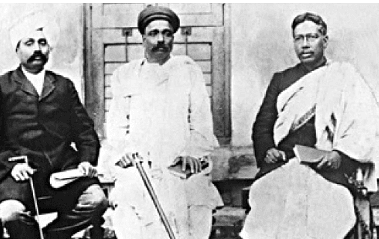 LAL BAL PAL
 - They criticized the Moderates for their "politics of prayers" and emphasized self-reliance and constructive work.
- The Swadeshi movement emerged in response to the partition of Bengal in 1905, advocating self-help, national education, and opposition to British rule.
- Radicals called for mass mobilization and boycott of British institutions and goods, with some suggesting the necessity of "revolutionary violence."
Other Developments
- In 1906, the All India Muslim League was formed, supporting the partition of Bengal and seeking separate electorates for Muslims.
- The Congress split in 1907, with Moderates opposing boycotts, but reunited in 1915.
- In 1916, the historic Lucknow Pact was signed between the Congress and the Muslim League, aiming to work together for representative government.
The Growth of Mass Nationalism
After 1919, the fight against British rule evolved into a mass movement, involving peasants, tribals, students, women, and at times, factory workers. During the 1920s, certain business groups also actively supported the Congress. The economic and political changes brought about by the First World War contributed to this shift.
Impact of First World War
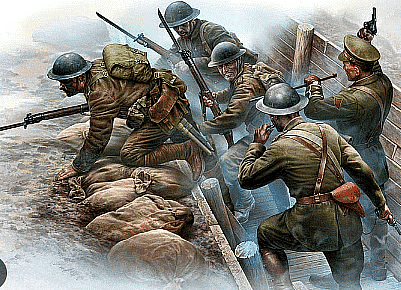 World War 1stThe war led to a significant increase in the Government of India's defense expenditure.
- Increased taxes and rising prices created hardships for the common people, while business groups reaped profits from the war.
- Returning Indian soldiers, influenced by anti-imperialist ideas, desired to oppose colonial rule in India.
- The 1917 revolution in Russia and ideas of socialism further inspired Indian nationalists.
The advent of Mahatma Gandhi
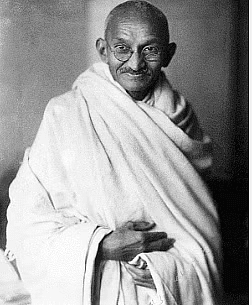 Mahatma Gandhi
- In these circumstances, Mahatma Gandhi emerged as a mass leader in 1915, bringing his experiences from South Africa.
- Traveling across India, Gandhi engaged in local movements, including the millworkers' strike in Ahmedabad in 1918.
The Rowlatt Satyagraha
- In 1919, Gandhi initiated a satyagraha against the repressive Rowlatt Act.
- Despite being largely restricted to cities, it marked the first all-India struggle against British rule.The Jallianwala Bagh massacre during this movement intensified public opposition.
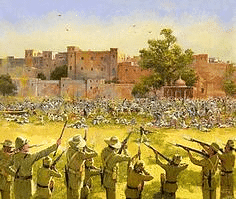 Jallianwala Bagh Massacre
Khilafat Agitation and Non-Cooperation Movement
- The Khilafat issue and British mistreatment of the Turkish Sultan led to the Khilafat agitation in 1920.
- Gandhi supported the Khilafat leaders, advocating the Non-Cooperation Movement.
- 1921-22 witnessed a surge in the Non-Cooperation Movement, with boycotts, protests, and widespread public participation.
People's Initiatives
- People resisted British rule non-violently and linked their movements to local grievances.
- Examples include protests against high land revenue in Kheda, picketing of liquor shops in Andhra and Tamil Nadu, and forest satyagrahas in Andhra Pradesh.
- Communal unity was seen in Bengal through the Khilafat-Non-Cooperation alliance.
The people's Mahatma
- Ordinary people thought of Gandhi as a messiah who could help them overcome poverty.
- Gandhi's efforts to build class unity were sometimes perceived as support for specific class struggles.
The happenings of 1922 -1929
- Gandhi called off the Non-Cooperation Movement in 1922 after the Chauri Chaura incident.
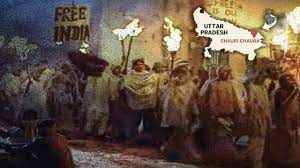 Chauri Chaura Incident
 - Emphasis shifted to constructive work in rural areas, and the Gandhians extended their support base.
- 1920s saw the formation of RSS and the Communist Party of India, each with distinct ideas about India's future.
- The Congress resolved to fight for complete independence (Purna Swaraj) in 1929.
The March to Dandi
- In 1930, Mahatma Gandhi announced his intention to lead a march to challenge the salt law, which granted the state a monopoly on salt manufacture and sale.
- Gandhiji and other nationalists argued that taxing such an essential item of food was unjust.
- The Salt March, covering over 240 miles from Sabarmati to Dandi, aimed to address a specific grievance shared by all, uniting both rich and poor.
- Participants, including peasants, tribals, and women, marched, and the movement gained support from a business federation.
- The government attempted to suppress the satyagrahis through brutal actions, leading to thousands being sent to jail.
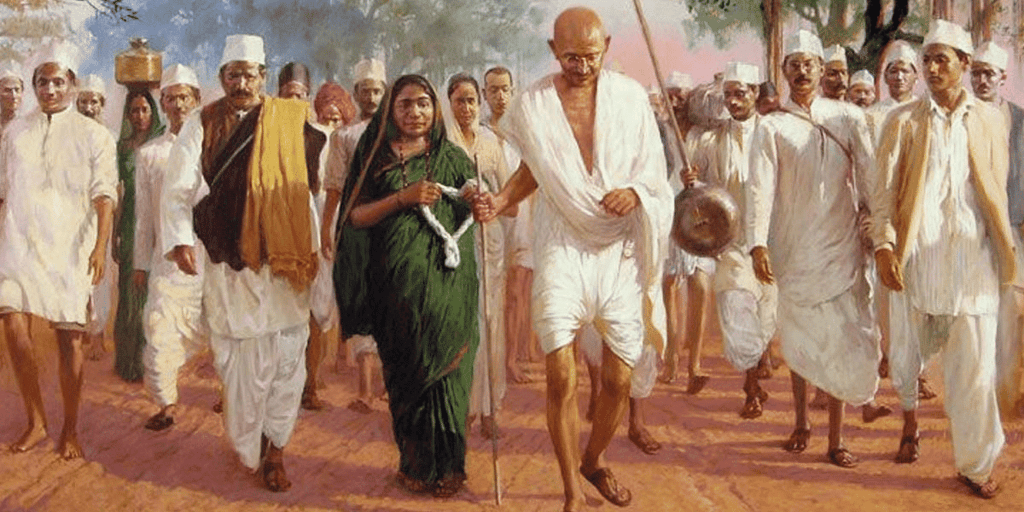 The March to Dandi
Provincial Autonomy
- The struggles of the Indian people resulted in the Government of India Act of 1935, which prescribed provincial autonomy.
- Elections to the provincial legislatures were announced in 1937, and the Congress formed governments in 7 out of 11 provinces.
Impact of Second World War
- In September 1939, after two years of Congress rule, the Second World War began.
- Congress leaders, critical of Hitler, were willing to support the British war effort but demanded independence for India after the war as a condition.
- The British, refusing to concede this demand, led to the resignation of Congress ministries in protest.
Try yourself: What was the main objective of the Indian National Congress during its initial two decades?
Quit India and Later
- In the middle of the Second World War, Mahatma Gandhi initiated a new phase of the movement, demanding the immediate departure of the British from India.
- Gandhiji urged people with the slogan "do or die" to fight non-violently against the British.
- Despite severe repression and arrests of leaders, the movement gained momentum, especially among peasants and youth.
- Communication and symbols of state authority were attacked, and in various areas, people established their own governments.
- The British responded with harsh measures, arresting over 90,000 people, and around 1,000 were killed in police firing.
- The rebellion ultimately weakened the British Raj.
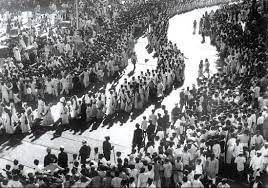 Quit India Movement
Muslim League's Demand for "Independent States"
- In 1940, the Muslim League moved a resolution seeking "Independent States" for Muslims in the north-western and eastern regions.
- The League, viewing Muslims as a separate "nation," was influenced by historical tensions and perceived a disadvantage for Muslims in a democratic structure.
- Failed negotiations post-World War II led to elections in 1946, where the League's success in Muslim-reserved seats fueled its demand for "Pakistan."
Path to Partition
- British efforts to propose a united but loosely confederated India failed, making partition inevitable.
- Following the failure, the Muslim League called for "Direct Action Day" on August 16, 1946, leading to riots in Calcutta and subsequent violence across northern India by March 1947.
- The Partition resulted in widespread violence, the deaths of hundreds of thousands, brutalities against women, and mass migration.
- Millions were forced to become refugees in alien lands, and the birth of Pakistan marked a significant change in the region.
Dateline
- 1878 - The Arms Act was passed.
- 1878- The Vernacular Press Act was passed.
- 1885 - The Indian National Congress came into existence.
- 1905 - Bengal got partitioned.
- 1915 - Mahatma Gandhi came to India from South Africa.
- 1919 - The Rowlatt Satyagraha started.
- 1919- The Jallianwala Bagh massacre took place.
- 1920 - The Non-Cooperation Movement started.
- 1922 - Gandhiji called off the Non-Cooperation Movement.
- 1929 - The Congress resolved to fight for Purna Swaraj.
- 26 Jan 1930 - Independence Day was observed all over the country.
- 1930 - Mahatma Gandhi launched Dandi March.
- August 1942 - The Quit India Movement started.
- 1947 - India got independence.
FAQs on Short Notes - The Making of the National Movement: 1870s
| 1. What were the main reasons behind the growth of Indian nationalism in the 1870s? |  |
| 2. How did the British education system contribute to the making of the national movement during this period? | |
| 3. What role did social reform movements play in shaping Indian nationalism in the 1870s? | |
| 4. Why did the Indian National Congress get established in 1885 and what impact did it have? | |
| 5. Who were the key figures in the early national movement of the 1870s and what did they contribute? | |





