CBSE Class 8  >  Class 8 Notes  >  Mathematics (Maths)   >  Important Questions: Comparing Quantities

Important Questions: Comparing Quantities

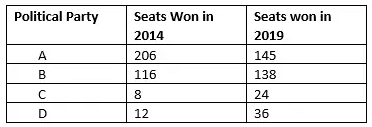
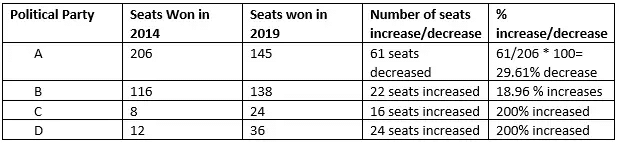
Q1: What is the percentage increase or decrease in the number of seats won by A, B, C and D in the general elections of 2019 as compared to the results of 2014?
Important Questions: Comparing QuantitiesSol:

Important Questions: Comparing Quantities


Q2: You buy a house for Rs 40,00,000 and pay a tax of 8%. How much is tax?
Sol:
 
Tax= 8% of Rs 40,00,000
= Rs 3,20,000

Q3: An agent of an insurance company gets a commission of 8 % on the basic premium he collects. What will be the commission earned by him if he collects Rs 4800?
Sol:

Commission = 8% of Rs 4800
= Rs 384

Q4: In an election, there are a total of 60000 voters and there are two candidates, A and B. 60 % of the voters go to the polls out of which 60 % vote for A. How many votes does B get?
Sol:

Votes who went to the polls =60% of 60,000 = 36,000
Number of Votes A got = 60% of 36,000 = 21,600
Number of Votes B get = 36,000 - 21,600 = 14,400

Q5: Find the following
(a) MP = Rs 1000, Discount 10%, SP = ?
(b) SP = Rs 81, Discount 10%, MP = ?
(c) MP = Rs 625, SP  = Rs 562.50, Discount% = ?
Sol:

(a) Discount = 10% of 1000  = Rs 100
SP = MP - discount = Rs 900
(b) Let x be the MP
Discount =10% of x = 10x/100
SP = x - x/10= 9x/10
Now
9x/10=81
x=90
(c) Discount = MP -SP= 625 - 562.5=62.5
%= (62.5/625) × 100=10%

Q6: Fill in the blank
(a) Five times a number is a ______ % increase in the number
(b) The cost price of 10 cardboard sheets is the same as the Selling price of 5 cardboard sheets. The profit % in this transaction is ___________
(c) The discount on an item is calculated on the _________ of the item
(d)______ is charged on the sale of an item by government and is added to the bill amount 
Ans:
(a) 400%
(b) 100%
(c) Marked price
(d) Sales tax

Q7: A tank can hold 50 liters of water. At present, it is only 30 % full. How many liters of water shall I put in the tank, so that it is 50 % full?
Sol:

Present status = 30% of 50 = 15 Litres
target status= 50% of 50 = 25 Litres
So water required = 25 - 15 = 10 L

Q8: A big mega store is having a festival sale and all the items are having 25% discount.
Vivek is having a Rs 50 Gift card, and he has chosen a game whose marked price is Rs 300. Now Vivek is confused about how to calculate the discount and what remaining money needs to be paid to the clerk. The sales clerk has suggested two ways to calculate the concession
Method 1: Subtract Rs 50 from the Marked price and then take a 25% discount on the remaining amount
Method 2: Take 25% discount on the Marked price and then subtract Rs 50 from it
Now the questions for you
(a) Do you think both the method will give same result? If not predict which method will be beneficial to him
(b) Calculate the amount Vivek has to pay to the clerk in each case
(c) What method do the store actually uses? And why?
Sol:

Let's first calculate using both the method
Method 1: 
MP = Rs 300
MP After Rs 50 deduction = Rs 300 -50=Rs 250
Discount = 25% of Rs 250 = Rs 62.5
Price after discount= Rs 250 - Rs 62.5= Rs 187.5
Method 2: 
MP = Rs 300
Discount = 25% of Rs 300 = Rs 75
Price after discount= Rs 300 - Rs 75= Rs 225
Amount left after Rs 50 gift deduction = Rs 225 - 50 = Rs 175
So both the methods gave different result. And method -2 is beneficial.
Method -2 is correct method and this is used by the stores

Q9: Out of a salary of Rs 75000, I kept 1/3 as savings. Out of the remaining money, I spend 25 % on food and 40 % on house rent. How much do I spend on food and house rent?
Sol:

Money for Saving= 1/3 of Rs 75,000 = Rs 25,000
Money left= Rs 75,000- Rs 25,000= Rs 50,000
Money spent on food = 25% of Rs 50,000= Rs 12,500
Money spent on house = 40% of Rs 50,000= Rs 20,000

Q10: Rina gets 94 marks in her exams. These are 47% of the total marks. Find the maximum number of marks.
Sol:
Lets x be the maximum number of marks
94 = 47% of x
94= 47x/100
x= 200

Q11: In case of gain on the selling of product.
Selling price is defined as
S. P= [1+ (Gain%/100)] × C.P
check if this is true
Sol:
 
SP = [1 + (Gain%/100)] × C.P
SP = C.P + Gain= C.P + (Gain%/100) × C.P= [1+ (Gain%/100)] × C.P
So this statement is correct

Q12: A's income is 20 % more than B. How much percent is B income less than A?
Sol:
Let x be B income
A income = x + 20% of x = 1.2x
Amount B's income less than A's = 1.2x - x = .2x
% B income less than A = (.2x/1.2x) × 100 = 16.66%

Q13: Sachin bought a pair of Reebok shoes at a sale of 25%. If the amount he paid was Rs 2700, find the marked price.
Sol: 
let x be the MP
Discount =25% of x = x/4
SP = x - x/4 = 3x/4
Now
3x/4 = 2700
x = Rs 3600

Q14: There are 400 boy students in class X in all the sections in Saint Xavier school. If 20% of the students are girls, find the number of students in class X.
Sol:
If girls = 20%, then boys = 80% of total
80% of T = 400 ⇒ T = 400 × 100/80 = 500

Q15: Z% of 100 + 10% of 50 = 100. Find the value of z.
Sol: 
Z% of 100 + 10% of 50 = 100
z + 5 = 100
z = 95


The document Important Questions: Comparing Quantities is a part of the Class 8 Course Mathematics (Maths) Class 8.
All you need of Class 8 at this link: Class 8

FAQs on Important Questions: Comparing Quantities

1. How do I calculate percentage increase and decrease in comparing quantities problems?
Ans. Percentage increase or decrease is found by dividing the change in quantity by the original value, then multiplying by 100. For example, if a price rises from ₹100 to ₹120, the percentage increase is (20÷100)×100 = 20%. This fundamental ratio calculation helps students solve real-world problems involving profit, loss, and price variations efficiently.
2. What's the difference between simple interest and compound interest for CBSE Class 8?
Ans. Simple interest calculates returns on the principal amount only, while compound interest calculates on principal plus accumulated interest. Simple interest formula: SI = (P×R×T)/100. Compound interest grows faster because interest is added to principal each period. Understanding this distinction is crucial for financial mathematics in comparing quantities topics.
3. Why do we use ratios and proportions when comparing two quantities?
Ans. Ratios and proportions establish relationships between quantities, making comparisons meaningful and standardised. A ratio like 3:5 shows relative size without absolute values, while proportions verify if two ratios are equal. These tools simplify complex comparisons in discount calculations, recipe adjustments, and map scaling problems across mathematics applications.
4. How do I solve discount and marked price problems without getting confused?
Ans. Start by identifying marked price (MP), discount percentage, and selling price (SP). Use: Discount = (Discount%÷100)×MP, then SP = MP - Discount. Students often confuse which value represents what; creating a visual table helps. Practice with flashcards and mind maps available on EduRev to strengthen concept clarity before exams.
5. What's the connection between profit-loss percentage and cost price in business mathematics?
Ans. Profit or loss percentage is always calculated based on cost price, not selling price. Profit% = ((SP-CP)÷CP)×100. This distinction matters because the same profit amount yields different percentages depending on the original cost. Mastering this relationship is essential for solving comparing quantities word problems involving transactions and business scenarios accurately.
Explore Courses for Class 8 exam
Get EduRev Notes directly in your Google search
Related Searches
past year papers, practice quizzes, MCQs, Important Questions: Comparing Quantities, Important Questions: Comparing Quantities, ppt, Semester Notes, Important Questions: Comparing Quantities, shortcuts and tricks, Free, Summary, Objective type Questions, video lectures, pdf , mock tests for examination, Previous Year Questions with Solutions, Sample Paper, Extra Questions, study material, Viva Questions, Exam, Important questions;