Structure of Indian Financial System - Interdisciplinary Issues in Indian Commerce System

Introduction to Indian Financial System -
The financial system of a country is an important tool for economic development of the country, as it helps in creation of wealth by linking savings with investments. It facilitates the flow of funds form the households (savers) to business firms (investors) to aid in wealth creation and development of both the parties.
The financial system of a country is concerned with:
- Allocation and Mobilization of savings
- Provision of funds
- Facilitating the Financial Transactions
- Developing financial markets
- Provision of legal financial framework
- Provision of financial and advisory services
According to Robinson, the primary function of a financial system is "to provide a link between savings and investment for creation of wealth and to permit portfolio adjustment in the composition of existing wealth"
A Financial System consists of various financial Institutions, Financial Markets, Financial Transactions, rules and regulations, liabilities and claims etc.
Features of Financial System:
- It plays a vital role in economic development of a country
- It encourages both savings and investment
- It links savers and investors
- It helps in capital formation
- It helps in allocation of risk
- It facilitates expansion of financial markets
- It aids in Financial Deepening and Broadening
Structure of Indian Financial System/Components of Indian Financial System:
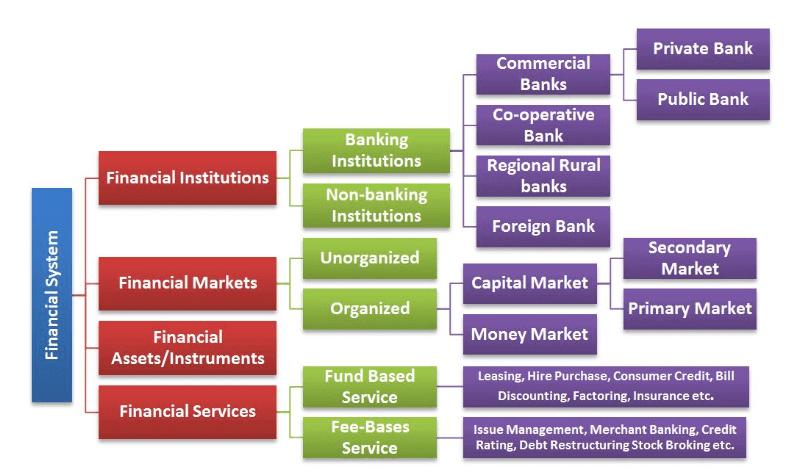
(1) Financial Institutions - Financial institutions are intermediaries of financial markets which facilitate financial transactions between individuals and financial customers.
It simply refers to an organization (set-up for profit or not for profit) that collects money from individuals and invests that money in financial assets such as stocks, bonds, bank deposits, loans etc.
There can be two types of financial institutions:
- Banking Institutions or Depository institutions - These are banks and credit unions that collect money from the public in return for interest on money deposits and use that money to advance loans to financial customers.
- Non- Banking Institutions or Non-Depository institutions - These are brokerage firms, insurance and mutual funds companies that cannot collect money deposits but can sell financial products to financial customers.
Financial Institutions may be classified into three categories:
- Regulatory - It includes institutions like SEBI, RBI, IRDA etc. which regulate the financial markets and protect the interests of investors.
- Intermediaries - It includes commercial banks such as SBI, PNB etc. that provide short term loans and other financial servicesto individuals and corporate customers.
- Non - Intermediaries - It includes financial institutions like NABARD, IDBI etc. that provide long-term loans to corporate customers.
(2) Financial Markets - It refers to any marketplace where buyers and sellers participate in trading of assets such as shares, bonds, currencies and other financial instruments. A financial market may be further divided into capital market and money market. While the capital market deals in long term securities having maturity period of more than one year, the money market deals with short-term debt instruments having maturity period of less than one year.
(3) Financial Assets/Instruments - Financial assets include cash deposits, checks, loans, accounts receivable, letter of credit, bank notes and all other financial instruments that provide a claim against a person/financial institution to pay either a specific amount on a certain future date or to pay the principal amount along with interest.
(4) Financial Services - Financial Services are concerned with the design and delivery of financial instruments and advisory services to individuals and businesses within the area of banking and related institutions, personal financial planning, leasing, investment, assets, insurance etc.
It involves provision of a wide variety of fund/asset based and non - fund based/advisory servicesand includes all kinds of institutions which provide intermediate financial assistance and facilitate financial transactions between individuals and corporate customers.
Functions of Indian Financial System
- It bridges the gap between savings and investment through efficient mobilization and allocation of surplus funds
- It helps a business in capital formation
- It helps in minimising riskand allocating risk efficiently
- It helps a business to liquidate tied up funds
- It facilitates financial transactions through provision of various financial instruments
- It facilitate trading of financial assets/instruments by developing and regulating financial markets
Importance of Indian Financial System
- It accelerates the rate and volume of savings through provision of various financial instruments and efficient mobilization of savings
- It aids in increasing the national output of the country by providing funds to corporate customers to expand their respective business
- It protects the interests of investors and ensures smooth financial transactions through regulatory bodies such as RBI, SEBI etc.
- It helps economic development and raising the standard of living of people
- It helps to promote the development of weaker section of the society through rural development banks and co-operative societies
- It helps corporate customers to make better financial decisions by providing effective financial as well as advisory services
- It aids in Financial Deepening and Broadening:
Financial Deepening - It refers to the increase in financial assets as a percentage of GDP
Financial Broadening - It refers to increasing number of participants in the financial system.
Financial Intermediaries/Intermediaries in Indian Financial System
- Commercial bank
- Cooperative Banks
- Regional Rural Banks
- Development Banks
- Non - banking Financial Companies
- Mutual Fund companies
- Insurance Companies
FAQs on Structure of Indian Financial System - Interdisciplinary Issues in Indian Commerce System
| 1. What is the structure of the Indian financial system? |  |
| 2. What are the interdisciplinary issues in the Indian commerce system? | |
| 3. What are the frequently used financial instruments in India? | |
| 4. What is the role of the RBI in the Indian financial system? | |
| 5. What are the challenges faced by the Indian financial system? | |