CBSE Class 9  >  Class 9 Notes  >  Science   >  Theory - Verification of Newton's Second Law, Physics, Science, Class 9

Theory - Verification of Newton's Second Law, Physics, Science, Class 9

Can you define Newton’s Second Law of Motion?

Newton's Second Law  of motion states that the rate of change of momentum of an object is proportional to the applied unbalanced force in the direction of the force.
 ie.,      F=ma

Where F is the force applied, m is the mass of the body, and a, the acceleration produced.


What will happen if a body is subject to multiple forces at the same time?

If a body is subjected to multiple forces at the same time, then the acceleration produced is proportional to the vector sum (that is, the net force) of all the individual forces.

 

Theory - Verification of Newton`s Second Law, Physics, Science, Class 9


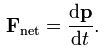
The Second Law can also be shown to relate the net force and the momentum p of the body:

Theory - Verification of Newton`s Second Law, Physics, Science, Class 9

 
Therefore, Newton's Second Law also states that the net force acting on a body is equal to the rate of change of momentum of the body.
Theory - Verification of Newton`s Second Law, Physics, Science, Class 9


How does momentum affect the net force?

The First Law of Motion indicates that when an unbalanced external force acts on an object, its velocity changes, ie., the object is accelerated. Now, let’s  study how the acceleration of an object depends on the force applied. Consider the example. A car at rest does not require much attention when parked along a road side. But the moving car, even at a low speed, may kill a person standing in its path. A small mass, such as a bullet may kill a person when fired from a gun. From these examples it is clear that the impact produced by the objects depends on their mass and velocity. When we combine the mass and velocity of an object, we get another quantity called momentum, which was introduced by Newton.


Let’s define Momentum:

Momentum has both direction and magnitude. Its direction is the same as that of velocity. When an unbalanced force is applied on an object, it changes the velocity of an object, which in turn changes its momentum. So, it is concluded that the force necessary to change the momentum of an object depends on the time rate at which the momentum is changed.

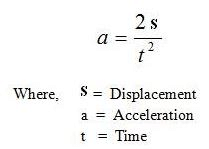
The acceleration of a moving object can be calculated by:
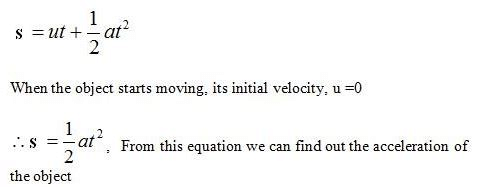
Theory - Verification of Newton`s Second Law, Physics, Science, Class 9
Theory - Verification of Newton`s Second Law, Physics, Science, Class 9  


LEARNING OUTCOME:

The student learns about

  1. Mass

  2. Acceleration

  3. Force

  4. Momentum

  5. Newton's Second Law of Motion

 Let’s understand the concept behind  Newton’s Second Law by a simple experiment.

The document Theory - Verification of Newton's Second Law, Physics, Science, Class 9 is a part of the Class 9 Course Science Class 9.
All you need of Class 9 at this link: Class 9

FAQs on Theory - Verification of Newton's Second Law, Physics, Science, Class 9

1. How can Newton's Second Law be verified?
Ans. Newton's Second Law can be verified through experiments and observations. One common method is to measure the acceleration of an object when a known force is applied to it. By varying the force and measuring the resulting acceleration, the relationship between force and acceleration can be established, thus verifying Newton's Second Law.
2. What is Newton's Second Law of Motion?
Ans. Newton's Second Law of Motion states that the acceleration of an object is directly proportional to the net force acting on it and inversely proportional to its mass. Mathematically, it can be expressed as F = ma, where F represents the net force, m is the mass of the object, and a is the acceleration produced.
3. Can Newton's Second Law be applied to objects at rest?
Ans. Yes, Newton's Second Law can be applied to objects at rest as well. In such cases, the net force acting on the object is zero, and according to the Second Law, the acceleration of the object will also be zero. This means that the object will remain at rest, in accordance with Newton's First Law of Motion.
4. Is Newton's Second Law applicable only to linear motion?
Ans. No, Newton's Second Law is applicable to all types of motion, including linear, rotational, and even fluid motion. The force and acceleration vectors may have different directions and magnitudes depending on the type of motion, but the relationship between force, mass, and acceleration remains the same.
5. Can Newton's Second Law be used to calculate the force required to accelerate an object?
Ans. Yes, Newton's Second Law can be used to calculate the force required to accelerate an object. By rearranging the equation F = ma, we can solve for force (F) by dividing the mass (m) of the object by its acceleration (a). This allows us to determine the force needed to achieve a desired acceleration, given the mass of the object.
Explore Courses for Class 9 exam
Get EduRev Notes directly in your Google search
Related Searches
pdf , Theory - Verification of Newton's Second Law, Exam, Extra Questions, Semester Notes, Class 9, Science, Important questions, Sample Paper, past year papers, study material, Summary, ppt, shortcuts and tricks, Physics, mock tests for examination, MCQs, video lectures, Theory - Verification of Newton's Second Law, Theory - Verification of Newton's Second Law, practice quizzes, Physics, Class 9, Objective type Questions, Physics, Free, Science, Previous Year Questions with Solutions, Science, Viva Questions, Class 9;