How to Write Formal Letters With Example

 What is Letter Writing?
Letter writing is an essential skill. Despite the prevalence of emails and text messages, everyone has to write letters at some point.
Letters of complaint, job applications, thank you letters, letters requesting changes or - making suggestions - the list goes on and on. Encouraging children to write letters from an early age will improve their communication, social and handwriting skills, and teach them what they need to know about writing and structuring letters.
There are two types of letters:
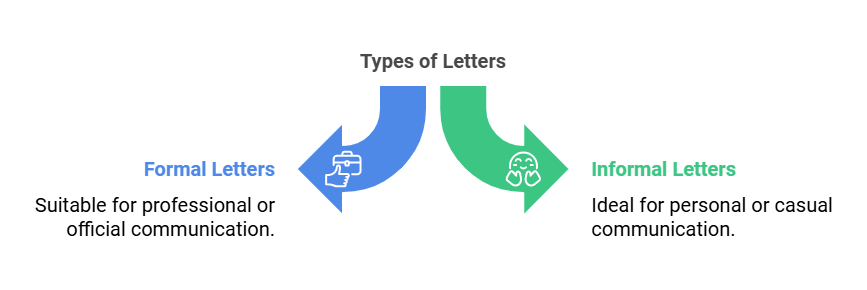
Formal Letter
- Written only for official purposes
- Written to The Editor, The Principal, The Municipal Commissioner, The Secretary of a Society, The Mayor, etc.
- It should be brief and precise.
- Formal tone and polite expression.
- Preferably left side of the page.
These are sometimes known as business letters. They are written in a strictly formal style. Such letters are always written on an A4 (8″ x 11″) sheet of paper. They can be folded three times so that the address to which the letter is being sent can appear in the window of a business envelope. The layout is always the same.
Important Points / Tips
- Purpose and Audience: Clearly understand the purpose of the letter and who your audience is. This will help you determine the tone and content of the letter.
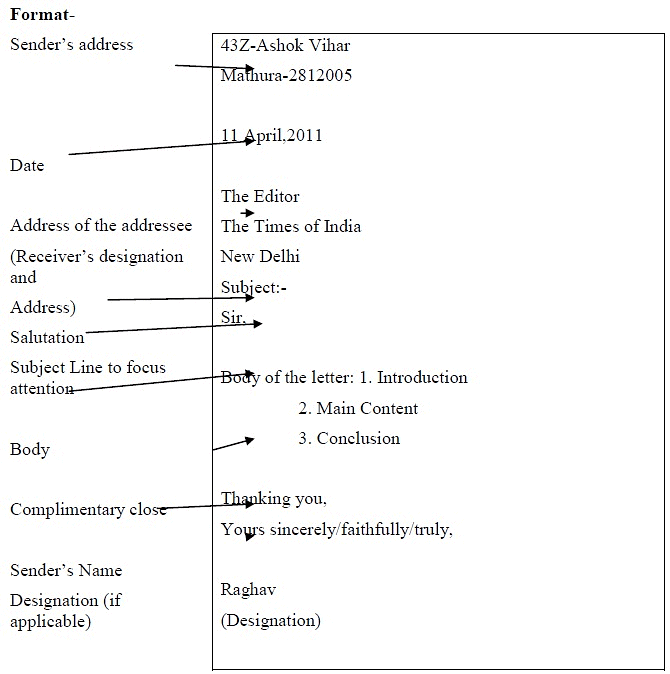
- Proper Structure: Follow the correct format for a formal letter, including the sender's address, date, recipient's address, salutation, body, closing, and signature.
- Clarity and Conciseness: Be clear and concise in your writing. Avoid using unnecessary words or overly complex sentences.
- Politeness and Respect: Use polite and respectful language throughout the letter. Remember to be courteous, even if you are addressing a complaint or issue.
- Formal Tone: Maintain a formal tone. Avoid slang, abbreviations, or casual language. Use complete sentences and proper grammar.
- Correct Salutation: Use an appropriate salutation based on your relationship with the recipient. If you know their name, use "Dear Mr./Ms. [Last Name]"; if not, use "Dear Sir/Madam".
- Relevant Details: Include all necessary details and information to support the purpose of your letter. Be specific and to the point.
- Proofread: Always proofread your letter for spelling, grammar, and punctuation errors. A well-written letter reflects your professionalism and attention to detail.
- Use Professional Language: Use formal and professional language. Avoid contractions (e.g., use "do not" instead of "don't") and ensure your vocabulary is appropriate for the context.
- Review and Edit: Before sending your letter, review it to ensure it conveys your message effectively. Make any necessary edits to improve clarity, coherence, and overall quality.
Format for a Formal Letter
Solved Examples
Here are a few sample formal papers for a better understanding of concept.Question 1.
Write an application to the principal complaining against a senior student of your school.
Answer:
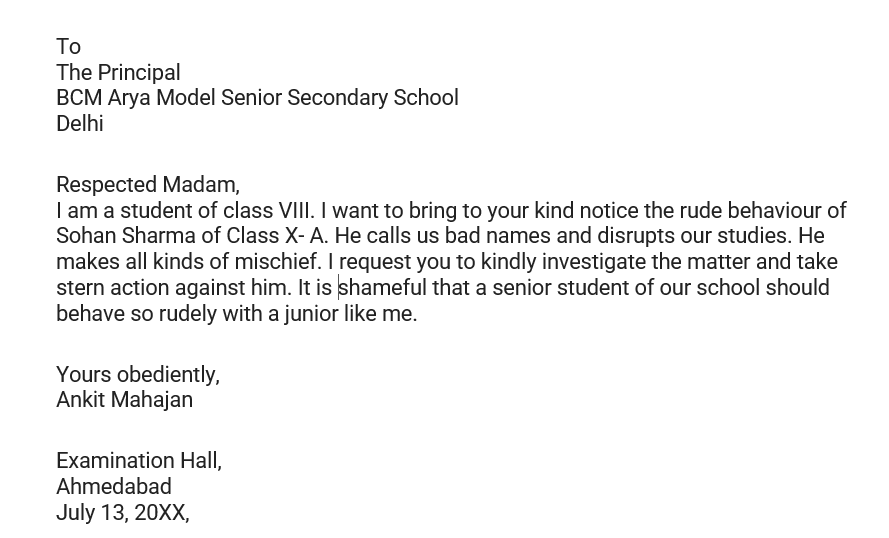
Question 2.
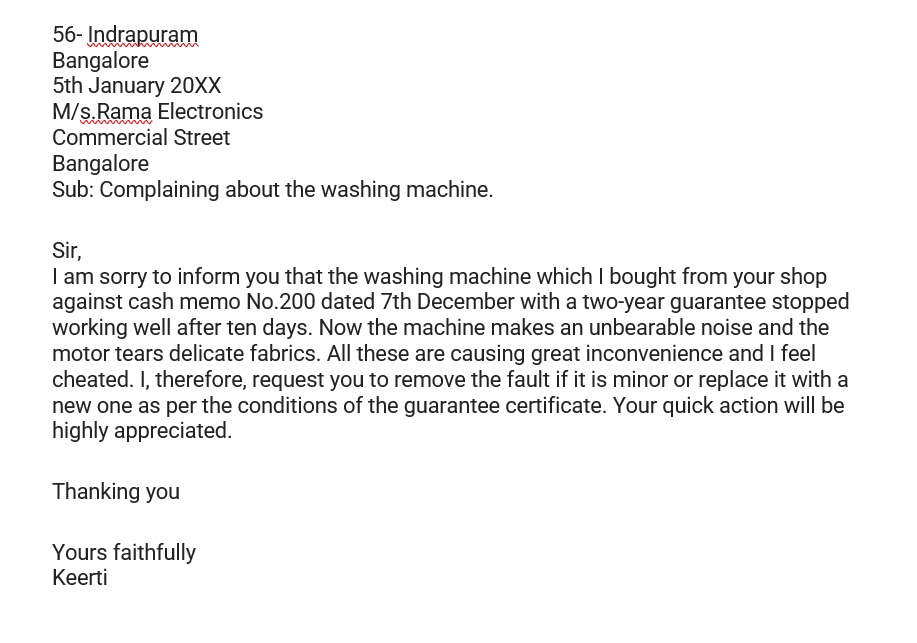
You are Keerti/Krishna of 56, Indrapuram, Bangalore. You bought a new "VIP" Washing Machine from M/s Rama Electronics, Commercial Street, Bangalore last week. Now you find that the machine makes an unbearable noise and the motor tears delicate fabrics. Write a letter to the dealer complaining about the same and requesting him to change the machine as early as possible.
Answer:
Question 3.
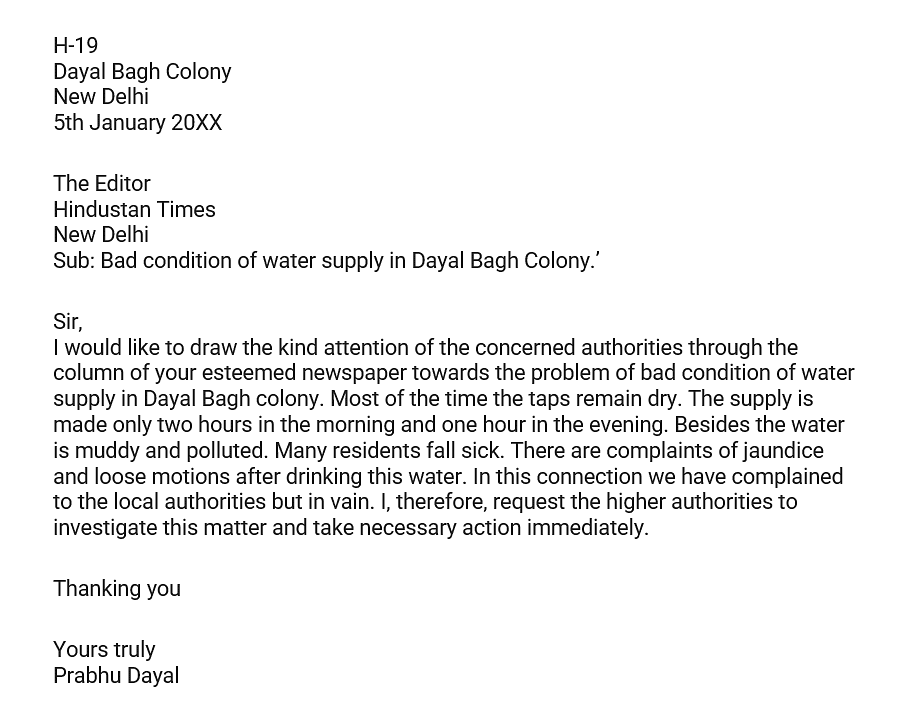
Write a letter to the Editor of a newspaper, complaining about the bad condition of water supply in your locality. You are Prabhu Dayal living at H-19 Dayal Bagh Colony, New Delhi.
Answer:
Question 4.
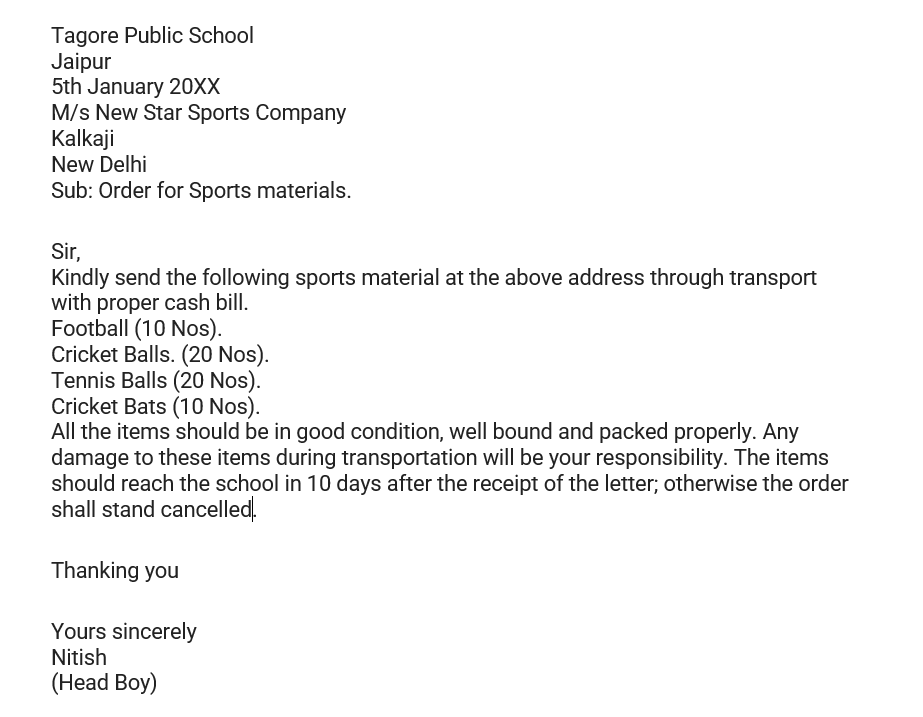
You are Nitish/Nikita, head boy/girl of Tagore Public School, Jaipur. Write a letter to New Star Sports Company, Kalkaji, New Delhi asking him to send more popular sports material for your games and sports department.
Answer:
Practice Questions
- Write an application to the principal of your school requesting him/her to arrange extra classes in English and Maths.
- Write an application to your principal asking him to sanction your medical leave for 2 weeks. Give reasons, why you need the leave.
- Write an application to your Principal, requesting him to arrange an educational trip, giving reasons.
- You are Shruti Dua, a student at Bosco Public School. You have been promoted to class VIII C, which is a Sanskrit section. You want to opt for the French Language for which you will have to request for a change in section. Write an application to the principal for the same.
- Write a letter to the Principal complaining about the misbehavior of a student in your class.
- Write a letter to a well-known person in your town asking him(or her) to deliver a lecture at your school.
- Write a letter to the Chairman, Water Supply Board regarding the insufficiency of water supply.
FAQs on How to Write Formal Letters With Example
| 1. What are the main parts of a formal letter and where do they go? |  |
| 2. How do I write the opening paragraph of a formal letter correctly? | |
| 3. What's the difference between formal and informal letters for Class 8 exams? | |
| 4. How should I close a formal letter and what complimentary closes are acceptable? | |
| 5. What common mistakes should I avoid while writing formal letters in exams? | |


