Chapter Notes: Formation of a Company


Modern businesses need large amounts of capital to grow. Increasing competition, rapid technological change and higher business risk have made the corporate form attractive for medium and large-scale operations. The process through which a business idea is converted into a legally recognised company involves several formal stages and legal documents. Persons who initiate and carry out these steps and accept related risks are known as promoters.
Stages in Company Formation
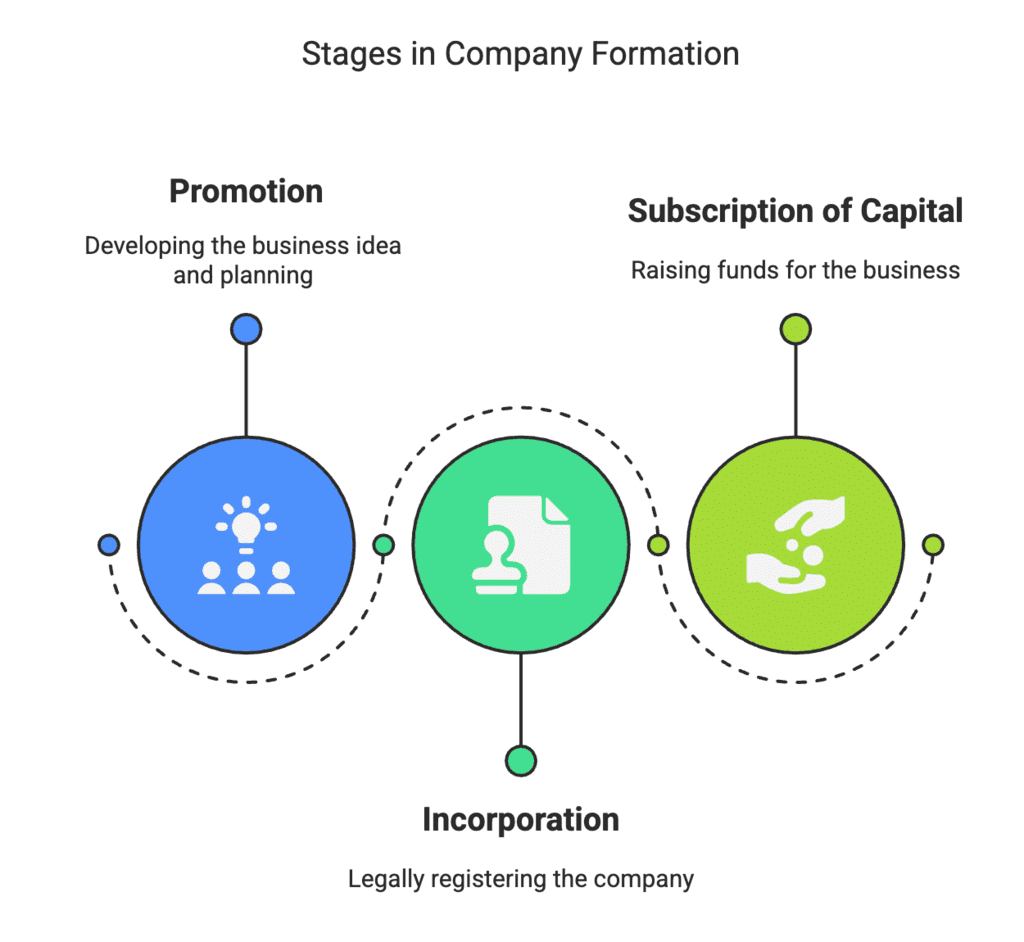
The process of forming a company begins with an idea and ends when the company is legally entitled to commence business. The main stages are:
- Promotion - Developing and planning the business, arranging resources and preparing for incorporation.
- Incorporation - Registering the company with the Registrar of Companies to obtain legal recognition.
- Subscription of Capital - Raising funds for the company through share or debenture issues (for public companies) or by private arrangements.
A private company need not raise funds from the public and therefore normally does not issue a prospectus or meet minimum public subscription requirements.
Promotion of a Company
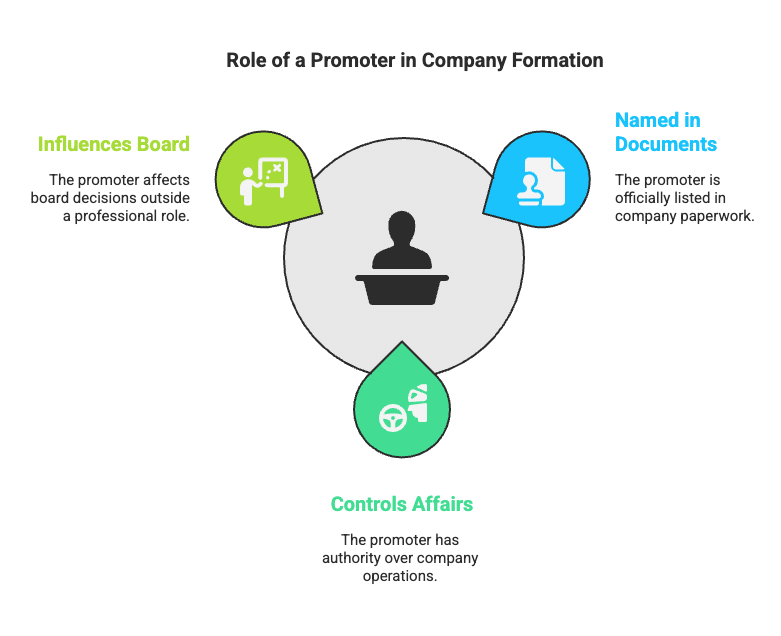
Promotion is the first stage in forming a company. It begins when an individual or group identifies a business opportunity and takes steps to convert that idea into a company. The person or group that initiates and organises these activities is called a promoter. Promoters bring together the necessary resources - money, materials, manpower and management - and take the preliminary decisions required to launch the company.
Who is a Promoter?
- A promoter is a person who undertakes to form a company in reference to a given project and performs the necessary acts to accomplish the purpose.
- Promoters assume responsibility for the matters relating to formation until the company is incorporated and takes over.
Functions of a Promoter
- Identifying a business opportunity - Looking for new products, services or markets, or ways to improve existing operations.
- Feasibility studies - Assessing whether the project is practically and economically viable: Technical feasibility - checking availability of technology and raw materials. Financial feasibility - ensuring sufficient funds can be arranged. Economic feasibility - confirming the project is likely to be profitable.
- Name approval - Choosing a suitable and unique company name and seeking approval from the Registrar of Companies; the name must not be misleading or too similar to an existing name.
- Selecting signatories for the Memorandum of Association - Choosing the persons who will sign the MoA; these signatories commonly become the first directors.
- Appointing professionals - Hiring bankers, auditors, company secretaries, chartered accountants and legal advisers to assist with formalities.
- Preparing legal documents - Promoters prepare essential documents for company registration, such as:
1. Memorandum of Association (MOA) - Defines the company's objectives.
2. Articles of Association (AOA) - Specifies company rules and regulations.
3. Consent of Directors- Written approval from the first directors.
After completing these steps, the company is legally registered and ready to start operations.
Documents Required for Registration and Incorporation
Memorandum of Association (MoA)
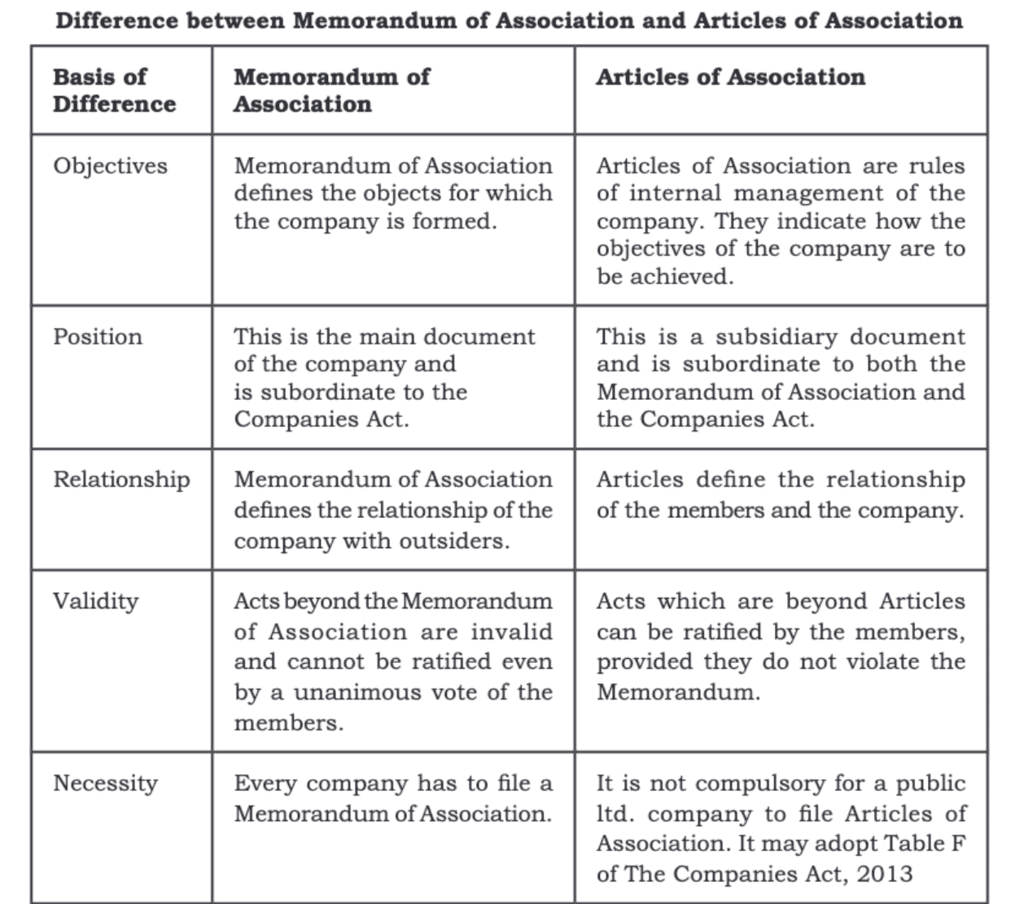
The Memorandum of Association (MoA) is the principal document that defines the constitution and scope of a company's powers and objects. Section 2(56) of the Companies Act, 2013 describes the MoA. It normally contains the following clauses:
- Name clause - Specifies the approved name of the company.
- Registered office clause - States the state in which the registered office will be located and the company must give the exact address within 30 days of incorporation.
- Objects clause - Defines the purposes for which the company is formed; the company may lawfully carry on only those activities stated here.
- Liability clause - Specifies the extent of liability of members (for example, limited to the unpaid amount on their shares).
Example of liability clause application: If a shareholder holds 1,000 shares of ₹10 each and has paid ₹6 per share, the remaining liability is ₹4 per share, i.e. ₹4,000 in total. - Capital clause - Declares the company's authorised capital and its division into shares of a fixed amount.
Example of capital clause: A company with authorised capital of ₹25,00,000 may be structured as 2,50,000 shares of ₹10 each.
The MoA must be signed by the subscribers: at least seven persons in the case of a public company and two persons in the case of a private company.
Articles of Association (AoA)
- The Articles of Association (AoA) set out rules for internal management and administration of the company and must not contravene the MoA.
- Under Section 2(5) of the Companies Act, 2013, companies may adopt model forms of AoA (Tables F-J in Schedule I) or draft their own articles consistent with law.
Consent of Proposed Directors
- Each person proposed as a director must give a written consent stating willingness to act as a director and, if required by the AoA, agree to take any qualification shares.
Agreement with Key Personnel
- If the company intends to appoint a Managing Director, Whole-time Director or Manager, any agreement relating to such appointment must be submitted during incorporation, where applicable.
Statutory Declaration
A declaration confirming that all legal registration requirements have been met must be submitted. This can be signed by:
An Advocate, Chartered Accountant, Cost Accountant, or Company Secretary involved in the company's formation, or
A Director, Manager, or Secretary of the company.
Payment of Registration Fees
- Registration fees as prescribed under the Companies Act must be paid at the time of filing. The fee is linked to the authorised share capital of the company.
Position and Duties of Promoters
- Promoters perform preliminary acts to get the company formed, but they are not agents of the company before incorporation because the company does not yet legally exist.
- Promoters are personally liable for pre-incorporation contracts unless the company, after incorporation, adopts and ratifies those contracts.
- Promoters occupy a fiduciary position - they must act honestly and in the best interests of the company, disclose any profits or benefits obtained in the promotion process, and avoid secret gains. Concealment of material facts can lead to rescission of contracts, recovery of secret profits, or claims for damages.
- Promoters cannot claim automatic reimbursement of promotion expenses; however, the company may choose to repay such expenses. Promoters may be compensated by lump-sum payments, commissions, allotment of shares or debentures, or options to subscribe to securities.
Incorporation of a Company
When promoters complete the required formalities, they apply for incorporation to the Registrar of Companies (ROC) in the state where the registered office will be situated. The ROC examines the documents and, on satisfaction, issues a Certificate of Incorporation.
Documents Commonly Submitted for Incorporation
- Memorandum of Association (MoA) - Signed by at least seven members for a public company and two members for a private company.
- Articles of Association (AoA) - Signed and stamped; public companies may submit a Statement in lieu of AoA if adopting Table A/formats in law.
- Consent of proposed directors - Written declarations from persons willing to act as directors.
- Agreement (if applicable) - Agreement relating to appointment of key managerial personnel like Managing Director.
- Approval letter from ROC - Confirmation of the approved company name.
- Statutory declaration - Confirming compliance with legal requirements, signed by a professional or authorised officer.
- Registered office address - The exact address may be provided within 30 days of incorporation if not furnished at the time of filing.
- Proof of fee payment - Evidence of payment of registration fees according to authorised capital.
Issuance of Certificate of Incorporation
After verifying documents, the ROC issues a Certificate of Incorporation. This certificate acts as the company's birth certificate and indicates the date on which the company legally comes into existence.
- Since 1 November 2000, companies are also assigned a Corporate Identity Number (CIN) for identification.
- The company is deemed to come into existence from the date specified on the Certificate of Incorporation, regardless of subsequent irregularities or defects in registration (the certificate is prima facie conclusive evidence of incorporation).
Legal Effects of the Certificate of Incorporation
- The company becomes a separate legal entity capable of owning property, entering contracts and suing or being sued in its own name.
- The company enjoys perpetual succession - it continues irrespective of changes in membership.
- On and from the date of incorporation, the company can enter into valid contracts, hold assets and carry on business.
- The certificate of incorporation is conclusive proof of the company's legal existence even if there were defects in the registration procedure.
Examples of Legal Recognition
- If incorporation documents are filed on 6 January and the certificate is prepared and issued on 8 January but the certificate is dated 6 January, the company will be regarded as legally formed on 6 January.
- If signatures on the Memorandum were forged but the ROC issues a certificate in good faith, the company's incorporation on the certificate date remains legally effective as between the company and third parties.
Certificate of Commencement of Business
- Both public and private companies must obtain a Certificate of Commencement of Business within 180 days of incorporation when required by law to do so.
- Without this certificate (where applicable), the company is not permitted to commence business operations or exercise borrowing powers.
Capital Subscription and Raising Funds
A public company may raise funds from the public by issuing securities such as shares and debentures. To invite public subscription it issues a prospectus and complies with several statutory and regulatory steps designed to protect investors and ensure transparency.
Steps for Raising Funds from the Public
1. SEBI approval and compliance
- The Securities and Exchange Board of India (SEBI) regulates public issues to protect investors and to ensure fair and transparent capital markets.
- Companies must make full and true disclosure of all material facts in the prospectus and obtain necessary approvals before the issue.
2. Filing of prospectus
- A prospectus is a formal invitation to the public to subscribe to securities; it must contain accurate, complete and non-misleading information to enable investors to take informed decisions.
- Any misstatement or omission of material facts in the prospectus can result in civil and criminal liabilities for the company and its directors.
3. Appointment of bankers, brokers and underwriters
- Bankers receive application money and handle subscription proceeds in separate bank accounts until allotment.
- Brokers and registrars distribute application forms, assist in marketing the issue and handle investor enquiries.
- Underwriters (if appointed) agree to subscribe for any unsubscribed portion of the issue and receive underwriting commission for this guarantee.
4. Minimum subscription
- As per regulatory requirements, the company must receive a specified minimum subscription (commonly 90% of the issue size under SEBI guidelines) before proceeding to allotment.
- If the minimum subscription is not achieved within the subscription period, the company must refund the application money to applicants.
5. Application to stock exchange for listing
- A company seeking to list its securities must apply to at least one recognised stock exchange for permission to list shares or debentures.
- If permission to list is withheld or not granted within a statutory period (for example, 10 weeks from the date of issue closure), the allotment may become void and the company must refund application monies promptly (within prescribed time limits).
6. Allotment of shares
- Application monies are kept in a separate bank account until shares are allotted.
- If an applicant is allotted fewer shares than applied for, the surplus application money must be refunded or adjusted against amounts due.
- Successful applicants receive allotment letters and a Return of Allotment must be filed with the Registrar (signed by a director or secretary) within the prescribed period (commonly 30 days).
Alternative to a Public Issue
A public company may avoid a public issue and raise capital by other means:
- Accepting subscriptions from friends, relatives or private investors.
- Using private placements to a selected group of investors, similar to arrangements used by private companies.
In such cases a prospectus is not required, but a Statement in lieu of Prospectus must generally be filed with the Registrar at least three days before allotment.
One Person Company (OPC)
The Companies Act, 2013 introduced the concept of the One Person Company (OPC) to encourage entrepreneurship and to enable micro and small business owners to adopt a corporate structure with fewer formalities. OPCs combine some benefits of a private limited company with simplified compliance for a single owner.
Background
- The concept of OPC was recommended by the JJ Irani Expert Committee (2005) to reduce legal complexity and support small entrepreneurs to formalise and corporatise their activities.
Benefits similar to a private limited company
- Separate legal entity - the company is distinct from its owner.
- Limited liability - the owner's personal assets are generally protected from company liabilities.
- Perpetual succession - the company continues despite the death or incapacity of the owner (subject to nomination rules).
Key characteristics and conditions for OPC
- Eligibility criteria - Only a natural person who is an Indian citizen and a resident in India can incorporate an OPC or be a nominee. A resident is a person who has stayed in India for at least 182 days in the previous financial year.
- Restriction on multiple OPCs - A person can incorporate only one OPC and act as nominee in only one OPC at a time. If a person becomes a member or nominee of another OPC, this must be resolved within 180 days.
- Restriction on membership - Minors cannot be members, nominees or beneficial owners of shares in an OPC.
- Conversion and activity limitations - An OPC cannot be incorporated or converted into a Section 8 (not-for-profit) company, and OPCs are restricted from undertaking certain activities such as acting as a Non-Banking Financial Company (NBFC) that carries out financial investment activities.
- Conversion to other company types - Voluntary conversion into another form of company is generally not permitted before two years from incorporation unless the OPC's paid-up capital exceeds ₹50 lakh or its annual turnover exceeds ₹2 crore in any financial year.
Practical points on OPCs
- OPCs reduce compliance burden for single entrepreneurs while allowing limited liability and a corporate identity.
- Nomination provisions allow an individual to nominate a successor who will become the member of the OPC on the death or incapacity of the sole member, ensuring continuity.
Summary
Formation of a company involves promotion, incorporation and capital subscription. Promoters identify opportunities, carry out feasibility, prepare legal documents and arrange resources. Incorporation requires filing the MoA, AoA and supporting documents with the Registrar of Companies; on verification the ROC issues a Certificate of Incorporation, giving the company legal existence and important legal consequences. Public companies raising capital from the public must follow regulatory steps (SEBI compliance, prospectus, bankers, brokers, underwriters, minimum subscription, allotment and listing). The Companies Act, 2013 also provides for simpler forms such as the One Person Company (OPC) to promote entrepreneurship with limited liability and easier compliance for a single owner.
FAQs on Chapter Notes: Formation of a Company
| 1. What are the main steps involved in forming a company under CBSE Business Studies? |  |
| 2. What's the difference between a promoter and a director when starting a company? | |
| 3. Why is the Certificate of Incorporation important in company registration? | |
| 4. How do Memorandum and Articles of Association differ in company formation? | |
| 5. What happens during the promotion phase before a company is officially registered? | |