Grade 10 Exam > Grade 10 Notes > English Language > Antonyms - Vocabulary
Antonyms - Vocabulary

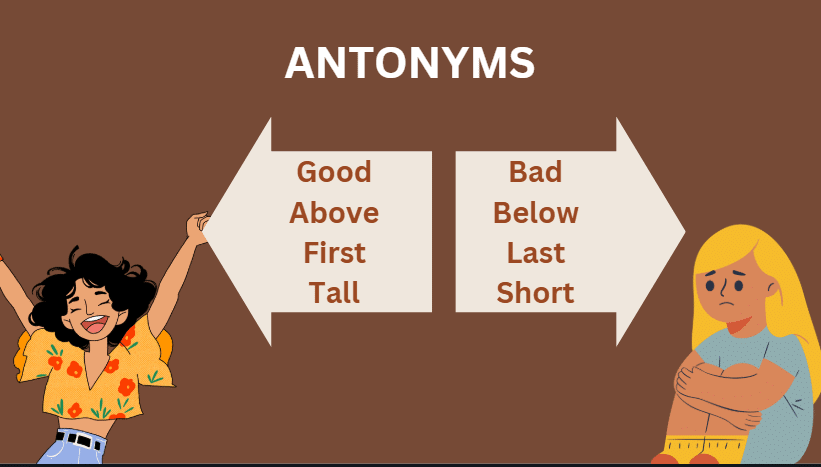
What is an Antonym?
Words that have completely opposite meanings are called antonyms.
- For instance, the word abrasive has several antonyms such as smooth, soft, and polished.
- Antonyms cannot be swapped with each other because doing so would change the meaning of the sentence to its opposite.
Why are Antonyms Used?
- Using antonyms helps make our communication clearer and more accurate.
- Learning and using antonyms expands our vocabulary.
- Our language becomes richer and more flexible as we learn to express a wider variety of ideas and emotions.
- Antonyms allow us to compare different concepts within our content.
- The differences in meanings are emphasized when we use antonyms.
Here are the words which are having different meanings:
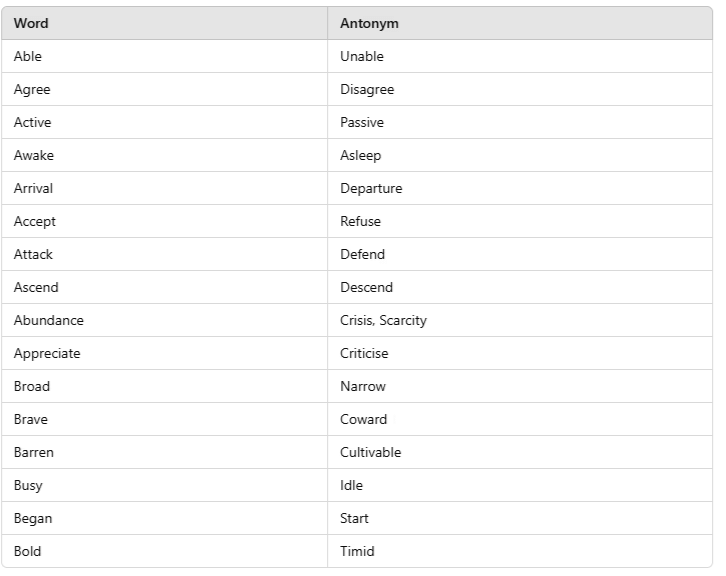
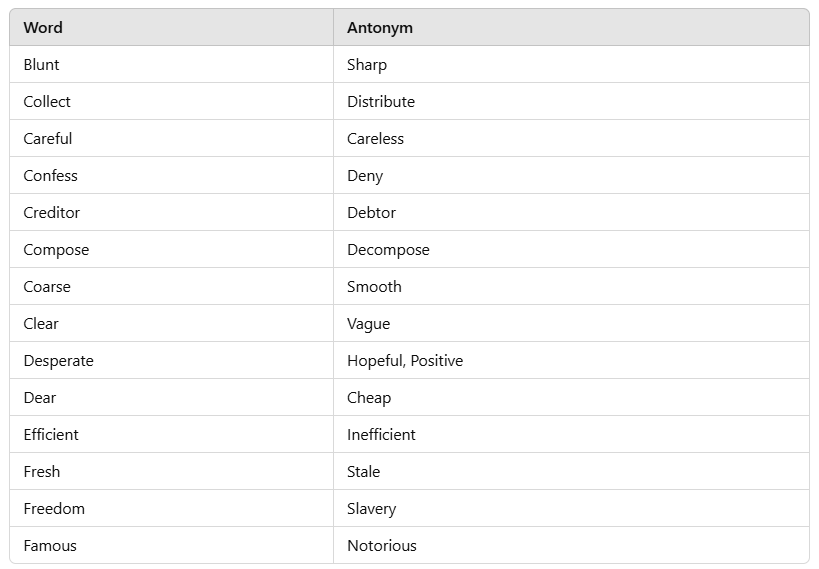
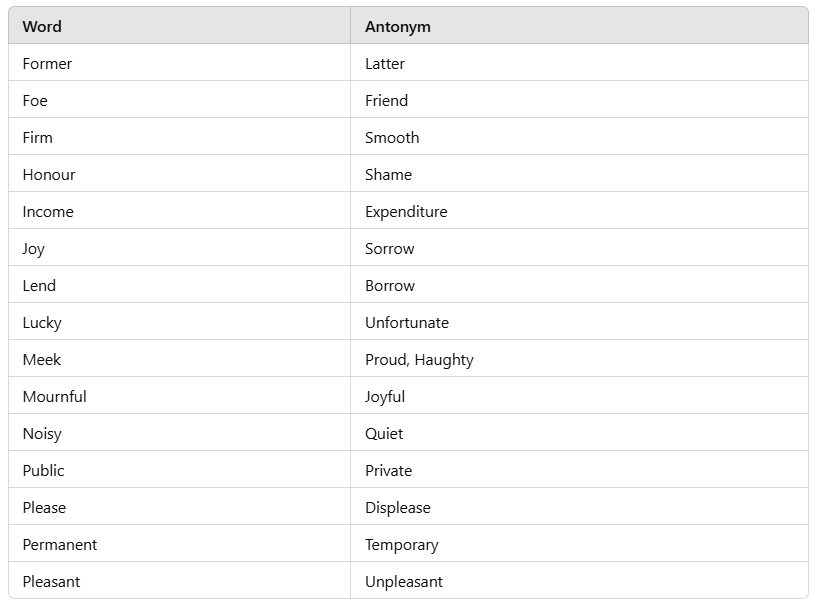
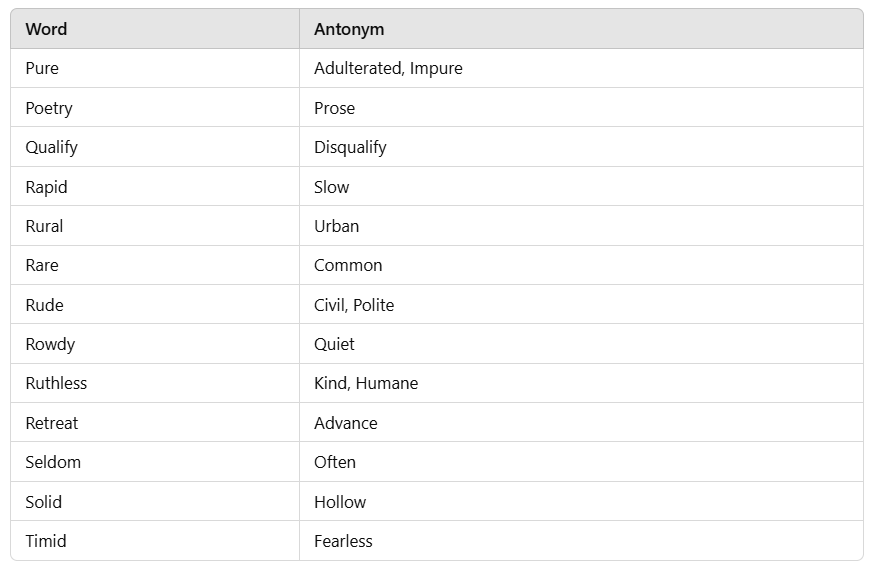
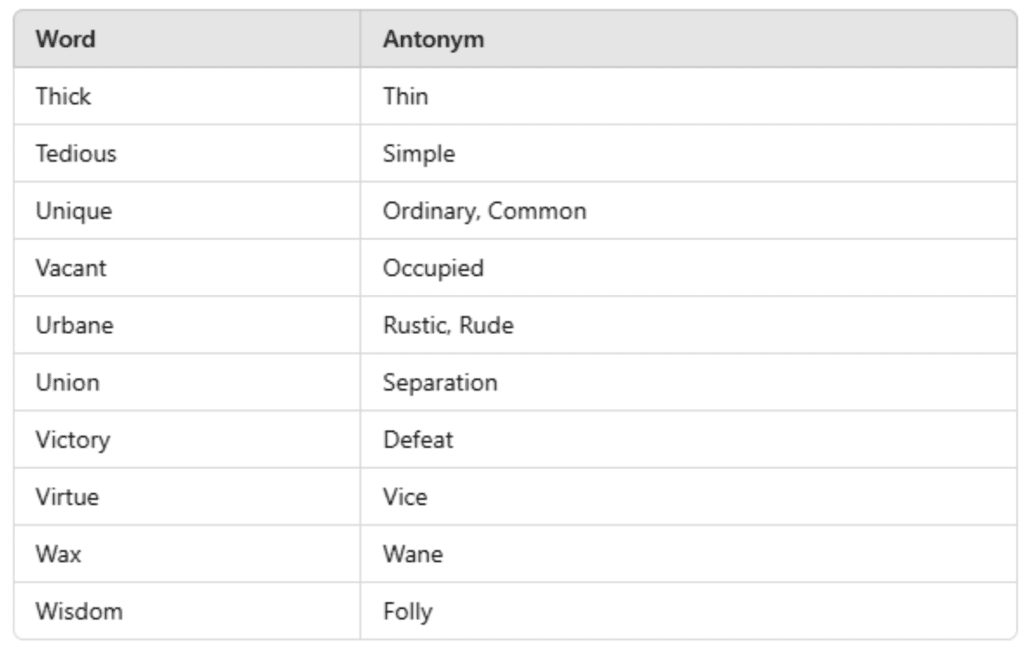
The document Antonyms - Vocabulary is a part of the Grade 10 Course English Language for Grade 10.
All you need of Grade 10 at this link: Grade 10
FAQs on Antonyms - Vocabulary
| 1. What's the difference between antonyms and synonyms in English vocabulary? |  |
Ans. Antonyms are words with opposite meanings, while synonyms are words with similar meanings. For example, "hot" and "cold" are antonyms, whereas "happy" and "joyful" are synonyms. Understanding this distinction helps Grade 10 students build stronger vocabulary and improves writing precision during exams.
| 2. How do I identify antonyms correctly for CBSE English vocabulary questions? | |
Ans. Identify antonyms by looking for words that express opposite or contrasting meanings. Check if the word negates or reverses the original term-for instance, "brave" versus "cowardly" or "bright" versus "dim." Practice with vocabulary flashcards and mind maps to recognise opposite word pairs quickly during board exams.
| 3. What are the main types of antonyms I need to know for Grade 10? | |
Ans. Three primary antonym types exist: complementary antonyms (complete opposites like "alive" and "dead"), gradable antonyms (varying degrees like "hot," "warm," "cold"), and relational antonyms (opposite roles like "teacher" and "student"). Mastering these categories strengthens vocabulary retention and helps students answer antonym-based exam questions confidently.
| 4. Why do some words have multiple antonyms and how do I choose the right one? | |
Ans. Words often have several antonyms depending on context and meaning. "Bright" can mean intelligent or luminous, with antonyms like "dull" or "dark" respectively. Always consider the word's context within a sentence. Refer to vocabulary PPTs and MCQ tests to practise selecting contextually appropriate antonyms for different scenarios.
| 5. How can I remember antonym pairs better for my English exams? | |
Ans. Create antonym word pairs using visual memory techniques and regular revision. Group opposites by categories-emotions, sizes, qualities-and use mnemonic devices or association methods. EduRev's detailed flashcards and mind maps for vocabulary help students retain antonym pairs effectively through structured, repetitive learning patterns.
About this Document

15.3K Views

4.73/5 Rating

Apr 19, 2026 Last updated
Related Exams
Document Description: Antonyms - Vocabulary for Grade 10 2026 is part of English Language for Grade 10 preparation. The notes and questions for Antonyms - Vocabulary have been prepared according to the Grade 10 exam syllabus. Information about Antonyms - Vocabulary covers topics like and Antonyms - Vocabulary Example, for Grade 10 2026 Exam. Find important definitions, questions, notes, meanings, examples, exercises and tests below for Antonyms - Vocabulary.
Introduction of Antonyms - Vocabulary in English is available as part of our English Language for Grade 10 for Grade 10 & Antonyms - Vocabulary in Hindi for English Language for Grade 10 course. Download more important topics related with notes, lectures and mock test series for Grade 10 Exam by signing up for free. Grade 10: Antonyms - Vocabulary
Description
Antonyms of English Language covers all the important topics, helping you prepare for the Grade 10 exam on EduRev. Start for free!
Information about Antonyms - Vocabulary
In this doc you can find the meaning of Antonyms - Vocabulary defined & explained in the simplest way possible. Besides explaining types of Antonyms - Vocabulary theory, EduRev gives you an ample number of questions to practice Antonyms - Vocabulary tests, examples and also practice Grade 10 tests



Related Searches
ppt, Antonyms - Vocabulary, Summary, shortcuts and tricks, MCQs, Sample Paper, Viva Questions, video lectures, Previous Year Questions with Solutions, Important questions, mock tests for examination, pdf , Semester Notes, Free, practice quizzes, past year papers, Exam, Antonyms - Vocabulary, Antonyms - Vocabulary, Extra Questions, study material, Objective type Questions;