Elimination Reactions(E1 and E2)(Part -2) - Organic Reaction Mechanisms,Organic Chemistry, CSIR-NET

Characteristics of an E1 Reaction
Kinetics – First order
Mechanism – Two steps
Identity of R group – More substituted halides react faster Rate: R3CX > R2CHX > RCH2X
Strength of the base – Favored by weaker bases such as H2O and ROH
Leaving group - Better leaving group leads to faster reaction rates. Just as in SN1 reactions, the rate determining step involves the C—X bond cleavage
Type of solvent - Favored by polar protic solvents, which can stabilize the ionic intermediates
SN1 and E1 Reactions
SN1 and E1 reactions have exactly the same first step—formation of a carbocation. They differ in what happens to the carbocation.
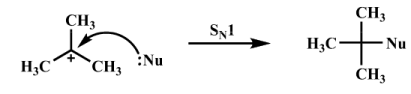
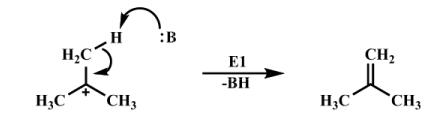
Since in both the reactions, the rate determining steps are the same, they cannot be individually controlled.
Because E1 reactions often occur with a competing SN1 reaction, E1 reactions of alkyl halides are much less useful than E2 reactions.
SN1, SN2, E1 or E2
3° Alkyl Halides
With strong bases: E2 elimination occurs
With weak nucleophiles or bases: A mixture of products from SN1 and E1 reactions
1° Alkyl Halides
With strong nucleophiles: Substitution occurs by an SN2 mechanism
With strong sterically hindered bases: Elimination occurs by an E2 mechanism
2° Alkyl Halides
With strong bases and nucleophiles: A mixture of SN2 and E2 reaction products are formed
With strong sterically hindered bases: Elimination occurs by an E2 mechanism
With weak nucleophiles or bases: A mixture of SN1 and E1 products results
Stereochemistry of the E2 Reaction
The transition state of an E2 reaction consists of four atoms from the substrate (one hydrogen atom, two carbon atoms, and the leaving group, X) aligned in a plane. There are two ways for the C—H and C—X bonds to be coplanar.
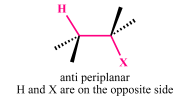
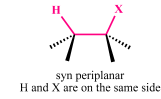
E2 elimination occurs most often in the anti periplanar geometry. This arrangement allows the molecule to react in the lower energy staggered conformation, and allows the incoming base and leaving group to be further away from each other.
The anti periplanar geometry also allows direct interaction between the bonding electrons of C—H bond and the anti-bonding orbital of the C—X bond.
E2 Reactions in 6-Membered Rings
The stereochemical requirement of an anti periplanar geometry in an E2 reaction has important consequences for compounds containing six-membered rings.
Chlorocyclohexane
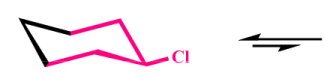
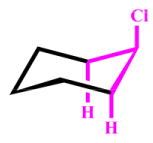
For E2 elimination, the C—Cl bond must be anti periplanar to the C—H bond on a β carbon, and this occurs only when the H and Cl atoms are both in the axial position. The requirement for trans-diaxial geometry means that elimination must occur from the less stable conformer.
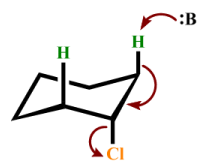
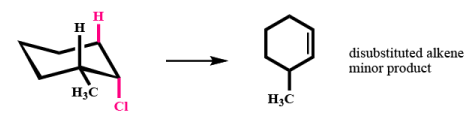
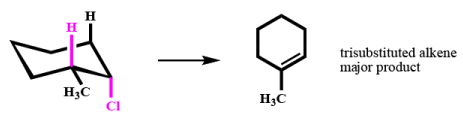
Dehydrohalogenation of c/s-1-Chloro-2-methylcyclohexane
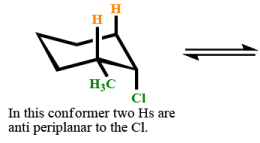
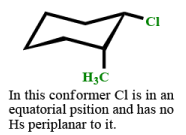
The conformer with Cl in an axial orientation reacts to give two alkenes. The alkene that is more substituted is the major product.
Dehydrohalogenation of fmns-1-Chloro-2-methylcyclohexane
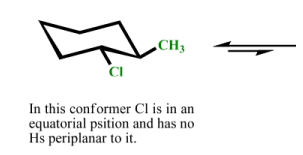
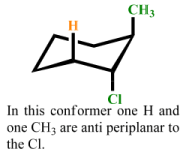
The conformer with Cl in an axial orientation has just one β-H atom. Only one product is formed, which is not what is predicted by the Zaitsev rule.
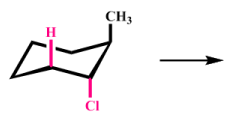
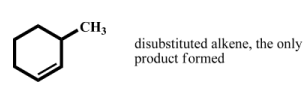
In conclusion, with substituted cyclohexanes, E2 elimination should occur with a trans diaxial arrangement of the leaving group and the β-H, and as a result of this requirement, the more substituted alkene is not necessarily the major product.
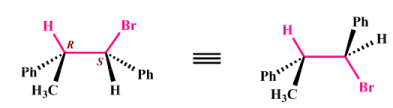
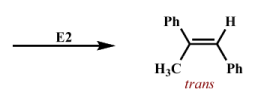
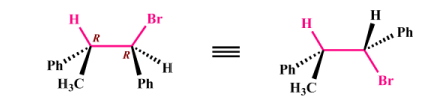
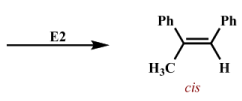
Stereospecificitv in E2 reactions
Diastereomeric starting compounds yield diastereomeric products after an E2 reaction
E1cB Reaction
An elimination reaction that happens when a compound bearing a poor leaving group and an acidic hydrogen is treated with a base.
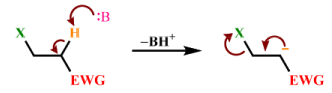
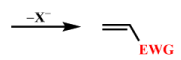
E1cB stands for Elimination Unimolecular conjugate Base. The reaction is unimolecular from the conjugate base of the starting compound, which in turn is formed by deprotonation of the starting compound by a suitable base.
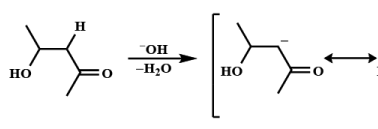
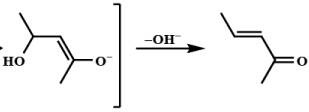
The electron withdrawing group (EWG) can be a carbonyl group (keto, aldehyde, ester), a nitro group, an electron deficient aromatic group etc. Dehydration of aldol is the most common E1cB reaction
FAQs on Elimination Reactions(E1 and E2)(Part -2) - Organic Reaction Mechanisms,Organic Chemistry, CSIR-NET
| 1. What are elimination reactions? |  |
| 2. What is an E1 reaction? | |
| 3. What is an E2 reaction? | |
| 4. How do E1 and E2 reactions differ? | |
| 5. What are the applications of elimination reactions in organic chemistry? | |

