Spectral and Magnetic Properties (Part - 1) - Inner Transition Elements, CSIR-NET

Inner transition elements – the lanthanides and actinides
In the lanthanides, the 4f electronic orbitals are being filled (elements 57 to 71, 4f1 to 4f14) while the two outer shell electronic configurations are 5d0, 6s2. Their properties are therefore extremely similar making chemical separation of individual members very difficult. The lanthanide contraction (decrease in size of the individual members as the atomic number increases) produces a slight difference in properties sufficient to separate them using ion-exchange chromatography. A similar series of elements exist in which the 5f orbitals are being filled and the 6d0, 7s2 remaining constant. These are the actinides (elements 89 to 103, 5f1 to 5f14). Since elements beyond 92, uranium, are not found in nature, most of the elements in the actinide series are synthetic elements of extremely short lifetimes. A list of these elements with their electronic configurations are given below:
Lanthanides | Actinides | ||||
57. Lanthanum | (La) | [Xn] 4f°, 5d\ 6s2 | 89. Actinium | (Ac) | [Rn] 5f°, 6d1, 7s2 |
58. Cerium | (Ce) | [Xn] 4f2, 5d0, 6s2 | 90. Thorium | (Th) | [Rn] 5f°, 6d2, 7s2 |
59. Praseodymium | (Pr) | [Xn] 4f3, 5d0, 6s2 | 91. Protoactinium | (Pa) | [Rn] 5f2, 6d1, 7s2 |
60. Neodymium | (Nd) | [Xn] 4f4, 5d0, 6s2 | 92. Uranium | (U) | [Rn] 5^, 6d1, 7s2 |
61. Promethium | (Pm) | [Xn] 4f5, 5d0, 6s2 | 93. Neptunium | (Np) | [Rn] 5f4, 6d1, 7s2 |
62. Samarium | (Sm) | [Xn] 4f6, 5d0, 6s2 | 94. Plutonium | (Pu) | [Rn] 5L6, 6d0, 7s2 |
63. Europium | (Eu) | [Xn] 4f7, 5d0, 6s2 | 95. Americium | (Am) | [Rn] 5f7, 6d0, 7s2 |
64. Gadolinium | (Gd) | [Xn] 4f7, 5d1, 6s2 | 96. Curium | (Cm) | [Rn] 5f7, 6d1, 7s2 |
65. Terbium | (Tb) | [Xn] 4f9, 5d0, 6s2 | 97. Berkelium | (Bk) | [Rn] 5f®, 6d0, 7s2 |
66. Dysprosium | (Dy) | [Xn] 4f10, 5d0, 6s2 | 98. Californium | (Cf) | [Rn] 5f10, 6d0, 7s2 |
67. Holmium | (Ho) | [Xn] 4f11, 5d0, 6s2 | 99. Einstenium | (Es) | [Rn] 5f11, 6d0, 7s2 |
68. Erbium | (Er) | [Xn] 4f12, 5d0, 6s2 | 100. Fermium | (Fm) | [Rn] 5f12, 6d0, 7s2 |
69. Thulium | (Tm) | [Xn] 4f13, 5d0, 6s2 | 101. Mendelevium | (Md) | [Rn] 5f13, 6d0, 7s2 |
70. Ytterbium | (Yb) | [Xn] 4f14, 5d0, 6s2 | 102. Nobelium | (No) | [Rn] 5f14, 6d0, 7s2 |
71. Lutetium | (Lu) | [Xn] 4f14, 5d\ 6s2 | 103. Lawrencium | (Lr) | [Rn] 5f14, 6d1, 7s2 |
Oxidation states: The stability associated with empty, half-filled and fully filled orbitals can be observed in La, Eu, Gd, Yb and Lu in the case of lanthanides, and in Ac, Th, Am, Cm, No and Lr in the case of actinides. The main oxidation state shown by all lanthanides in their compounds is +3, obtained by the removal of the two electrons in 6s orbital and one from either 5d or 4f. The other oxidation states exhibited by some of the lanthanides can be explained on the basis of the stability of empty, half-filled and fully filled orbitals. For example, Ce exhibits an oxidation state of +4 since it can obtain an empty 4f orbital by the loss of 4 electrons. Eu prefers an oxidation state of +2, Gd shows an oxidation state of only +3 and Tb shows an oxidation state of +4 since a half-filled 4f7 configuration can be retained in all these situations. Yb prefers an oxidation state of +2 since it can retain the full 4f14 configuration. A similar tendency is expected in the actinides also. These differences in the preferred oxidation states among the lanthanide elements are made use of in their separation by chemical methods.
Colour of salts: Salts of many lanthanide elements are coloured. These colours are seen to depend on the electronic arrangement in the 4f orbital. When this orbital is empty, half-filled or full, such ions are found to be colourless. Thus La3+ ion (f0), Gd3+ (f7) and Lu3+ (f14) are colourless. In the case of other ions, it is seen that configurations with fn and f14-n have the same colour, because they have the same number of unpaired electrons. Since the f-orbitals are well protected by the 5th and 6th electronic shells, they are split by ligand fields only to a lesser extent compared to the d-orbital splitting in the outer transition elements. The colours are due to low-energy f → f electronic transitions.
ions | configuration | colour | ions | configuration | colour |
La3+ | f0 | colourless | Lu3+ | f14 = f14-0 | colourless |
Ce3+ | f1 | colourless | Yb3+ | f13 = f14-1 | colourless |
Pr3+ | f2 | green | Tm3+ | f12 = f14-2 | green |
Nd3+ | f3 | red | Er3+ | f11 = f14-3 | red |
Pm3+ | f4 | pink | Ho3+ | f10 = f14-4 | pink |
Sm3+ | f5 | yellow | Dy3+ | f9 = f14-5 | yellow |
Eu3+ | f6 | colourless | Tb3+ | f8 = f14-6 | colourless |
Gd3+ | f7 | colourless | Gd3+ | f7 = f14-7 | colourless |
Relationship of electronic configuration to magnetic and spectroscopic properties of transition elements, lanthanides and actinides – Term symbols.
Magnetic effects in substances arise from unpaired electrons in orbitals. A spinning electron is equivalent to a moving electric field and generates a magnetic moment. In the case of paired electrons with opposite spins in the same orbital, the magnetic fields generated by them oppose each other and cancel. Thus atoms or ions having only paired electrons in them do not have any magnetic moment and are called diamagnetic. But atoms or ions having unpaired electrons in them have a resultant magnetic moment and are said to be paramagnetic. In inorganic complexes, the ligands usually contain only paired electrons. Therefore they do not contribute any magnetic moment, and all the magnetism of the compound is due to the central metal ion.
In addition to the spin, motion of electrons in the orbital around the nucleus also generates a magnetic moment. The portion of the total magnetic moment generated by the electron spin is called the “spin contribution to magnetic moment” and the portion due to the motion around the nucleus is called the “orbital contribution to magnetic moment.” The total magnetic moment of the atom or ion will be the total sum of these two contributions for all the unpaired electrons in it. For a single electron, its spin contribution depends on its spin quantum number, and its orbital contribution depends on the magnetic quantum numbers available in its orbital. The possible electronic transitions generating the spectrum of the atom or ion also depend on these quantum numbers. If s is the spin quantum number of an electron, its spin contribution to magnetic moment, µs, is given by:
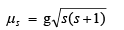
where s is the absolute value of the spin (i.e. 1/2 ) and ‘g’ is a constant called the “gyromagnetic ratio.” The orbital contribution to the magnetic moment for an electron, µl, depends on the l value of its orbital, and is given by:
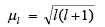
These two moments will couple with each other to produce the total magnetic moment due to this electron. The total effect can then be represented by a new quantum number ‘j’, where j = (l + s).
Term symbols: When there are more than one unpaired electrons, the resultant magnetic or spectroscopic behaviour of the atom or ion will be the sum total of the spin and orbital contributions of all these electrons. Therefore the resultant behaviour of the atom or ion may be represented using a set of suitable quantum numbers representing the total spin and orbital contributions of all the electrons in it. These are the ‘S’ value representing the total spin contribution, the ‘L’ value representing the total orbital contribution and ‘J’ representing the spinorbit coupling where J = L + S. Then, just as t he orbital for an electron is given a name s, p, d, or f depending on the value of l, spectroscopists have assigned a symbol for the atom or ion depending on the value of L. These are correspondingly S, P, D or F depending on whether L = 0, 1, 2 or 3.
[Now if we know whether an electron is in the s, p, d or f orbital, we can predict the spectral lines that may be obtained from them. But historically the procedure was just the reverse. Spectroscopists observed the spectral lines and assigned names to the orbitals producing them depending on the observed spectral characteristics. s = sharp (S → P), p = principal (P → S), d = diffuse (D → P) and f = fundamental (F → D)]
Two schemes have been proposed to make the assigned J values agree with actual experimental observations. These are (1) the Russel-Saunders coupling (also known as the LS coupling) and (2) the j-j coupling.
In the Russel-Saunders coupling scheme, all the s values of the individual electrons are first added together to obtain the resultant S value for the atom or ion.
S = s1 + s2 + s3 + … = ∑s
Similarly, the orbital moment values of all individual electrons are summed to obtain the resultant L value for the atom or ion.
L = l1 + l2 + l3 + … = ∑l = ML
[Actually, it is not the l value, but the magnetic quantum numbers m associated to them that are summed. Therefore L is sometimes written as ML]. Then
J = L – S (if the orbital is less than half filled) or J = L + S (if the orbital is more than half filled).
But in the j-j coupling scheme, the j values for all the individual electrons are first determined by adding the l and s values for each electron. These j values are then summed to obtain the resultant J value for the atom or ion.
j1 = l1 + s1; j2 = l2 + s2; j3 = l3 + s3; … and J = j1 + j2 + j3 + … = ∑j
The Russel-Saunders coupling scheme is used for the lighter metals and the j-j coupling scheme is used for heavier atoms such as lanthanides and actinides.
To get the term symbol for the atom or ion in the ground state, it is designated as S, P, D or Fdepending on the value of L. Then the value 2S+1, called the multiplicity (number of lines into which a spectral line will be split when placed in a magnetic field), is written as a superscript and the J value is written as a subscript. For example, if S = 1 and L = 1, then the corresponding term symbol is 3P0 (pronounced as “triplet pee”. The multiplicities are singlet, doublet, triplet, quartet etc.). If S = ½ and L = 0, then the term symbol is 2S½ .
How to obtain the term symbol from the electronic configuration? The actual and correct procedure for determining term symbols is somewhat long and tedious, depending on the number of electrons present. But a fairly easy (but not very accurate) method is discussed here for students exam purpose only. The trick is to consider only the unpaired electrons.
Example 1: Term symbol for carbon in the ground state. The electronic configuration is 2p2. All the inner electrons are paired and therefore not considered. Following all principles, the arrangement is:
S = ½ + ½ = 1; L = 1 + 0 = 1; Since L = 1, the symbol is P.
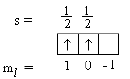
Multiplicity = 2S + 1 = 3; J = L – S = 1 – 1 = 0.
Therefore term symbol for p2 configuration is 3P0
Example 2: For helium, the electronic configuration is 1s2. The arrangement is:
S = ½ - ½ = 0; L = 0; Since L = 0, the symbol is S.
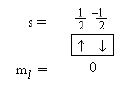
Multiplicity = 2S + 1 = 1; J = L – S = 0.
Therefore term symbol for s2 configuration is 1S0
Example 3: For the p6 configuration in neon,
S = ½ - ½ + ½ - ½ + ½ - ½ = 0; L = 1 + 1 + 0 + 0 – 1 – 1 = 0;
Since L = 0, the symbol is S.
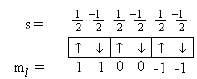
Multiplicity = 2S + 1 = 1; J = L – S = 0.
Therefore term symbol for p6 configuration is 1S0
Note: From the above two examples it can be seen that whenever there are only paired electrons, the term symbol is 1S0. The state is a singlet, meaning that there is only one spectral line. That is why we can neglect all paired electrons.
Example 4: For the Ni2+ ion, the electronic configuration is 3d8. The arrangement is:
S = ½ - ½ + ½ - ½ + ½ - ½ + ½ + ½ = 1;
L = -2 – 1 = -3 (considering only unpaired);
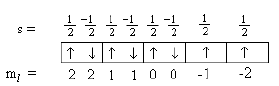
Since L = 3 (take only the absolute value), the symbol is F.
Multiplicity = 2S + 1 = 3; J = L + S = 4.
Therefore term symbol for d8 configuration is 3F4
FAQs on Spectral and Magnetic Properties (Part - 1) - Inner Transition Elements, CSIR-NET
| 1. What are inner transition elements and why do they have unique spectral properties? |  |
| 2. How does the magnetic behaviour of lanthanides differ from transition metals? | |
| 3. Why do inner transition elements show variable oxidation states in their spectroscopic studies? | |
| 4. What is the relationship between crystal field splitting and the colour of lanthanide complexes? | |
| 5. How can students effectively prepare spectral and magnetic properties concepts for CSIR-NET without memorising everything? | |


