Introduction: Analogy

Analogy questions in competitive exams assess logical reasoning, problem-solving and cognitive ability. They require the identification of patterns and relationships between pairs of elements. Practising analogies strengthens both verbal and non-verbal reasoning and helps develop analytical skills that are useful across many professional and academic contexts.
What is Analogy?
An analogy is a statement showing a relationship between two things, used to explain how two pairs are similar in the way their parts relate. In tests, analogies present a known pair and ask you to find another pair that shares the same relationship.
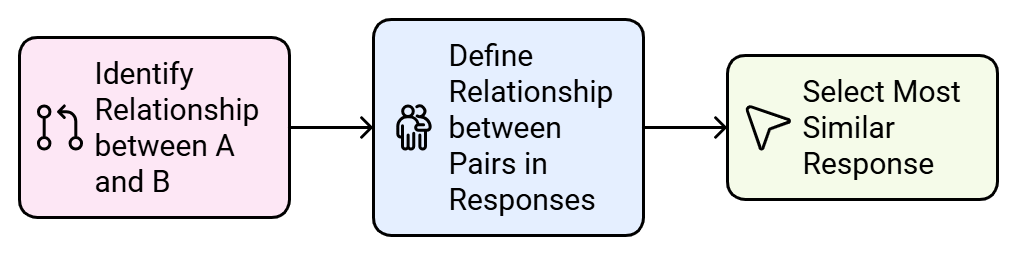
- Analogy questions test your ability to precisely define a connection or relationship between two words (or figures, numbers, letters) and to recognise the same relation among answer choices.
- First, identify the relationship between the two given elements. Then check which option shows the same relationship with the third element.
- Typically, you are given two related objects (A : B) and a third object C. You must find D such that A : B :: C : D (read "A is to B as C is to D").
- Relationships may be semantic (meaning), functional (use/purpose), part-whole, cause-effect, degree, sequence, transformation, morphological (form), positional (letters), numerical, or pictorial (figures).
Analogy Types
Analogy is a standard topic in logical reasoning. Questions are prepared in a variety of forms. Below are the principal types with explanations and examples.
Letter / Word-Based Analogy
- These analogies involve pairs of letters or words where a fixed logical relation links the pair.
- Identify the rule that transforms the first element into the second (for example, shifting letters, replacing by opposite, adding/removing prefix or suffix, synonym/antonym relation), then apply the same rule to the given element to find the unknown.
- Common patterns: alphabetical shifts, reverse order, positional mapping (A↔Z), synonyms, antonyms, part-whole or category relations, and word-formation rules.
- Example:
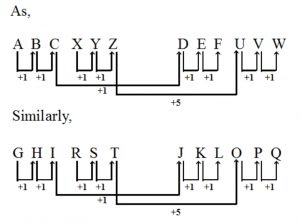
D : F :: R : ?
In D → F there is a forward shift of 2 letters (D→E→F). Applying the same shift to R gives T. So D : F :: R : T.
Try yourself: ABCXYZ : DEFUVW:: GHIRST?
Number-Based Analogy
- Pairs of numbers are related by a mathematical rule. Determine the operation (or operations) that convert the first number to the second and apply it to the third to get the fourth.
- Common operations: addition, subtraction, multiplication, division, powers (squares, cubes), digit operations, factorials, arithmetic or geometric progressions, and combined operations.
- Example:
5 : 25 :: 7 : ?
Here 5² = 25, so 7² = 49. - Example:
2 : 8 :: 6 : ?
Here 2³ = 8, so 6³ = 216.
Try yourself: 4 : 20 : : 8 : ?
Letters / Words and Number-Based Analogy (Mixed Analogy)
- Mixed analogies combine letters/words with numbers; a single pattern controls both the alphabetic and numeric parts.
- Decipher how letters and digits change across the first pair, then apply identical changes to the given pair.
- Example:
B2D5 : C4E25 :: F5H9 : ?
Explanation: B→C (+1), 2 → 2² = 4, D→E (+1), 5 → 5² = 25. Applying the same: F→G, 5 → 5² = 25, H→I, 9 → 9² = 81. Therefore F5H9 → G25I81.
Image-Based Analogy
- Figures are given with a relationship (rotation, reflection, addition/removal of parts, overlaying, inversion, scaling, shading changes). Identify the transformation and choose the option that follows the same rule.
- Common figure relations: mirror image (left ↔ right), water image (vertical inversion), rotation (clockwise/anti-clockwise), addition/removal of features, or combinational changes.
- Carefully compare corresponding features (position, orientation, number of elements, shading) rather than relying on superficial similarity.
- Example:
Select a suitable figure from the Answer Figures that would replace the question mark (?).
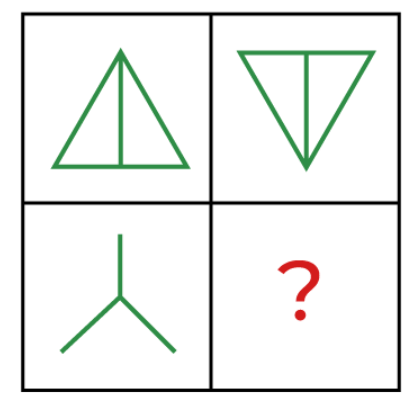
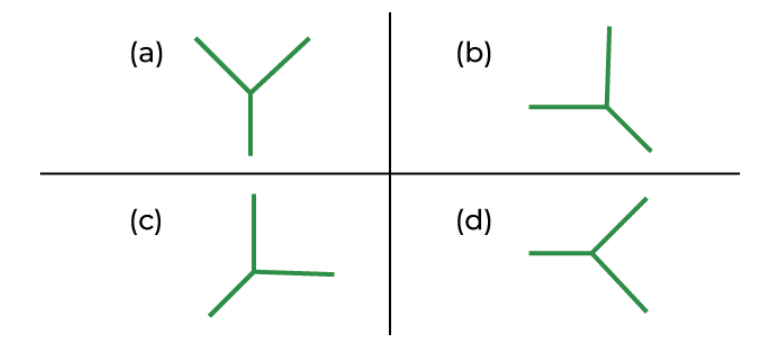
Answer: Option A
Solution: In the first row the second image is the vertical opposite (mirror across a horizontal axis) of the first image. The same vertical inversion is applied to the second row, so the correct option is A.
Miscellaneous Analogy
- These may draw on general knowledge, science, current affairs, mathematics or any other subject. The relationship can be factual or conceptual (for example, unit-quantity, inventor-invention, disease-cause).
- To answer such items reliably, maintain a broad factual base and practise mapping factual relations to standard analogy formats.
- Example:
Force : Newton :: Current : ___
The SI unit of Force is Newton; similarly the SI unit of Current is Ampere.
Try yourself: India : Rupee: : Japan : ___
Tips and Tricks to Solve Analogies
- Analogy patterns repeat; learn and practise common patterns so you can recognise them quickly.
- Always state the relationship between the given pair in a short phrase (for example, "part : whole", "tool : user", "degree : extreme", "cause : effect", "unit : quantity", "action → result", or "letter shift +2").
- Substitute the pair into a simple sentence that shows the relation, and then substitute the test pair into the same sentence to check candidates. Keep the order exactly as given (A : B :: C : D means "A relates to B as C relates to D").
- If no option matches the exact relationship you identified, your relationship is likely incorrect or incomplete. Analogy demands precision.
- When stuck, eliminate obviously wrong options: those with different semantic relations, wrong category, or impossible transformations.
- For pictorial items, compare structural details (number of elements, orientation, shading) rather than overall look; small differences often determine the correct choice.
- Pro Hack 1: Use the "Sentence Test" - Create a clear sentence like "Baker produces something that people eat" and test every option with the exact same sentence structure. Only the perfect match survives!
- Pro Hack 2: Reverse Engineering Trick - If you're confused about A : B, try checking B to A. Sometimes the relationship becomes crystal clear backwards.
- Pro Hack 3: Elimination is Your Best Friend - Quickly throw out options that use a completely different relationship type (e.g., one is synonym, another is cause-effect). This saves 20-30 seconds in exam.
- Pro Hack 4: For number analogies, always check both single and combined operations (square + add, multiply + digit sum, etc.). Don't stop at the first pattern you see.
- Pro Hack 5: In mixed analogies, solve letters and numbers separately first, then combine. Watch for hidden patterns like +1 letter with square of number.
- Pro Hack 6: Time Management Tip - Spend maximum 30-45 seconds per analogy. If it's taking longer, mark and move on. Practice daily 10-15 questions to build speed.
- Common Student Mistake to Avoid: Don't pick options that look similar visually or semantically without verifying the exact relationship. Precision wins marks!
Solved Examples
Example 1: baker : eating -
(a) surgeon : anesthesia
(b) author : reading
(c) gardener : watering
(d) policeman : enforcement
Ans: (b)
Sol: eating is an activity involving the product of the baker's work. Reading is an activity that involves the product of the author's work. The other responses do not show the same relationship: anesthesia precedes a surgeon's operation, watering is one of a gardener's tasks, and enforcement is the objective of a policeman's work.
Example 2: to shutter : is closed -
(a) to explain : is understood
(b) to estimate : is exact
(c) to believe : is correct
(d) to permit : is forbidden
Ans: (a)
Sol: To shutter something causes it to be closed. To explain something causes it to be understood. The others do not have the same causative result relation.
Example 3: deck : fleet -
(a) ruler : country
(b) roof : neighborhood
(c) clothespin : laundry
(d) player : team
Ans: (b)
Sol: A deck is the upper part of a ship; a group of ships forms a fleet. A roof is the upper part of a house; a group of houses forms a neighbourhood. The other choices do not preserve the same part → group relation.
Example 4: warn : wariness -
(a) distort : truth
(b) provoke : anger
(c) know : proficiency
(d) dissuade : action
Ans: (b)
Sol: To warn produces wariness in someone. To provoke produces anger in someone. The other choices do not show the same cause → emotional effect pairing.
Example 5: Curd : Milk :: Shoe : ?
(a) Leather
(b) Cloth
(c) Jute
(d) Silver
Ans: (a)
Sol: Curd is made from milk; similarly a shoe is typically made from leather.
Example 6: Calf : Piglet :: Shed : ?
(a) Prison
(b) Nest
(c) Pigsty
(d) Den
Ans: (c)
Sol: Calf is the young of a cow and piglet is the young of a pig. A shed is a dwelling/shelter for a cow; a pigsty is the dwelling for a pig.
Example 7: Malaria : Mosquito :: ? : ?
(a) Poison : Death
(b) Cholera : Water
(c) Rat : Plague
(d) Medicine : Disease
Ans: (b)
Sol: Malaria is transmitted by mosquitoes; cholera is commonly spread through contaminated water.
Example 8: ABC : ZYX :: CBA : ?
(a) XYZ
(b) BCA
(c) YZX
(d) ZXY
Ans: (a)
Sol: ABC is the reverse sequence of ZYX. CBA is the reverse of ABC; therefore the analogous reverse of ZYX is XYZ.
Example 9: 4 : 18 :: 6 : ?
(a) 32
(b) 38
(c) 11
(d) 37
Ans: (b)
Sol: 4² + 2 = 18. Applying the same rule: 6² + 2 = 36 + 2 = 38.
Example 10: Chill : Freeze
(a) Slice : Cut
(b) Simmer : Boil
(c) Roast : Stew
(d) Cook : Fry
Ans: (b)
Sol: Chill is a lower degree (milder form) of Freeze. Simmer is a lower degree (milder form) of Boil. Hence option (b) is correct.
Final Notes
- Always put the relationship between the test pair into a short descriptive phrase before checking options.
- Practice a variety of analogy types-alphabetic, numeric, mixed and pictorial-to build speed and accuracy.
- When an item involves factual knowledge, verify the fact (unit names, scientific relations, common-usage pairings) before choosing the option.
- Bonus Tip: Daily practice with timed quizzes is the real game-changer. Watch your accuracy skyrocket in just one week!
FAQs on Introduction: Analogy
| 1. What exactly is analogy and why does it keep appearing in SSC CGL reasoning? |  |
| 2. How do I identify the relationship between word pairs in analogy questions? | |
| 3. What are the most common types of analogies asked in SSC CGL exams? | |
| 4. Why do I keep getting analogy questions wrong even when I understand the concept? | |
| 5. How should I practise analogy problems to improve my speed and accuracy for SSC CGL? | |