NCERT Solutions: Number System (Exercise 1.1)

Q1. Is zero a rational number? Can you write it in the form p/q where p and q are integers and q ≠ 0?
Ans: We know that a number is said to be rational if it can be written in the form p/q , where p and q are integers and q
Taking the case of '0',
Yes, zero is a rational number.
0 =
Example : 
Since, it satisfies the necessary condition, we can conclude that 0 can be written in the p/q form, where q can either be positive or negative number.
Hence, 0 is a rational number.
Q2. Find six rational numbers between 3 and 4.
Ans: We can find any number of rational numbers between two rational numbers. There are infinite rational numbers between 3 and 4.
- First of all, we make the denominators same by multiplying or dividing the given rational numbers by a suitable number.
- If denominator is already same then depending on number of rational numbers we need to find in question, we add one and multiply the result by numerator and denominator.
As we have to find 6 rational numbers between 3 and 4, we will multiply both the numbers, 3 and 4, with 6+1 = 7 (or any number greater than 6)
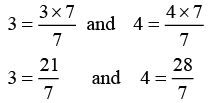
We can choose 6 rational numbers as: 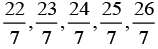 and
and
Q3. Find five rational numbers between 3/4 and 4/5.
Ans: There are infinite rational numbers between 3/4 and 4/5.
Since we need to make the denominators same first, then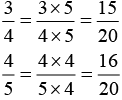
To find out 5 rational numbers between 3/5 and 4/5, we will multiply both the numbers 3/5 and 4/5
with 5+1=6 (or any number greater than 5)
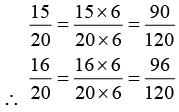
∴ Five rational numbers between  are
are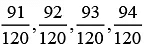 and
and
Q4. State whether the following statements are true or false. Give reasons for your answers.
(i) Every natural number is a whole number.
Ans: True
Natural Numbers: Natural numbers are set of numbers that contain numbers from 1 to infinity. Set of natural numbers is represented as N= {1, 2, 3.......}.
Whole numbers: Numbers starting from 0 to infinity (without fractions or decimals)
Set of Whole numbers is represented as W= 0,1,2,3....
As all the natural numbers comes in the set of whole numbers. Hence, every natural number is a whole number.
(ii) Every integer is a whole number.
Ans: False
Integers: Integers are set of numbers that contain positive, negative and 0; excluding fractional and decimal numbers.
i.e., integers = {...-4,-3,-2,-1,0,1,2,3,4...}
Whole numbers: Numbers starting from 0 to infinity (without fractions or decimals)
i.e., Whole numbers = 0,1,2,3....
Hence, we can say that integers include whole numbers as well as negative numbers.
Every whole number is an integer; however, every integer is not a whole number.
(iii) Every rational number is a whole number.
Ans: False
Rational numbers: All numbers in the form p/q, where p and q are integers and q ≠ 0.
i.e., Rational numbers = 0, 19/30 , 2, 9/-3, -12/7...
Whole numbers: Numbers starting from 0 to infinity (without fractions or decimals)
i.e., Whole numbers = 0,1,2,3....
Hence, we can say that integers include whole numbers as well as negative numbers.
Every whole number is rational, however, every rational number is not a whole number.
FAQs on NCERT Solutions: Number System (Exercise 1.1)
| 1. What is the difference between rational and irrational numbers in Class 9 maths? |  |
| 2. How do I identify whether a decimal number is rational or irrational? | |
| 3. Why do we need to learn about real numbers and their properties in Class 9? | |
| 4. What are some common mistakes students make when simplifying surds and radicals? | |
| 5. How do I locate irrational numbers like √2 and √3 on a number line accurately? | |





