Long Answer Type Questions: Polynomials

Question 1. Factorise: 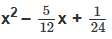
Solution: 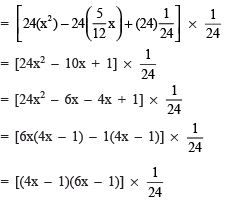
Thus, 
Question 2. Factorise: (x6 - y6)
Solution: x6 - y6 = (x3)2 - (y3)2
= (x3 - y3)(x3 + y3) [∵ a2 - b2 = (a + b)(a - b)]
= [(x - y)(x2 + xy + y2)][(x + y)(x2 - xy + y2)]
[∵ a3 + b3 = (a2 + b2 - ab)(a + b) and a3 - b3 = (a2 + ab + b2)(a - b)]
= (x - y)(x + y)(x2 + xy + y2)(x2 - xy + y2)
Thus, x6 - y6 = (x - y)(x + y)(x2 + xy + y2)(x2 - xy + y2)
Question 3. If the polynomials 2x3 + 3x2 - a and ax3 - 5x + 2 leave the same remainder when each is divided by x - 2, find the value of 'a'
Solution: Let p(x) = 2x3 + 3x2 - a and f(x) = ax3 - 5x + 2
| when p(x) is divided by x - 2 then remainder = p(2) since p(2) = 2(2)3 + 3(2)2 - a = 2(8) + 3(4) - a = 16 + 12 - a ∴ Remainder = 28 - a | when f(x) is divided by x - 2, then remainder = f(2) since, f(2) = a(2)3 - 5(2) + 2 = a(8) - 10 + 2 = 8a - 8 ∴ Remainder = 8a - 8 |
28 - a = 8a - 8
⇒ 8a + a = 28 + 8
⇒ 9a = 36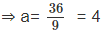
Thus , a = 4
Question 4. Find the values of 'p' and 'q', so that (x - 1) and (x + 2) are the factors of x3 + 10x2 + px + q.
Solution: Here f(x) = x3 + 10x2 + px + q
Since, x + 2 = 0 [∵ x + 2 is a factor of f(x)]
⇒ x= -2 If x + 2 is a factor f(x),
then f(-2) = 0 i.e. (-2)3 + 10(-2)2 + p(-2) + q = 0 [∵Factor theorem]
⇒ -8 + 40 + (-2p) + q = 0 ⇒ 32 - 2p + q = 0 ...(1)
⇒ 2p - q = 32 Also x - 1 = 0 ⇒ x = 1
If (x - 1) is a factor of f(x), then f(1) must be equal to 0. [∵Factor theorem]
i.e. (1)3 + 10(1)2 + p(1) + q = 0
⇒ 1 + 10 + p + q = 0
⇒ 11 + p + q = 0
⇒ p + q = -11 ...(2)
Now, by adding (1) and (2), we get
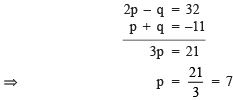
Now we put p = 7 in (2), we have 7 + q = -11
⇒ q = -11 - 7 = -18
Thus, the required value of p and q are 7 and -18 respectively.
Question 5. If (x2 - 1) is a factor of the polynomial px4 + qx3 + rx2 + sx + t, then prove that p + r + t = q + s = 0.
Solution: We have f(x) = px4 + qx3 + rx2 + sx + t
Since, (x2 - 1) is a factor of f(x), [∵ x2 - 1 = (x + 1)(x - 1)]
then (x + 1) and (x - 1) are also factors of f(x).
∴ By factor theorem, we have f(1) = 0 and f(-1) = 0
For f(1) = 0, p(1)4 + q(1)3 + r(1)2 + s(1) + t = 0
⇒ p + q + r + s + t = 0 ...(1)
For f(-1) = 0, p(-1)4 + q(-1)3 + r(-1)2 + s(-1) + t = 0
⇒ p - q + r - s + t = 0 ...(2)
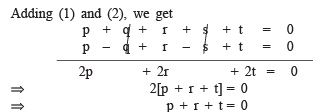
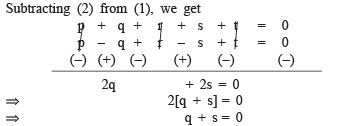
From (4) and (3), we get p + r + t = q + s = 0
Question 6. If x + y = 12 and xy = 27, find the value of x3 + y3.
Solution: Since, (x + y)3 = x3 + y3 + 3xy (x + y)
∴ Substituting x + y = 12 and xy = 27,
we have: (12)3 =x3 + y3 + 3 (27) (12)
⇒ x3 + y3 = 81(12) - 123
= [92 - 122] × 12
= [(9 + 12) (9 - 12)] × 12
= 21 × 3 × 12 = 756
Question 7. If a + b + c = 5 and ab + bc + ca = 10, Then prove that a3 + b3 + c3 - 3abc = -25.
Solution: Since, a3 + b3 + c3 - 3abc
= (a + b + c) (a2 + b2 + c2 - ab - bc - ca)
∴ a3 + b3 + c3 - 3 abc = (a + b + c) [(a2 + b2 + c2 + 2ab+ 2bc+ 2cb) - 3ab - 3bc - 3ca]
= (a + b + c) [(a + b + c)2 - 3 (ab + bc + ca)]
= 5 [ 52 - 3(10)]
= 5[25 - 30]
= 5[-5] = -25
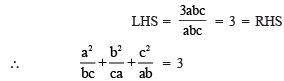
Question 8. If a, b, c are all non-zero and a + b + c = 0, prove that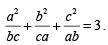
Solution: Since, a + b + c = 0
∴ a3 + b3 + c3 = 3abc ..... (1)
Now, in  = 3, we have
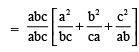 [Multiplying and dividing by 'abc']
 ..... (2)
From (1) and (2), we have
FAQs on Long Answer Type Questions: Polynomials
| 1. What is a polynomial and how is it defined? |  |
| 2. How do we classify polynomials based on the number of terms they have? | |
| 3. What is the degree of a polynomial and how is it determined? | |
| 4. Can a polynomial have negative exponents or fractional exponents? | |
| 5. How can polynomials be used in real-life applications? | |