NCERT Solutions: Coordinate Geometry (Exercise 3.1 & 3.2)

Exercise 3.1
Q1. How will you describe the position of a table lamp on your study table to another person?
Ans:
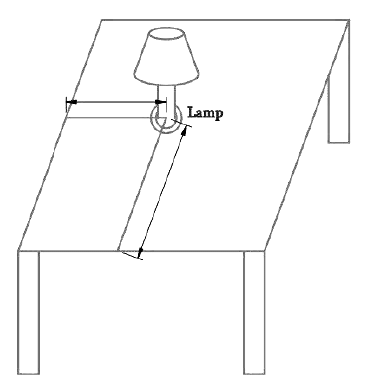
The above figure shows a study table in 3-D with a lamp placed on it.
Now consider only the top surface of the table; this becomes a 2-D rectangular plane.
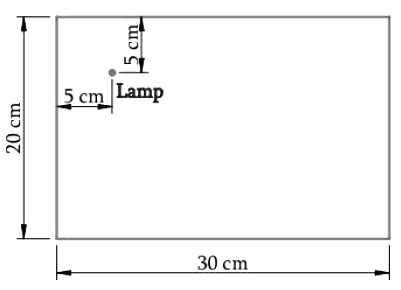
From the figure above,
- Model the lamp as a point.
- Model the top surface of the table as a 2-D plane (a rectangle).
The table measures 20 cm along its shorter side and 30 cm along its longer side.
- We measure the position of the lamp by its distances from the two sides (these play the role of axes).
- Let us assume
- Distance of the lamp from the shorter side is 5 cm.
- Distance of the lamp from the longer side is 15 cm.
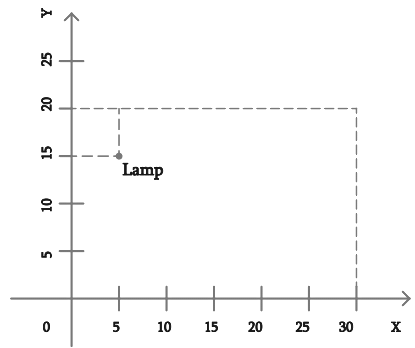
Therefore, if we take the corner nearest those two sides as the origin, the co-ordinates of the lamp (measured in cm) are (5, 15).
Thus the lamp's position can be precisely described by the ordered pair (5, 15).
Q2. (Street Plan): A city has two main roads which cross each other at the center of the city.
These two roads are along the North-South direction and East- West direction.
All the other streets of the city run parallel to these roads and are 200 m apart. There are 5 streets in each direction. Using 1cm = 200 m, draw a model of the city on your notebook. Represent the roads/streets by single lines. There are many cross- streets in your model. A particular cross-street is made by two streets, one running in the North-South direction and another in the East- West direction. Each cross street is referred to in the following manner:
If the 2nd street running in the North-South direction and 5th in the East-West direction meet at some crossing, then we will call this cross-street (2, 5).
Using this convention, find:
(i) How many cross - streets can be referred to as (4, 3).
(ii) How many cross - streets can be referred to as (3, 4).
Ans:
Draw two perpendicular lines to represent the two main roads (North-South and East-West) meeting at the city centre.
Using the scale 1 cm = 200 m, draw the remaining four streets parallel to each main road so that each pair of adjacent streets is 1 cm apart.
Street plan is as shown in the figure:
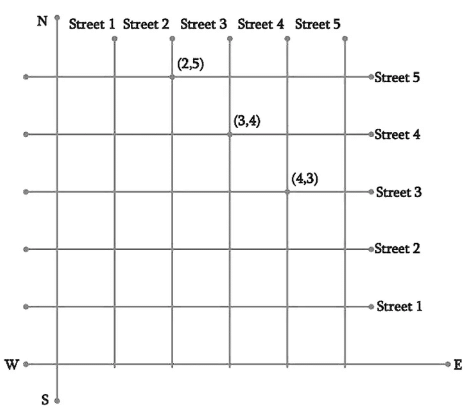
(i) The label (4, 3) denotes the intersection of the 4th North-South street with the 3rd East-West street. This uniquely identifies one crossing. Therefore, there is only one cross-street referred to as (4, 3).
(ii) Similarly, (3, 4) denotes the intersection of the 3rd North-South street with the 4th East-West street, which is also a single unique crossing. Therefore, there is only one cross-street referred to as (3, 4).
Exercise 3.2
Q1. Write the answer of each of the following questions:
(i) What is the name of horizontal and the vertical lines drawn to determine the position of any point in the Cartesian plane?
(ii) What is the name of each part of the plane formed by these two lines?
(iii) Write the name of the point where these two lines intersect.
Ans:
(i) The horizontal line is called the x-axis and the vertical line is called the y-axis.
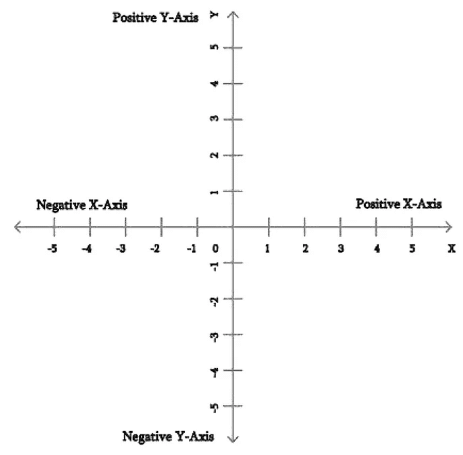
(ii) Each part of the plane formed by the x- and y-axes is called a quadrant.
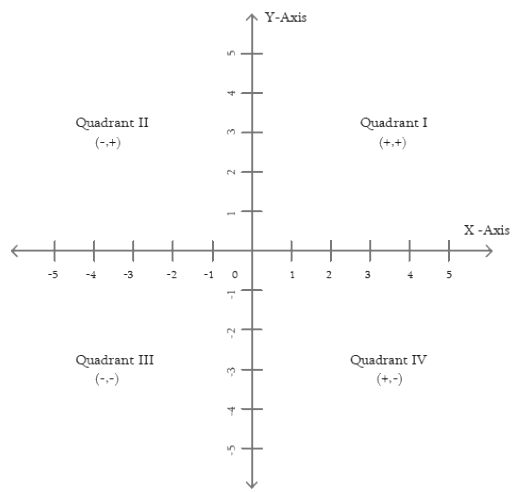
(iii) The point where the x-axis and the y-axis intersect is called the origin (O).
Q2. See the given figure, and write the following:
(i) The coordinates of B.
(ii) The coordinates of C.
(iii) The point identified by the coordinates (-3, -5).
(iv) The point identified by the coordinates (2, -4).
(v) The abscissa of the point D.
(vi) The ordinate of the point H.
(vii) The coordinates of the point L.
(viii) The coordinates of the point M.
Ans:
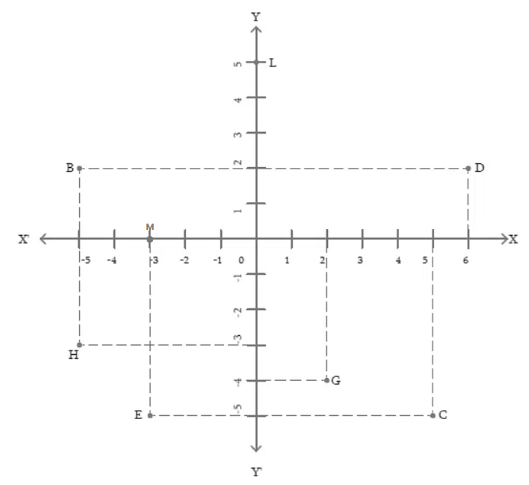
From the figure above,
(i) The coordinates of point B are (-5, 2).
(ii) The coordinates of point C are (5, -5).
(iii) The point having the coordinates (-3, -5) is E.
(iv) The point having the coordinates (2, -4) is G.
(v) The abscissa (x-coordinate) of point D is 6.
(vi) The ordinate (y-coordinate) of point H is -3.
(vii) The coordinates of point L are (0, 5).
(viii) The coordinates of point M are (-3, 0).
FAQs on NCERT Solutions: Coordinate Geometry (Exercise 3.1 & 3.2)
| 1. What is coordinate geometry? |  |
| 2. How is the coordinate plane divided? | |
| 3. What is the formula for the distance between two points in coordinate geometry? | |
| 4. How do you find the slope of a line in coordinate geometry? | |
| 5. What is the equation of a straight line in coordinate geometry? | |





