NCERT Solutions: Linear Equations in Two Variables

Exercise 4.1
Q1. The cost of a notebook is twice the cost of a pen. Write a linear equation in two variables to represent this statement. (Take the cost of a notebook to be ₹ x and that of a pen to be ₹ y)
Ans: Let the cost of a notebook be = ₹ x
Let the cost of a pen be = ₹ y
According to the question,
The cost of a notebook is twice the cost of a pen.
i.e., cost of a notebook = 2×cost of a pen
x = 2 × y
x = 2y
x - 2y = 0
x - 2y = 0 is the linear equation in two variables to represent the statement, 'The cost of a notebook is twice the cost of a pen.'
Q2. Express the following linear equations in the form ax + by + c = 0 and indicate the values of a, b and c in each case:
(i) 2x + 3y= 
Ans: Consider 2x + 3y=  Equation (1)
⇒ 2x + 3y - = 0
Comparing this equation with the standard form of the linear equation in two variables, ax + by + c = 0 we have,
a = 2
b = 3
c = -
(ii) x - (y/5) - 10 = 0
Ans: The equation x -(y/5)-10 = 0 can be written as,
(1)x+(-1/5)y +(-10) = 0
Now comparing x+(-1/5)y+(-10) = 0 with ax+by+c = 0
We get,
a = 1
b = -(1/5)
c = -10
(iii) -2x + 3y = 6
Ans: -2x+3y = 6
Re-arranging the equation, we get,
-2x+3y-6 = 0
The equation -2x+3y-6 = 0 can be written as,
(-2)x+(3)y+(- 6) = 0
Now, comparing (-2)x+(3)y+(-6) = 0 with ax+by+c = 0
We get, a = -2
b = 3
c =-6
(iv) x = 3y
Ans: x = 3y
Re-arranging the equation, we get,
x-3y = 0
The equation x-3y=0 can be written as,
(1)x+(-3)y+(0)c = 0
Now comparing 1x+(-3)y+(0)c = 0 with ax+by+c = 0
We get a = 1
b = -3
c = 0
(v) 2x = -5y
Ans: 2x = -5y
Re-arranging the equation, we get,
2x+5y = 0
The equation 2x+5y = 0 can be written as,
2x+5y+0 = 0
Now, comparing (2)x+(5)y+0= 0 with ax+by+c = 0
We get a = 2
b = 5
c = 0
(vi) 3x + 2 = 0
Ans: 3x+2 = 0
The equation 3x+2 = 0 can be written as,
3x+0y+2 = 0
Now comparing 3x+0+2= 0 with ax+by+c = 0
We get a = 3
b = 0
c = 2
(vii) y-2 = 0
Ans: y-2 = 0
The equation y-2 = 0 can be written as,
(0)x+(1)y+(-2) = 0
Now comparing (0)x+(1)y+(-2) = 0with ax+by+c = 0
We get a = 0
b = 1
c = -2
(viii) 5 = 2x
Ans: 5 = 2x
Re-arranging the equation, we get,
2x = 5
i.e., 2x-5 = 0
The equation 2x-5 = 0 can be written as,
2x+0y-5 = 0
Now comparing 2x+0y-5 = 0 with ax+by+c = 0
We get a = 2
b = 0
c = -5
Exercise 4.2
Q1. Which one of the following options is true, and why?
y = 3x + 5 has
(i) A unique solution
(ii) Only two solutions
(iii) Infinitely many solutions
Ans: Let us substitute different values for x in the linear equation y = 3x + 5,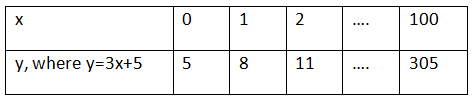
From the table, it is clear that x can have infinite values, and for all the infinite values of x, there are infinite values of y as well.
Hence, (iii) infinitely many solutions is the only option true.
Q2. Write four solutions for each of the following equations:
(i) 2x + y = 7
Ans: To find the four solutions of 2x + y =7 we substitute different values for x and y
Let x = 0:
2(0) + y = 7 ⇒ y = 7 ⇒ (0, 7)
Let x = 1:
2(1) + y = 7 ⇒ 2 + y = 7 ⇒ y = 5 ⇒ (1, 5)
Let y = 1:
2x + 1 = 7 ⇒ 2x = 6 ⇒ x = 3 ⇒ (3, 1)
Let x = 2:
2(2) + y = 7 ⇒ 4 + y = 7 ⇒ y = 3 ⇒ (2, 3)
The four solutions are (0, 7), (1, 5), (3, 1), (2, 3).
(ii) πx + y = 9
Ans: To find the four solutions of πx+y = 9 we substitute different values for x and y
Let x = 0:
π(0) + y = 9 ⇒ y = 9 ⇒ (0, 9)
Let x = 1:
π(1) + y = 9 ⇒ y = 9 - π ⇒ (1, 9 - π)
Let y = 0:
πx + 0 = 9 ⇒ x = 9/π ⇒ (9/π, 0)
Let x = -1:
π(-1) + y = 9 ⇒ -π + y = 9 ⇒ y = 9 + π ⇒ (-1, 9 + π)
The four solutions are (0, 9), (1, 9 - π), (9/π, 0), (-1, 9 + π).
(iii) x = 4y
Ans: To find the four solutions of x = 4y we substitute different values for x and y
Let x = 0:
0 = 4y ⇒ y = 0 ⇒ (0, 0)
Let x = 1:
1 = 4y ⇒ y = 1/4 ⇒ (1, 1/4)
Let y = 4:
x = 4 × 4 ⇒ x = 16 ⇒ (16, 4)
Let y = 1:
x = 4 × 1 ⇒ x = 4 ⇒ (4, 1)
The four solutions are (0, 0), (1, 1/4), (16, 4), (4, 1).
Q3. Check which of the following are solutions of the equation x-2y = 4 and which are not:
(i) (0, 2)
Ans: (x, y) = (0, 2)
Here, x = 0 and y = 2
Substituting the values of x and y in the equation x - 2y = 4, we get,
x - 2y = 4
⟹ 0 - (2 × 2) = 4
But, -4 ≠4
Therefore, (0, 2) is not a solution of the equation x - 2y = 4
(ii) (2, 0)
Ans: (x,y) = (2, 0)
Here, x = 2 and y = 0
Substituting the values of x and y in the equation x - 2y = 4, we get,
x - 2y = 4
⟹ 2-(2 × 0) = 4
⟹ 2 - 0 = 4
But, 2 ≠ 4
(2, 0) is not a solution of the equation x - 2y = 4
(iii) (4, 0)
Ans: (x, y) = (4, 0)
Here, x = 4 and y = 0
Substituting the values of x and y in the equation x - 2y = 4, we get,
x - 2y = 4
⟹ 4 - 2 × 0 = 4
⟹ 4-0 = 4
⟹ 4 = 4
(4, 0) is a solution of the equation x - 2y = 4
(iv) (√2, 4√2)
Ans: (x, y) = (√2, 4√2)
Here, x = √2 and y = 4√2
Substituting the values of x and y in the equation x - 2y = 4, we get,
x -2y = 4
⟹ √2-(2×4√2) = 4
√2-8√2 = 4
But, -7√2 ≠ 4
(√2, 4√2) is not a solution of the equation x - 2y = 4
(v) (1, 1)
Ans: (x, y) = (1, 1)
Here, x = 1 and y = 1
Substituting the values of x and y in the equation x - 2y = 4, we get,
x - 2y = 4
⟹ 1 -(2 × 1) = 4
⟹ 1 - 2 = 4
But, -1 ≠ 4
(1, 1) is not a solution of the equation x-2y = 4
Q4. Find the value of k, if x = 2, y = 1 is a solution of the equation 2x+3y = k.
Ans: The given equation is
2x + 3y = k
According to the question, x = 2 and y = 1.
Now, Substituting the values of x and y in the equation 2x + 3y = k,
We get,
(2 × 2)+(3 × 1) = k
⟹ 4 + 3 = k
⟹ 7 = k
k = 7
The value of k, if x = 2, y = 1 is a solution of the equation 2x + 3y = k, is 7.
FAQs on NCERT Solutions: Linear Equations in Two Variables
| 1. What are linear equations in two variables? |  |
| 2. How do you solve a linear equation in two variables? | |
| 3. What is the importance of linear equations in two variables? | |
| 4. Can linear equations in two variables have more than one solution? | |
| 5. How can linear equations in two variables be graphically represented? | |





