Very Short Answer Type Questions: Linear Equations in Two Variables

Question 1. Show that x = 1, y = 3 satisfy the linear equation 3x - 4y + 9 = 0.
Ans: The ordered pair (1, 3) satisfies the equation.
We have 3x - 4y + 9 = 0.
Putting x = 1 and y = 3,
L.H.S. = 3(1) - 4(3) + 9
= 3 - 12 + 9.
L.H.S. = 0 = R.H.S.
Therefore, x = 1 and y = 3 satisfy the given linear equation.
Question 2. Write whether the following statements are True or False? Justify your answers.
(i) ax + by + c, where a, b and c are real numbers, is a linear equation in two variables.
(ii) A linear equation 2x + 3y = 5 has a unique solution.
(iii) All the points (2, 0), (-3, 0), (4, 2) and (0, 5) lie on the x-axis.
(iv) The line parallel to y-axis at a distance 4 units to the left of y-axis is given by the equation x = -4.
(v) The graph of the equation y = mx + c passes through the origin.
Solution.
(i) Ans: False.
Explanation: For an equation to be a linear equation in two variables of the form ax + by + c = 0, both x and y must appear; thus the coefficients a and b should not be zero simultaneously. If one of them is zero, the equation reduces to a single-variable equation, not a linear equation in two variables.
(ii) Ans: False.
Explanation: The equation 2x + 3y = 5 represents a straight line in the xy-plane. A single linear equation in two variables has infinitely many solutions (all the points on that line), not a unique solution. A unique solution would require two independent linear equations.
(iii) Ans: False.
Explanation: Points on the x-axis have y = 0. Here (2, 0) and (-3, 0) lie on the x-axis, but (0, 5) lies on the y-axis and (4, 2) lies in the first quadrant, so not all the given points lie on the x-axis.
(iv) Ans: True.
Explanation: The line x = -4 is a vertical line four units to the left of the y-axis. Any vertical line parallel to the y-axis at a fixed distance is given by x = constant, so x = -4 is correct.
(v) Ans: False.
Explanation: The line y = mx + c passes through the origin (0, 0) only when c = 0. Substituting x = 0 gives y = c, so for the origin to lie on the line we must have c = 0. In general, when c ≠ 0 the graph does not pass through the origin.
Question 3. Write whether the following statement is True or False? Justify your answer.
The coordinates of points given in the table:

Represent some of the solutions of the equation 2x + 2 = y.
Ans: True.
Explanation: Each pair in the table satisfies y = 2x + 2 because every y-coordinate equals two times the x-coordinate plus two. Therefore the given points are solutions of the equation.
Question 4. Look at the following graphical representation of an equation. Which of the points (0, 0) (0, 4) or (-1, 4) is a solution of the equation?
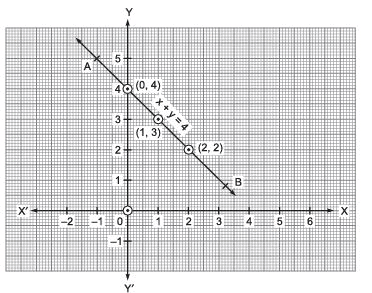
Ans: (0, 4) is a solution of the equation.
Explanation: On the graph the point (0, 4) lies on the line, while (0, 0) and (-1, 4) do not lie on that line.

Question 5. Look at the following graphical representation of an equation. Which of the following is not its solution?
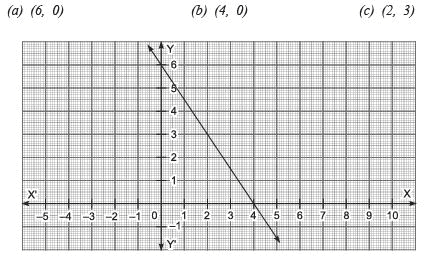
Ans: The point (6, 0) is not a solution of the equation.
Explanation: The point (6, 0) does not lie on the plotted graph, so it does not satisfy the equation. All other listed points lie on the graph and therefore satisfy the equation.
FAQs on Very Short Answer Type Questions: Linear Equations in Two Variables
| 1. What is a linear equation in two variables? |  |
| 2. How many solutions can a linear equation in two variables have? | |
| 3. How do you graph a linear equation in two variables? | |
| 4. Can a linear equation have more than two variables? | |
| 5. How can linear equations in two variables be used in real-life situations? | |





