NCERT Solutions: Introduction to Euclid’s Geometry (Exercise 5.1)

Q1: Which of the following statements are true and which are false? Give reasons for your answers.
(i) Only one line can pass through a single point.
(ii) There are an infinite number of lines which pass through two distinct points.
(iii) A terminated line can be produced indefinitely on both the sides
(iv) If two circles are equal, then their radii are equal.
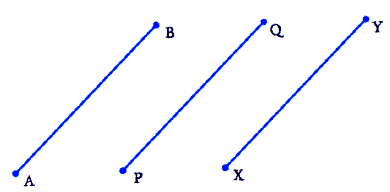
(v) In the following figure, if AB = PQ and PQ = XY, then AB = XY.
Ans: (i) False
Explanation: Through a single point P, infinitely many lines can be drawn by changing the direction of the line while keeping it passing through P. The figure shows several such lines through the same point P, so it is not true that only one line can pass through a single point.
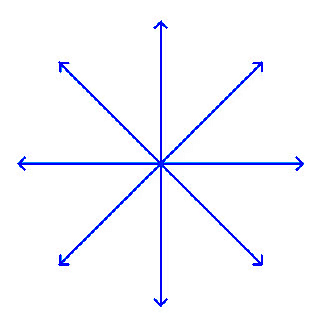
Ans: (ii) False
Explanation: Through two distinct points P and Q only one straight line can be drawn that passes through both. The figure shows the single line joining P and Q. Thus there are not infinitely many lines through two distinct points; there is exactly one.

Ans: (iii) True
Explanation: A terminated line (a line segment) has two end-points, but it can be extended (produced) indefinitely in both directions to form a complete straight line. If AB is a line segment, producing it on both sides gives a line that continues without end.

Ans: (iv) True
Explanation: If two circles are equal, they coincide in size. Equality of circles means they have the same radius. Thus the radii of equal circles are equal.
Ans: (v) True
Explanation: Given AB = PQ and PQ = XY, by the transitive property of equality (Euclid's first axiom: things equal to the same thing are equal to one another), AB = XY. Here AB, PQ and XY are line segments; if both AB and XY are equal to the same segment PQ, then AB and XY are equal to each other.
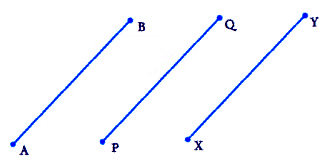
Q2: Give a definition for each of the following terms. Are there other terms that need to be defined first? What are they, and how might you define them?
(i) parallel lines
(ii) perpendicular lines
(iii) line segment
(iv) radius of a circle
(v) square
Ans: Yes, we need to have an idea about the terms point, line, ray, angle, plane, circle and quadrilateral before defining the required terms.
Point: A point is represented by a small dot on paper; it has no size, only position.
Line: A line is straight and extends indefinitely in both directions. It has no end-points and no definite length; arrowheads on both ends indicate it continues without end.
Note: In geometry, a line means the entire straight path that extends without end in both directions. A perfect physical line cannot be drawn; we use arrows to indicate indefinite extension.
Ray: A ray is part of a line with one end-point and extends indefinitely in one direction. It has no definite length.
Angle: Two rays sharing a common end-point form an angle.
Plane: A plane is a flat surface such that the line joining any two points on it lies entirely in the plane.
Circle: A circle is the set of all points in a plane that are at the same distance from a fixed point called the centre.
Quadrilateral: A quadrilateral is a closed figure made of four line segments.
Definitions of the required terms are given below:
(i) Parallel Lines:
- If the perpendicular distance between two lines is always constant, they are called parallel lines.
- Equivalently, lines that never meet (do not intersect) are parallel.
- To understand parallel lines, one must know the concepts of point, line and distance between lines.
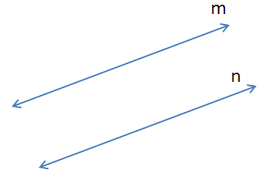
Note: The distance between two parallel lines remains the same at every point.
(ii) Perpendicular Lines:
- Two lines that intersect each other at 90∘ are called perpendicular lines.
- To define perpendicular lines, one needs the ideas of a line and of a right angle.
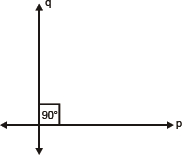
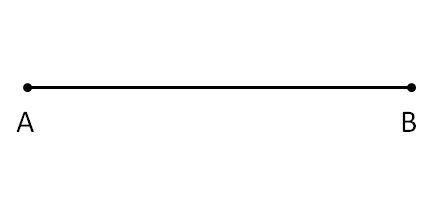
(iii) Line Segment: A line segment is a part of a line with definite length and two end-points. For example, a segment with end-points A and B is written as or
or
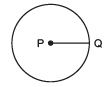
(iv) Radius of a Circle:
- The radius of a circle is the distance from its centre to any point on the circle.
- To define radius, one must know what a point and a circle are.
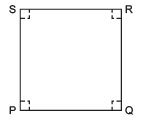
(v) Square: A square is a quadrilateral with all four sides equal and all four angles right angles. In the figure, PQRS is a square.
Q3. Consider two 'postulates' given below:
(i) Given any two distinct points A and B, there exists a third point C which is in between A and B.
(ii) There exist at least three points that are not on the same line.
Do these postulates contain any undefined terms? Are these postulates consistent?
Do they follow Euclid's postulates? Explain.
Ans:
Undefined terms: Yes. The postulates use undefined terms such as point and between without giving precise definitions inside the postulates. It is not specified whether the point C lies on the line segment AB or lies elsewhere, and the plane in which the points lie is not stated.
Consistency: The postulates are consistent, provided we interpret them reasonably. Two consistent interpretations are:
- C lies on the line segment AB and is between A and B; or
- C does not lie on the segment AB (in which case the statement would be false unless clarified).
Do they follow Euclid's postulates? No. These particular postulates do not match Euclid's five postulates. They are closer to axioms or statements proposed for a system, but they are not the same as Euclid's postulates which specify, for example, that a straight line can be drawn joining any two points and that a finite straight line can be produced indefinitely.
Q4. If a point C lies between two points A and B such that AC = BC, then prove that AC = (1/2)AB. Explain by drawing the figure.
Ans: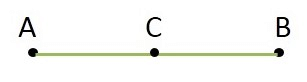
Given AC = BC.
Adding AC to both sides gives:
AC + AC = BC + AC
2 AC = BC + AC
But BC + AC = AB (since C lies between A and B and AC + CB = AB).
Therefore 2 AC = AB.
Dividing both sides by 2 gives AC = (1/2) AB.
Hence proved.
Q5. In Question 4, point C is called a mid-point of line segment AB. Prove that every line segment has one and only one mid-point.
Ans:
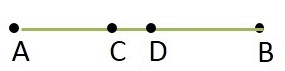
Let AB be a line segment. Suppose, for contradiction, there are two mid-points C and D of AB.
Since C is a mid-point, AC = CB. (1)
Since D is a mid-point, AD = DB. (2)
Subtract (2) from (1): (AC - AD) = (CB - DB).
Left side equals CD and right side equals CD with opposite sign, so CD = -CD.
This gives 2·CD = 0, hence CD = 0.
Thus C and D coincide. Therefore a line segment has exactly one mid-point.
Q6. In the figure, given below, if AC = BD, then prove that AB = CD.
Ans:
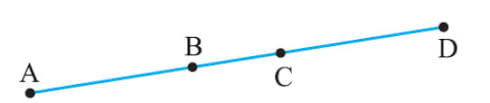
Given AC = BD.
From the figure, AC = AB + BC.
Also BD = BC + CD.
Since AC = BD, we have AB + BC = BC + CD.
Subtract BC from both sides (Euclid's axiom: when equals are subtracted from equals, remainders are equal):
AB + BC - BC = BC + CD - BC
Therefore AB = CD.
Hence proved.
Q7. Why is Axiom 5, in the list of Euclid's axioms, considered a 'universal truth'? (Note that the question is not about the fifth postulate.)
Ans:
Axiom 5 states that the whole is greater than the part.
This is considered a universal truth because it applies in every context, not just mathematics.
Case I (mathematics): Let t be a whole quantity and suppose t = a + b + c where a, b and c are parts. Then t is greater than each part a, b and c.
Case II (everyday example): Consider the continent Asia and one country India which lies in Asia. Asia (the whole) is greater than India (a part). This shows the axiom holds in general situations as well.
Therefore, the statement "the whole is greater than the part" is a universal truth.
FAQs on NCERT Solutions: Introduction to Euclid’s Geometry (Exercise 5.1)
| 1. What is Euclid's Geometry? |  |
| 2. What are the axioms in Euclid's Geometry? | |
| 3. How is Euclid's Geometry different from non-Euclidean geometry? | |
| 4. What are the main components of Euclid's Geometry? | |
| 5. How is Euclid's Geometry relevant in today's world? | |





