CBSE Class 9  >  Class 9 Notes  >  Mathematics (Maths)   >  Long Answer Type Questions: Lines & Angles

Long Answer Type Questions: Lines & Angles

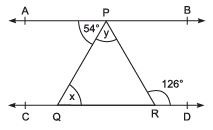
Q1:  In the adjoining  figure, AB || CD. If ∠ APQ = 54° and ∠ PRD = 126°, then find x and y.
 Solution: 
∵ AB || CD and PQ is a transversal, then interior alternate angles are equal.
Long Answer Type Questions: Lines & Angles

⇒ ∠ APQ = ∠ PQR  [alt. interior angles]
⇒ 54° = x       [∵ ∠ APQ = 54° (Given)]
Again, AB || CD and PR is a transversal, then ∠ APR = ∠ PRD    [Interior alternate angles]
But ∠ PRD = 126°        [Given]
∴ ∠ APR = 126°
Now, exterior∠ PRD + ∠ PRQ = 180°
⇒ 126°+∠ PRQ = 180°
⇒∠ PRQ= 180°-126° = 54°

In triangle PQR ,

∠ PQR + ∠ PRQ + ∠ QPR =  180° ( Angle sum property) 

54°+ 54° +∠ QPR= 180°

108+ ∠ QPR =180°

∠ QPR =180°-108° = 72° 
Thus, x = 54° and y = 72°.


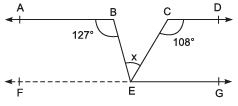
Q2: In the adjoining figure AB || CD || EG, find the value of x.
 Solution:
Let us draw FEG || AB || CD through E.
Now, since FE || AB and BE are transversals,
∴ ∠ ABE + ∠ BEF = 180°
[Interior opposite angles]
Long Answer Type Questions: Lines & Angles

⇒ 127° + ∠ BEF = 180°  [co int. angles] 
⇒ ∠ BEF = 180° - 127° = 53°
Again, EG || CD and CE is a transversal.
∴ ∠ DCE + ∠ CEG = 180°          [Interior opposite angles]
⇒ 108° + ∠ CEG = 180° ⇒ ∠ CEG = 180° - 108° = 72°
Since FEG is a straight line, then
⇒ ∠BEF + ∠BEC + ∠CEG = 180°                 [Sum of angles at a point on the same side of a line = 180°]
⇒ 53° + x + 72° = 180°
⇒ x = 180° - 53° - 72°
= 55°
Thus, the required measure of x = 55°.

Q3: AB and CD are parallel, and EF is a transversal. If ∠BEF = 70°, find ∠EFD and ∠CFE

Ans: Since AB || CD and EF is a transversal, by the Corresponding Angles Theorem:

∠BEF = ∠EFD

Thus, ∠EFD = 70°.

By the Linear Pair Axiom:

∠EFD + ∠CFE = 180°

70° + ∠CFE = 180°

∠CFE = 110°.

So, ∠EFD = 70° and ∠CFE = 110°.

Q4:  If two parallel lines are intersected by a transversal, prove that the bisectors of the two pairs of interior angles enclose a rectangle.

Ans: Long Answer Type Questions: Lines & Angles
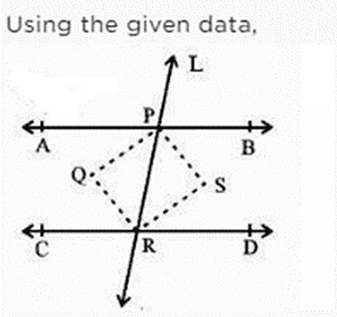
Two parallel lines AB and CD are intersected by a transversal L at P and R

respectively

PQ, RQ, RS and PS are bisectors of ∠APR, ∠PRC, ∠PRD and ∠BPR respectively.

Since AB || CD and L is a transversal

∠APR = ∠PRD ( alt. interior angles)

∠APQ = 1/2(∠PRD)  = ∠QPR = ∠PRS

these are alternate interior angles.

QP || RS. Similarly QR || PS.

PQRS is a parallelogram.

Also ray PR stands on AB

∠APR + ∠BPR = 180° ( linear pair)

∠QPR + (1/2) ∠BPR = 90°

∠QPR + ∠SPR = 90° 

∠QPS = 90°

Therefore PQRS is a parallelograrn, one of whose angle is 90°.

Hence PQRS satisfies all the properties of being a rectangle.

Hence PQRS is a rectangle

Q5: In the given figure, AOC is a line, find x. Long Answer Type Questions: Lines & Angles

Ans: AOC is a straight line 

∠AOB + ∠BOC= 180°

60 + 3x = 180°

3x = 180 - 60 

x = 120/ 3 

x= 40°

The document Long Answer Type Questions: Lines & Angles is a part of the Class 9 Course Mathematics (Maths) Class 9.
All you need of Class 9 at this link: Class 9

FAQs on Long Answer Type Questions: Lines & Angles

1. What are the basic types of angles and their properties?
Ans. The basic types of angles include acute angles (less than 90 degrees), right angles (exactly 90 degrees), obtuse angles (greater than 90 degrees but less than 180 degrees), straight angles (exactly 180 degrees), reflex angles (greater than 180 degrees but less than 360 degrees), and full angles (exactly 360 degrees). Each type of angle has distinct properties that influence their relationships with other angles, such as complementary angles (two angles that add up to 90 degrees) and supplementary angles (two angles that add up to 180 degrees).
2. How do you find the measure of an unknown angle in a triangle?
Ans. The sum of the interior angles in a triangle is always 180 degrees. To find the measure of an unknown angle, you can subtract the sum of the known angles from 180 degrees. For example, if a triangle has angles measuring 50 degrees and 70 degrees, the measure of the unknown angle can be calculated as 180 - (50 + 70) = 60 degrees.
3. What is the relationship between parallel lines and angles formed by a transversal?
Ans. When a transversal intersects two parallel lines, several pairs of angles are formed, including corresponding angles, alternate interior angles, and consecutive interior angles. Corresponding angles are equal, alternate interior angles are equal, and consecutive interior angles are supplementary (add up to 180 degrees). These relationships are essential for solving problems involving parallel lines and transversals.
4. How can we prove that two lines are parallel using angles?
Ans. To prove that two lines are parallel, you can use angle relationships formed by a transversal. If you can show that either corresponding angles are equal, alternate interior angles are equal, or consecutive interior angles are supplementary, then you can conclude that the two lines are parallel based on the converse of the respective angle theorems.
5. What are complementary and supplementary angles, and how can they be identified?
Ans. Complementary angles are two angles whose measures add up to 90 degrees, while supplementary angles are two angles whose measures add up to 180 degrees. To identify them, you can measure the angles with a protractor or use algebraic expressions to set up equations. For example, if one angle measures x degrees, its complement can be represented as (90 - x) degrees, and its supplement can be represented as (180 - x) degrees.
Explore Courses for Class 9 exam
Get EduRev Notes directly in your Google search
Related Searches
Viva Questions, pdf , Long Answer Type Questions: Lines & Angles, Semester Notes, Summary, Previous Year Questions with Solutions, Extra Questions, study material, MCQs, mock tests for examination, Exam, Sample Paper, video lectures, Long Answer Type Questions: Lines & Angles, practice quizzes, shortcuts and tricks, Long Answer Type Questions: Lines & Angles, ppt, Important questions, past year papers, Objective type Questions, Free;


