Facts that Matter: Pair of Linear Equations in Two Variables


Linear Equation in Two Variable
A relation in two variables that can be written in the form
\(ax + by + c = 0\)
where a, b and c are real numbers and at least one of a or b is non-zero, is called a linear equation in two variables. The variables are usually denoted by x and y.
General Form of a Pair of Linear Equations in Two Variables
A pair of linear equations in two variables is written as
\(a_{1}x + b_{1}y + c_{1} = 0\)
\(a_{2}x + b_{2}y + c_{2} = 0\)
where \(a_{1}, b_{1}, c_{1}, a_{2}, b_{2}, c_{2}\) are real numbers and for each equation the coefficients of \(x\) and \(y\) are not both zero.
Solution of a Pair of Linear Equations in Two Variables
A solution of the pair of linear equations in two variables is an ordered pair \((x,y)\) which satisfies both equations simultaneously. Geometrically, each linear equation represents a straight line in the plane; a solution corresponds to a point common to both lines.
There are three algebraic possibilities for solutions of a pair of linear equations:
- Exactly one solution (the two lines intersect at a single point).
- No solution (the two lines are parallel and distinct).
- Infinitely many solutions (the two lines coincide).
There are three standard algebraic methods to solve a pair of linear equations and a graphical method.

Algebraic Methods
Each method is useful in different situations; choose the one which simplifies calculations for the given coefficients.
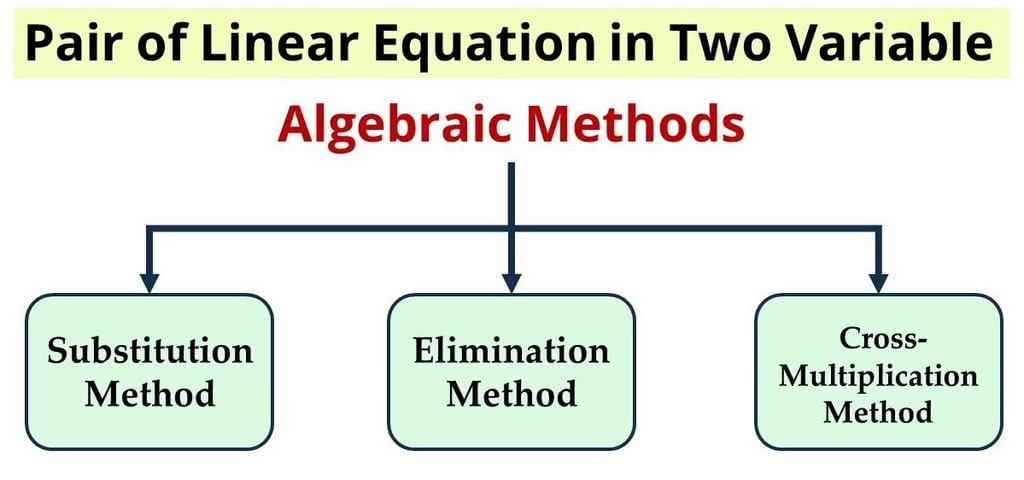 Types of Algebraic Methods
Substitution Method
Step 1: Solve one of the equations for one variable (for example, express \(y\) in terms of \(x\)).
Step 2: Substitute this expression into the other equation to obtain an equation in one variable and solve it.
Final Step: Substitute the found value back into the earlier expression to obtain the remaining variable.
Example: Solve the pair of equations using substitution method
\(x + y = 5\)
\(x - y = 1\)
Sol.
Express \(y\) in terms of \(x\) from the first equation.
\(y = 5 - x\)
Substitute \(y = 5 - x\) into the second equation.
\(x - (5 - x) = 1\)
Simplify the equation.
\(x - 5 + x = 1\)
\(2x - 5 = 1\)
\(2x = 6\)
\(x = 3\)
Substitute \(x = 3\) into \(y = 5 - x\).
\(y = 5 - 3\)
\(y = 2\)
Answer: \((x,y) = (3,2)\).
Elimination Method
Step 1: Multiply the equations by suitable constants so the coefficients of one variable become equal in magnitude.
Step 2: Add or subtract the equations to eliminate that variable and obtain an equation in one variable.
Step 3: Solve the single variable equation.
Final Step: Substitute this value into one of the original equations to find the other variable.
Example: Solve the pair of equations using Elimination method
\(2x + 3y = 13\)
\(3x - 2y = 4\)
Sol.
Multiply the first equation by 3 and the second by 2 so that coefficients of \(x\) match:
\(6x + 9y = 39\)
\(6x - 4y = 8\)
Subtract the second equation from the first to eliminate \(x\).
\((6x + 9y) - (6x - 4y) = 39 - 8\)
\(13y = 31\)
\(y = \dfrac{31}{13} = \dfrac{31}{13}\)
Substitute \(y\) into the original first equation.
\(2x + 3\left(\dfrac{31}{13}\right) = 13\)
\(2x + \dfrac{93}{13} = 13\)
\(2x = 13 - \dfrac{93}{13}\)
\(2x = \dfrac{169 - 93}{13}\)
\(2x = \dfrac{76}{13}\)
\(x = \dfrac{38}{13}\)
Answer: \(\left(\dfrac{38}{13}, \dfrac{31}{13}\right)\).
Determinant Method (Cramer's Rule)
Write the pair in the form
\(a_{1}x + b_{1}y = -\,c_{1}\)
\(a_{2}x + b_{2}y = -\,c_{2}\)
Define the determinant
\(\Delta = \begin{vmatrix} a_{1} & b_{1} \\[4pt] a_{2} & b_{2} \end{vmatrix} = a_{1}b_{2} - a_{2}b_{1}\)
Also define
\(\Delta_{x} = \begin{vmatrix} -c_{1} & b_{1} \\[4pt] -c_{2} & b_{2} \end{vmatrix} = -c_{1}b_{2} + c_{2}b_{1}\)
\(\Delta_{y} = \begin{vmatrix} a_{1} & -c_{1} \\[4pt] a_{2} & -c_{2} \end{vmatrix} = -a_{1}c_{2} + a_{2}c_{1}\)
If $\Delta \neq 0$, the system has a unique solution.
\(x = \dfrac{\Delta_{x}}{\Delta}\)
\(y = \dfrac{\Delta_{y}}{\Delta}\)
If \(\Delta = 0\) and at least one of \(\Delta_x, \Delta_y\) is non-zero, the system has no solution.
If \(\Delta = 0\) and \(\Delta_x = \Delta_y = 0\), the system has infinitely many solutions.
Example: Solve the pair of equations using Determinant Method
\(2x + y = 5\)
\(3x - 2y = 4\)
Sol.
Write constants on right side:
\(2x + y = 5\)
\(3x - 2y = 4\)
Compute determinant \(\Delta\).
\(\Delta = \begin{vmatrix} 2 & 1 \\[4pt] 3 & -2 \end{vmatrix} = 2(-2) - 3(1) = -4 - 3 = -7\)
Compute \(\Delta_x\).
\(\Delta_x = \begin{vmatrix} 5 & 1 \\[4pt] 4 & -2 \end{vmatrix} = 5(-2) - 4(1) = -10 - 4 = -14\)
Compute \(\Delta_y\).
\(\Delta_y = \begin{vmatrix} 2 & 5 \\[4pt] 3 & 4 \end{vmatrix} = 2(4) - 3(5) = 8 - 15 = -7\)
Since $\Delta \neq 0$, find \(x\) and \(y\).
\(x = \dfrac{\Delta_x}{\Delta} = \dfrac{-14}{-7} = 2\)
\(y = \dfrac{\Delta_y}{\Delta} = \dfrac{-7}{-7} = 1\)
Answer: \((2,1)\).
Graphical Method
Each linear equation represents a straight line in the plane. The nature of the solution set corresponds to how the two lines relate.
- If the two lines intersect at one point, the system has a unique solution: the coordinates of the intersection point.
- If the two lines are parallel and distinct, they have no common point and the system has no solution (the system is inconsistent).
- If the two lines coincide (are the same line), every point on the line satisfies both equations and the system has infinitely many solutions (the system is dependent and consistent).
Consistency: Conditions and Tests
Consider the pair:
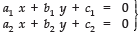
The following three situations may arise.
(i) If

then the system is consistent and has a unique solution.
(ii) If
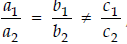
then the system is inconsistent and has no solution.
(iii) If
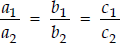
then the system is dependent and consistent (infinitely many solutions).
FAQs on Facts that Matter: Pair of Linear Equations in Two Variables
| 1. What is a pair of linear equations in two variables? |  |
| 2. How can we solve a pair of linear equations in two variables? | |
| 3. What is the substitution method for solving a pair of linear equations in two variables? | |
| 4. How does the elimination method work for solving a pair of linear equations in two variables? | |
| 5. What is the graphical method for solving a pair of linear equations in two variables? | |