NCERT Solutions: Heron’s Formula (Exercise 10.1)

Q1. A traffic signal board, indicating 'SCHOOL AHEAD', is an equilateral triangle with side 'a'. Find the area of the signal board, using Heron's formula. If its perimeter is 180 cm, what will be the area of the signal board?
Ans: For an equilateral triangle with side 'a', area = (√3/4) a2
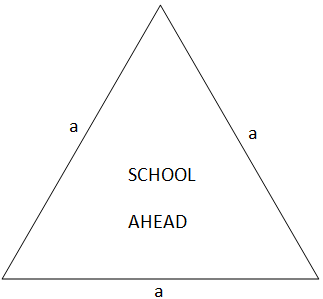
∵ Each side of the triangle = a cm
The perimeter of the signal board will be
∴ a + a + a = 180 cm
3a = 180 cm
a = (180/3) = 60 cm
Now, Semi-perimeter (s)= (180/2) = 90 cm
∵ Area of the triangle
Area of the given triangle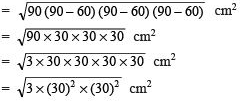
= 30 x 30 x√3 = 900√3 cm2
Thus, the area of the given triangle = 900√3 cm2.
Q2. The triangular side walls of a flyover have been used for advertisements. The sides of the walls are 122 m, 22 m and 120 m (see Fig). The advertisements yield an earning of ₹ 5000 per m2 per year. A company hired one of its walls for 3 months. How much rent did it pay?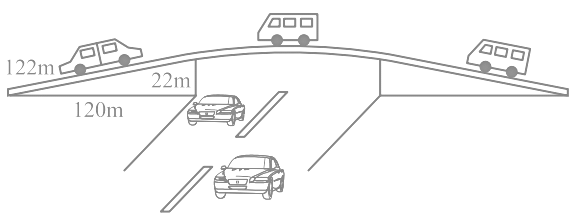 Ans: The sides of the triangular wall are a = 122 m, b = 120 m and c = 22 m.
Now, the perimeter will be
∴
∵ The area of a triangle is given by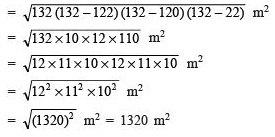
∵ Rent for 1 year (i.e. 12 months) per m2 = Rs 5000
∴ Rent for 3 months per m2 = Rs 5000 x (3/12)
⇒ Rent for 3 months for 1320 m2 = 5000 x (3/12) x 1320 = 5000 x 3 x 110
= Rs 16,50,000.
Q3. There is a slide in a park. One of its side walls has been painted in some colour with the message "KEEP THE PARK GREEN AND CLEAN" (see Fig). If the sides of the wall are 15 m, 11 m and 6 m, find the area painted in colour.
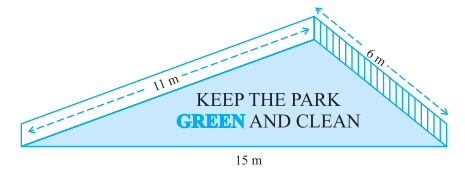
Ans: The sides of the wall are a = 15 m, b = 11 m, and c = 6 m.
∴
The area of the triangular surface of the wall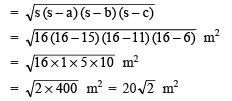
Thus, the required area painted in colour = 20√2 m2.
Q4. Find the area of a triangle, two sides of which are 18 cm and 10 cm and the perimeter is 42 cm.
Ans: To find the area of a triangle with two sides measuring 18 cm and 10 cm, and a perimeter of 42 cm, we first identify the sides: Let the sides of the triangle be a = 18 cm, b = 10 cm, and c = ?.
∵ Perimeter (2s) = 42 cm
Semi-parameter or s = (42/2) = 21 cm
c = Perimeter - (side a + side b)
c = 42 - (18 + 10) cm = 14 cm
∵ Area of a triangle = 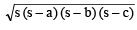
∴ Area of the given triangle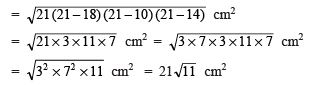
Thus, the required area of the triangle = 21√11 cm2.
Q5. Side of a triangle is in the ratio of 12: 17: 25 and its perimeter is 540 cm. Find its area.
Ans: The perimeter of the triangle = 540 cm.
Semi-perimeter of the triangle, s= (540/2) = 270 cm
∵ The sides are in the ratio of 12: 17: 25.
∴ Let the sides be a = 12x cm, b = 17x cm and c = 25x cm.
12x + 17x + 25x = 540
54x = 540
x = (540/54) = 10
∴ a = 12 x 10 = 120 cm, b = 17 x 10 = 170 cm, c = 25 x 10 = 250 cm.
(s - a) = (270 - 120) cm = 150 cm
(s - b) = (270 - 170) cm = 100 cm
(s - c) = (270 - 250) cm = 20 cm
∴ Area of the triangle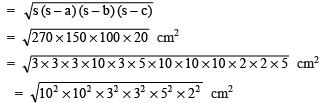
= 10 x 10 x 3 x 3 x 5 x 2 cm2 = 9,000 cm2
Thus, the required area of the triangle = 9,000 cm2.
Q6. An isosceles triangle has a perimeter of 30 cm and each of the equal sides is 12 cm. Find the area of the triangle.
Ans: Equal sides of the triangle are 12 cm each.
Let the third side = x cm.
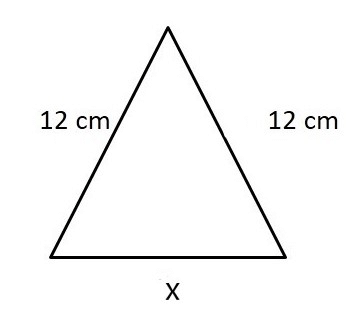 ∵ Perimeter = 30 cm
∴ 12 cm + 12 cm + x cm = 30 cm
x = 30 - 12 - 12 = 6 cm
Semi-perimeter = (30/2) cm = 15 cm
∴ Area of the triangle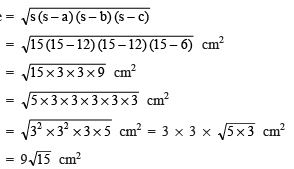
Thus, the required area of the triangle = 9√15 cm2.
FAQs on NCERT Solutions: Heron’s Formula (Exercise 10.1)
| 1. How do I use Heron's formula to find the area of a triangle when I only know the three sides? |  |
| 2. Why does Heron's formula sometimes give me a different answer than the base-height method? | |
| 3. Can I apply Heron's formula to find areas of quadrilaterals or only triangles? | |
| 4. What's the semi-perimeter in Heron's formula and why is it so important? | |
| 5. How do I check if three given side lengths can actually form a valid triangle before using Heron's formula? | |





