NCERT Solutions: Pair of Linear Equations in Two Variables (Exercise 3.2)

Q1: Solve the following pair of linear equations by the substitution method
(i) x + y = 14
x - y = 4
Sol: Given,
x + y = 14 and x - y = 4 are the two equations.
From 1st equation, we get, x = 14 - y
Now, substitute the value of x in second equation to get,
(14 - y) - y = 4
14 - 2y = 4
2y = 10
Or y = 5
By the value of y, we can now find the exact value of x;
∵ x = 14 - y
∴ x = 14 - 5 Or x = 9
Hence, x = 9 and y = 5.
(ii) s - t = 3
(s / 3) + (t / 2) = 6
Sol: Given,
s - t = 3 and (s / 3) + (t / 2) = 6 are the two equations.
From 1st equation, we get, s = 3 + t .......(1)
Now, substitute the value of s in second equation to get,
(3 + t) / 3 + (t / 2) = 6
⇒ (2(3 + t) + 3t ) / 6 = 6
⇒ (6 + 2t + 3t) / 6 = 6
⇒ (6 + 5t) = 36
⇒ 5t = 30
⇒ t = 6
Now, substitute the value of t in equation (1)
s = 3 + 6 = 9
Therefore, s = 9 and t = 6.
(iii) 3x - y = 3
9x - 3y = 9
Sol: Given,
3x - y = 3 and 9x - 3y = 9 are the two equations.
From 1st equation, we get,
x = (3 + y) / 3
Now, substitute the value of x in the given second equation to get,
9(3 + y) / 3 - 3y = 9
⇒ 9 + 3y - 3y = 9
⇒ 9 = 9
Therefore, y has infinite values and since, x = (3 + y) / 3, so x also has infinite values.
(iv) 0.2x + 0.3y = 1.3
0.4x + 0.5y = 2.3
Sol: Given,
0.2x + 0.3y = 1.3 and 0.4x + 0.5y = 2.3 are the two equations.
From 1st equation, we get,
x = (1.3 - 0.3y) / 0.2 .......(1)
Now, substitute the value of x in the given second equation to get,
0.4(1.3 - 0.3y) / 0.2 + 0.5y = 2.3
⇒ 2(1.3 - 0.3y) + 0.5y = 2.3
⇒ 2.6 - 0.6y + 0.5y = 2.3
⇒ 2.6 - 0.1 y = 2.3
⇒ 0.1 y = 0.3
⇒ y = 3
Now, substitute the value of y in equation (1), we get,
x = (1.3 - 0.3(3)) / 0.2 = (1.3 - 0.9) / 0.2 = 0.4 / 0.2 = 2
Therefore, x = 2 and y = 3.
(v) √2 x + √3 y = 0
√3 x - √8 y = 0
Sol: Given,
√2 x + √3 y = 0 and √3 x - √8 y = 0
are the two equations.
From 1st equation, we get,
x = - (√3 / √2)y ..........(1)
Putting the value of x in the given second equation to get,
√3(-√3 / √2)y - √8y = 0
⇒ (-3 / √2)y - √8 y = 0
⇒ y = 0
Now, substitute the value of y in equation (1), we get,
x = 0
Therefore, x = 0 and y = 0.
(vi) (3x / 2) - (5y / 3) = -2
(x / 3) + (y / 2) = (13 / 6)
Sol: Given,
(3x / 2) - (5y / 3) = -2 and (x / 3) + (y / 2) = 13 / 6 are the two equations.
From 1st equation, we get,
(3 / 2)x = -2 + (5y / 3)
⇒ x = 2(-6 + 5y) / 9 = (-12 + 10y) / 9 ............(1)
Putting the value of x in the given second equation to get,
((-12 + 10y) / 9) / 3 + y / 2 = 13 / 6
⇒ y / 2 = 13 / 6 - ((-12 + 10y) / 27 ) + y / 2 = 13 / 6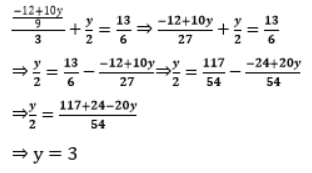
Now, substitute the value of y in equation (1), we get,
(3x / 2) - 5(3) / 3 = -2
⇒ (3x / 2) - 5 = -2
⇒ x = 2
Therefore, x = 2 and y = 3.
Q2: Solve 2x + 3y = 11 and 2x - 4y = - 24 and hence find the value of 'm' for which y = mx + 3.
Sol: 2x + 3y = 11..................(I)
2x - 4y = -24...............(II)
From equation (II), we get
x = (11 - 3y) / 2 ...................(III)
Substituting the value of x in equation (II), we get
2(11 - 3y) / 2 - 4y = 24
11 - 3y - 4y = -24
-7y = -35
y = 5.....................(IV)
Putting the value of y in equation (III), we get
x = (11 - 3 × 5) / 2 = -4 / 2 = -2
Hence, x = -2, y = 5
Also,
y = mx + 3
5 = -2m +3
-2m = 2
m = -1
Therefore the value of m is -1.
Q3: Form the pair of linear equations for the following problems and find their solution by substitution method.
(i) The difference between two numbers is 26 and one number is three times the other. Find them.
Sol: Let the two numbers be x and y respectively, such that y > x.
According to the question,
y = 3x .................. (1)
y - x = 26 ..............(2)
Substituting the value of (1) into (2), we get
3x - x = 26
x = 13 ................ (3)
Substituting (3) in (1), we get y = 39
Hence, the numbers are 13 and 39.
(ii) The larger of two supplementary angles exceeds the smaller by 18 degrees. Find them.
Sol: Let the larger angle by xº and smaller angle be yº.
We know that the sum of two supplementary pair of angles is always 180º.
According to the question,
x + y = 180º................ (1)
x - y = 18º .................(2)
From (1), we get x = 180º - y ............. (3)
Substituting (3) in (2), we get
180º - y - y =18º
162º = 2y
y = 81º .............. (4)
Using the value of y in (3), we get
x = 180º - 81º
= 99º
Hence, the angles are 99º and 81º.
(iii) The coach of a cricket team buys 7 bats and 6 balls for Rs.3800. Later, she buys 3 bats and 5 balls for Rs.1750. Find the cost of each bat and each ball.
Solution: Let the cost a bat be x and cost of a ball be y.
According to the question,
7x + 6y = 3800 ................... (I)
3x + 5y = 1750 ................... (II)
From (I), we get
y = (3800 - 7x) / 6....................(III)
Substituting (III) in (II). we get,
3x + 5(3800 - 7x) / 6 =1750
⇒ 3x + 9500 / 3 - 35x / 6 = 1750
⇒ 3x - 35x / 6 = 1750 - 9500 / 3
⇒ (18x - 35x) / 6 = (5250 - 9500) / 3
⇒ -17x / 6 = -4250 / 3
⇒ -17x = -8500
x = 500 ............................. (IV)
Substituting the value of x in (III), we get
y = (3800 - 7 × 500) / 6 = 300 / 6 = 50
Hence, the cost of a bat is Rs 500 and cost of a ball is Rs 50.
(iv) The taxi charges in a city consist of a fixed charge together with the charge for the distance covered. For a distance of 10 km, the charge paid is Rs 105 and for a journey of 15 km, the charge paid is Rs 155. What are the fixed charges and the charge per km? How much does a person have to pay for travelling a distance of 25 km?
Solution: Let the fixed charge be Rs x and per km charge be Rs y.
According to the question,
x + 10y = 105 ................. (1)
x + 15y = 155 ................. (2)
From (1), we get x = 105 - 10y ................... (3)
Substituting the value of x in (2), we get
105 - 10y + 15y = 155
5y = 50 y = 10 ................. (4)
Putting the value of y in (3), we get
x = 105 - 10 × 10 = 5
Hence, fixed charge is Rs 5 and per km charge = Rs 10
(v) A fraction becomes 9 / 11, if 2 is added to both the numerator and the denominator. If, 3 is added to both the numerator and the denominator it becomes 5 / 6. Find the fraction.
Solution: Let the fraction be x / y.
According to the question,
(x + 2) / (y + 2) = 9 / 11
11x + 22 = 9y + 18
11x - 9y = -4 ................. (1)
(x + 3) / (y + 3) = 5 / 6
6x + 18 = 5y +15
6x - 5y = -3 ................... (2)
From (1), we get x = (-4 + 9y) / 11 ................. (3)
Substituting the value of x in (2), we get
6(-4 + 9y) / 11 - 5y = -3
-24 + 54y - 55y = -33
-y = -9
y = 9 ..................... (4)
Substituting the value of y in (3), we get
x = (-4 + 9 × 9 ) / 11 = 7
Hence the fraction is 7 / 9.
(vi) Five years hence, the age of Jacob will be three times that of his son. Five years ago, Jacob's age was seven times that of his son. What are their present ages?
Solution: Let the age of Jacob and his son be x and y respectively.
According to the question, (x + 5) = 3(y + 5) x - 3y = 10 ...........................(1)
(x - 5) = 7(y - 5) x - 7y = -30 ...........................(2)
From (1), we get x = 3y + 10 ......................... (3)
Substituting the value of x in (2), we get
3y + 10 - 7y = -30
-4y = -40
y = 10 ..................(4)
Substituting the value of y in (3), we get
x = 3 x 10 + 10 = 40
Hence, the present age of Jacob's and his son is 40 years and 10 years respectively.
FAQs on NCERT Solutions: Pair of Linear Equations in Two Variables (Exercise 3.2)
| 1. How do I know if two linear equations have one solution, no solution, or infinite solutions? |  |
| 2. What's the difference between substitution method and elimination method for solving linear equations in two variables? | |
| 3. Why do some pairs of linear equations have no solution even though both equations look correct? | |
| 4. How do I solve word problems involving two variables for bank exams and competitive exams? | |
| 5. Can I use graphical method to solve Exercise 3.2 problems, or should I stick to algebraic methods? | |