Value Based Questions: Probability

VALUE BASED QUESTIONS
Q1. Roshan is a wholesaler of electric-bulbs. He sells a box of 600 electric bulbs which contains 12 defective bulbs to an electrician. He gives 12 extra bulbs to the electrician. In the process of replacing the defective bulbs by non-defective bulbs, the electrician takes out one bulb at random from the box.
(a) What is the probability that it is non-defective bulb?
(b) Which mathematical concept is used in the above problem?
(c) By giving 12 extra non-defective bulbs to the electrician, which value is depicted by Roshan?
Sol. (a) Total number of bulbs in the box = 600
Number of defective bulbs = 12
Number of non-defective bulbs = 600 - 12 = 588
Number of possible outcomes = 600
Number of favourable outcomes = 588
Probability (P) that the bulb taken at random is non-defective = favourable outcomes / total outcomes = 588/600 = 49/50 ≈ 0.98


(b) Probability - This problem uses the concept of probability, where probability of an event is found as the ratio of the number of favourable outcomes to the total number of equally likely possible outcomes.
(c) Honesty - By giving 12 extra non-defective bulbs, Roshan demonstrates honesty and fairness towards the electrician; he ensures replacements without causing loss.
Q2. There are 40 students in class X, of whom 25 are girls and 15 are boys. They plan to go to help the earthquake victims in a camp. Their class-teacher has to select one student at random for the class representative.
(a) What is the probability that the student selected for class-representative is (i) a girl (ii) a boy
(b) Which mathematical concept is used in the above problem?
(c) By planning to go for the help of earthquake victims, which value is depicted by the students of class X?
Sol. (a) Total number of students in the class = 40
Number of girls = 25
Number of boys = 15
(i) Probability that the selected student is a girl = number of favourable outcomes / total outcomes = 25/40 = 5/8 = 0.625
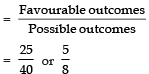
(ii) Probability that the selected student is a boy = 15/40 = 3/8 = 0.375
(b) Probability - The concept used is probability; each student is equally likely to be chosen, so probability = favourable outcomes ÷ total outcomes.
(c) Compassion and social service - By planning to help earthquake victims, the students show compassion, empathy and a willingness to serve people in need.
FAQs on Value Based Questions: Probability
| 1. What is probability and why is it important? |  |
| 2. How do you calculate the probability of an event? | |
| 3. What is the difference between theoretical probability and experimental probability? | |
| 4. How can probability be used in real-life situations? | |
| 5. What is conditional probability and how is it calculated? | |




