NCERT Solutions: Surface Areas & Volumes (Exercises 12.1, 12.2)

Exercise 12.1
Q1. 2 cubes each of volume 64 cm3 are joined end to end. Find the surface area of the resulting cuboid.
Sol. Volume of each cube = 64 cm3
Let the edge of each cube = x
∴ x3 = 64 = 43
⇒ x =4 cm
⇒ Now, the Length of the resulting cuboid 'l' = 2x cm = 8cm
⇒ Breadth of the resulting cuboid 'b' = x cm = 4 cm
⇒ Height of the resulting cuboid 'h' = x cm = 4 cm
∴ Surface area of the cuboid = 2 (lb + bh + hl)
= 2 [(8 × 4) + (4 × 4) + (4 × 8)]
= 2 [32 + 16 + 32] cm2 = 2 [80] cm2 = 160 cm2.
Q2. A vessel is in the form of a hollow hemisphere mounted by a hollow cylinder. The diameter of the hemisphere is 14 cm and the total height of the vessel is 13 cm. Find the inner surface area of the vessel.
Sol. For the cylindrical part
Radius (r) = 7 cm
Height (h) = 6 cm
∴ Curved surface area
= 2πrhFor hemispherical part
Radius (r) = 7 cm
∴ Surface area = 2πr2∴ Total surface area = CSA of cylinder + CSA of hemisphere
= (264 + 308) cm2 = 572 cm2

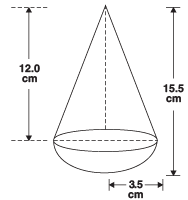
Q3. A toy is in the form of a cone of radius 3.5 cm mounted on a hemisphere of the same radius. The total height of the toy is 15.5 cm. Find the total surface area of the toy.
Sol. Here, r = 3.5 cm
∴ h = (15.5 - 3.5) cm = 12.0 cmTotal surface area of the toy = CSA of the hemisphere + CSA of the cone
⇒ Surface area of the conical part = πrl
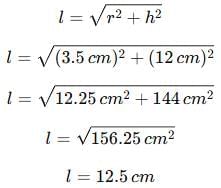
⇒ Surface area of the hemispherical part = 2πr2Slant height of the cone
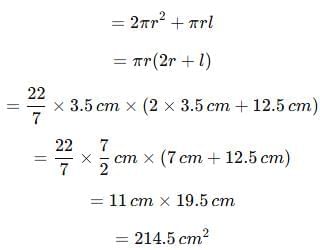
Total surface area of the toy = CSA of the hemisphere + CSA of the cone
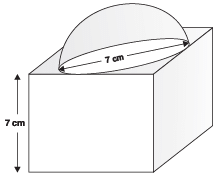
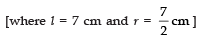
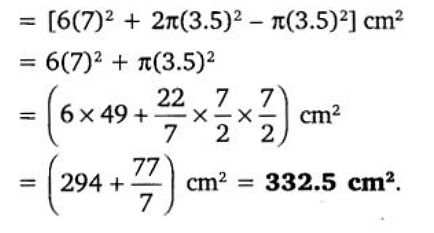
Q4. A cubical block of side 7 cm is surmounted by a hemisphere. What is the greatest diameter the hemisphere can have? Find the surface area of the solid.
Sol. Side of the block = 7 cm
⇒ The greatest diameter of the hemisphere = 7 cm
Surface area of the solid:
= [Total S.A. of the cubical block] + [S.A. of the hemisphere] - [Base area of the hemisphere]
= (6 × l2) + 2πr2 - πr2
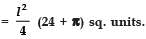
Q5. A hemispherical depression is cut out from one face of a cubical wooden block such that the diameter l of the hemisphere is equal to the edge of the cube. Determine the surface area of the remaining solid.
Sol. Let 'l' be the side of the cube.
∴ The greatest diameter of the curved hemisphere = l
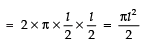
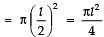
⇒ Radius of the curved hemisphere = l/2
∴ Surface area of hemisphere = 2πr2
Base area of the hemisphere
Surface area of the cube = 6 × l2 = 6l2
∴ Surface area of the remaining solid

Q6. A medicine capsule is in the shape of a cylinder with two hemispheres stuck to each of its ends (see Fig.). The length of the entire capsule is 14 mm and the diameter of the capsule is 5 mm. Find its surface area.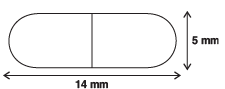
Sol. Radius of the hemispherical part
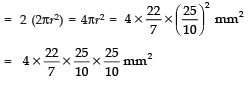
= 5/2 mm = 2.5 mm∴ Surface area of one hemispherical part = 2πr2
⇒ Surface area of both hemispherical parts
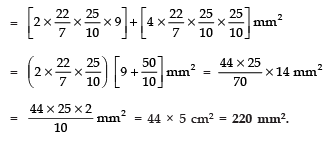
Area of cylindrical part =
∴ Total surface area

Q7. A tent is in the shape of a cylinder surmounted by a conical top. If the height and diameter of the cylindrical part are 2.1 m and 4 m respectively, and the slant height of the top is 2.8 m, find the area of the canvas used for making the tent. Also, find the cost of the canvas of the tent at the rate of Rs 500 per m2. (Note that the base of the tent will not be covered with canvas.)
Sol.
For cylindrical part:
Radius (r) = 4/2 m = 2 m
Height (h) = 2.1 m
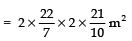
∴ Curved surface area = 2πrh =
For conical part:
Slant height (l) = 2.8 m
Base radius (r)= 2m
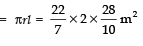
∴ Curved surface area
Total surface area:
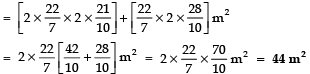
= [Surface area of the cylindrical part] + [Surface area of conical part]Cost of the canvas used
Cost of 1 m2 of canvas = Rs 500
∴ Cost of 44 m2 of canvas = Rs 500 × 44 = Rs. 22000
Q8. From a solid cylinder whose height is 2.4 cm and diameter 1.4 cm, a conical cavity of the same height and same diameter is hollowed out. Find the total surface area of the remaining solid to the nearest cm2.
Sol.
For cylindrical part:
Height = 2.4 cm
Diameter = 1.4 cm
⇒ Radius (r) = 0.7 cmFor conical part:
Base area (r) = 0.7 cm
Height (h) = 2.4 cm
∴ Slant height∴ Curved surface area of the conical part
Base area of the conical partTotal surface area of the remaining solid:







Q9. A wooden article was made by scooping out a hemisphere from each end of a solid cylinder, as shown in Fig. If the height of the cylinder is 10 cm, and its base is of radius 3.5 cm, find the total surface area of the article.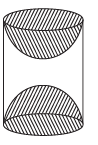
Sol. Radius of the cylinder (r) = 3.5 cm
Height of the cylinder (h) = 10 cm
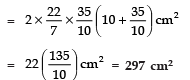
∴ Total surface area = 2πrh + 2πr2 = 2πr (h + r)Curved surface area of a hemisphere = 2πr2
∴ Curved surface area of both hemispheres
Base area of a hemisphere = πr2∴ Base area of both hemispheres = 2πr2
∴ Total surface area of the remaining solid
= 297 cm2 + 154 cm2 - 77 cm2
= (451 - 77) cm2 = 374 cm2.


Exercise 12.2
[Unless stated otherwise, take π = 22/7]
Q1. A solid is in the shape of a cone standing on a hemisphere with both their radii being equal to 1 cm and the height of the cone is equal to its radius. Find the volume of the solid in terms of π.
Sol. Here, r = 1 cm and h = 1 cm.
∵ Volume of the conical part = 1/3 πr2h
Volume of the hemispherical part =2/3 πr3
∴ Volume of the solid shape

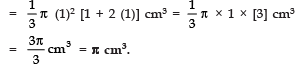
Q2. Rachel, an engineering student, was asked to make a model shaped like a cylinder with two cones attached at its two ends by using a thin aluminium sheet. The diameter of the model is 3 cm and its length is 12 cm. If each cone has a height of 2 cm, find the volume of air contained in the model that Rachel made. (Assume the outer and inner dimensions of the model to be nearly the same.)
Sol. Here, diameter = 3 cm
⇒ Radius (r)= 3/2 cm
Total height = 12 cm
Height of a cone (h1) = 2 cm
∴ Height of both cones = 2 × 2 = 4 cm
⇒ Height of the cylinder (h2) = (12 - 4) cm
= 8 cm.
Now, volume of the cylindrical part = πr2h2
Volume of both conical parts:
=
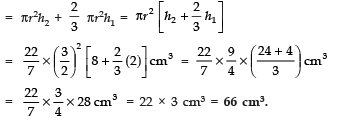
∴ Volume of the whole model

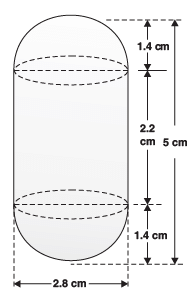
Q3. A gulab jamun contains sugar syrup up to about 30% of its volume. Find approximately how much syrup would be found in 45 gulab jamuns, each shaped like a cylinder with two hemispherical ends with length 5 cm and diameter 2.8 cm (see figure).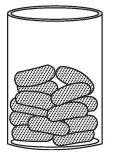
Sol. Since a gulab jamun is like a cylinder with hemispherical ends.
Total height of the gulab jamun = 5 cm.
Diameter = 2.8 cm
⇒ Radius = 1.4 cm
∴ Length (height) of the cylindrical part
= 5 cm - (1.4 + 1.4) cm
= 5 cm - 2.8 cm = 2.2 cm
Now, volume of the cylindrical part
= πr2h
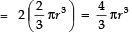
Volume of a hemispherical end = 2/3 πr3
Volume of both the hemispherical ends
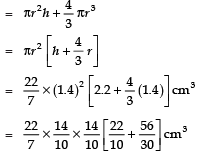
∴ Volume of a gulab jamun
⇒ Volume of 45 gulab jamuns
Since the quantity of syrup in gulab jamuns= 338.184 cm3
= 338 cm3 (approx.)



Q4. A pen stand made of wood is in the shape of a cuboid with four conical depressions to hold pens. The dimensions of the cuboid are 15 cm by 10 cm by 3.5 cm. The radius of each of the depressions is 0.5 cm and the depth is 1.4 cm. Find the volume of wood in the entire stand (see Fig.).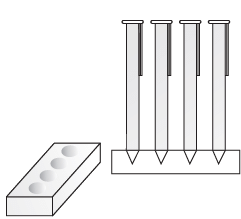
Sol. Dimensions of the cuboid are 15 cm, 10 cm and 3.5 cm.
∴ Volume of the cuboid
Since each depression is conical with base radius (r) = 0.5 cm and depth (h) = 1.4 cm,
∴ Volume of each depression (cone)
Since there are 4 depressions,
∴ Total volume of 4 depressions
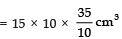
Now, volume of the wood in entire stand
= [Volume of the wooden cuboid] - [Volume of 4 depressions]




Q5. A vessel is in the form of an inverted cone. Its height is 8 cm and the radius of its top, which is open, is 5 cm. It is filled with water up to the brim. When lead shots, each of which is a sphere of radius 0.5 cm are dropped into the vessel, one-fourth of the water flows out. Find the number of lead shots dropped in the vessel.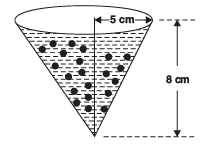
Sol. Height of the conical vessel (h) = 8 cm
Base radius (r) = 5 cm
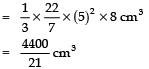
∴ Volume of the cone = 1/3 πr2h
Since Volume of the cone = [Volume of water in the cone]
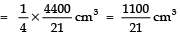
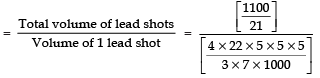
Now, Total volume of lead shots
= 1/4 of [Volume of water in the cone]
Since, radius of a lead shot (sphere) (r) = 0.5 cm
∴ Volume of 1 lead shot =∴ Number of lead shots
Thus, the required number of lead shots = 100.



Q6. A solid iron pole consists of a cylinder of height 220 cm and base diameter 24 cm, which is surmounted by another cylinder of height 60 cm and radius 8 cm. Find the mass of the pole, given that 1 cm3 of iron has approximately 8 g mass. (Use π = 3.14) 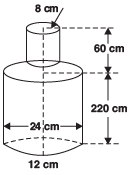
Sol. Height of the big cylinder (h) = 220 cm
Base radius (r) = 24/2 cm = = 12 cm
∴ Volume of the big cylinder = πr2h = π (12)2 × 220 cm3
Also, height of smaller cylinder (h1) = 60 cm
Base radius (r1) = 8 cm
∴ Volume of the smaller cylinder πr12h1
= π (8)2 × 60 cm3
∴ Volume of iron
= [Volume of big cylinder] + [Volume of the smaller cylinder]
= π × 220 × 122 + π × 60 × 82 cm3
= 3.14 [220 × 12 × 12 + 60 × 8 × 8] cm3 = 314/100 [20 × 144 + 60 × 64] cm3


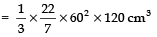
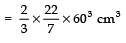
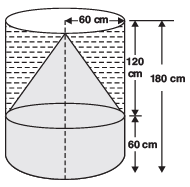
Q7. A solid consisting of a right circular cone of height 120 cm and radius 60 cm standing on a hemisphere of radius 60 cm is placed upright in a right circular cylinder full of water such that it touches the bottom. Find the volume of water left in the cylinder, if the radius of the cylinder is 60 cm and its height is 180 cm.
Sol. Height of the conical part = 120 cm.
Base radius of the conical part = 60 cm.
∴ Volume of the conical part =
Radius of the hemispherical part = 60 cm.
∴ Volume of the hemispherical part
∴ Volume of the solid
= [Volume of conical part] + [Volume of hemispherical part]
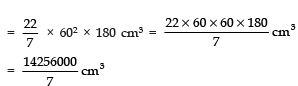
Volume of the cylinder = πr2h
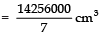
⇒ Volume of water in the cylinder
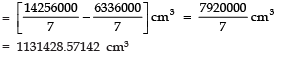
∴ Volume of the water left in the cylinder
[∵ 1000000 cm3 = 1 m3]
= 1.13142857142 m3 = 1.131 m3 (approx).

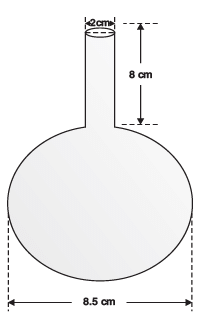
Q8. A spherical glass vessel has a cylindrical neck 8 cm long, 2 cm in diameter; the diameter of the spherical part is 8.5 cm. By measuring the amount of water it holds, a child finds its volume to be 345 cm3. Check whether she is correct, taking the above as the inside measurements, and π = 3.14.
Sol. Volume of the cylindrical part
= πr2h = 3.14 × 12 × 8 cm3 [∵ Radius = 2/3 = 1 cm, height (h) = 8 cm]
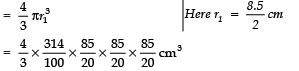
Volume of the spherical part
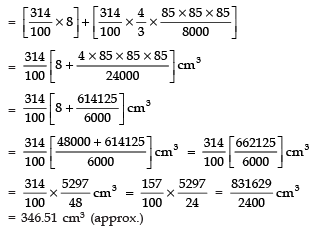
Total volume of the glass-vessel
⇒ Volume of water in the vessel = 346.51 cm3
Since the child finds the volume as 345 cm3
∴ The child's answer is not correct
⇒ The correct answer is 346.51 cm3.

FAQs on NCERT Solutions: Surface Areas & Volumes (Exercises 12.1, 12.2)
| 1. How do I find the surface area of a cylinder in CBSE Class 10 exams? |  |
| 2. What's the difference between curved surface area and total surface area for cones? | |
| 3. How do I calculate the volume of a hemisphere and why is it half of a sphere's volume? | |
| 4. What formulas do I need to memorize for Exercise 12.1 and 12.2 problems? | |
| 5. How do composite solids and real-world problems work in NCERT surface area and volume questions? | |