Short Answer Questions: Coordinate Geometry

Q1: Points P (5, - 3) is one of the two points of trisection of the line segment joining the points A (7, - 2) and B (1, - 5) near to A. Find the coordinates of the other point of trisection.
Ans:
Let the two trisection points divide AB into three equal parts. The point nearer to A is P which divides AB in the ratio 1 : 2.
Using section formula, coordinates of a point dividing A(x1, y1) and B(x2, y2) in the ratio m : n are given by ((n x1 + m x2)/(m+n), (n y1 + m y2)/(m+n)).
For the point nearer to A we have ratio 1 : 2 and P = (5, -3), which matches.
The other trisection point Q divides AB in the ratio 2 : 1.
So coordinates of Q = ((1·7 + 2·1)/3, (1·(-2) + 2·(-5))/3) = ((7 + 2)/3, (-2 -10)/3) = (3, -4).Thus, the other point of trisection is (3, -4).

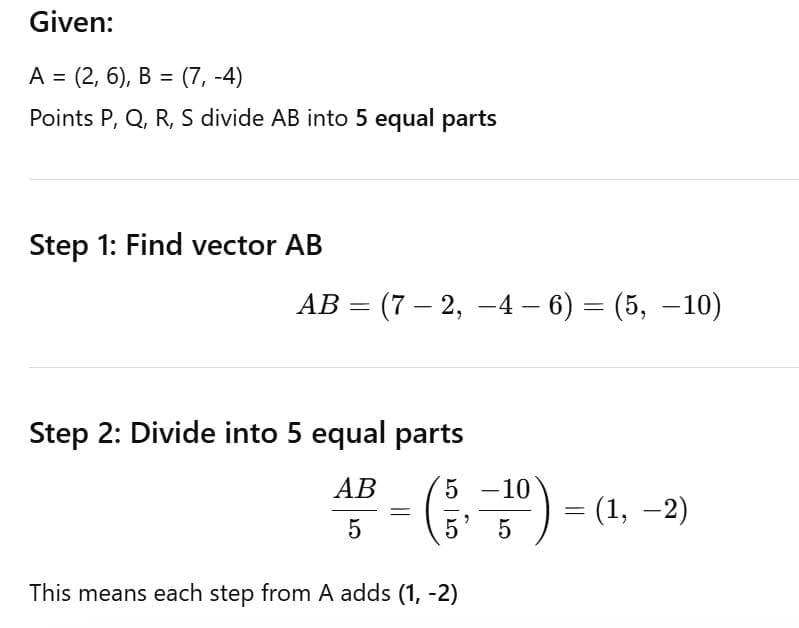
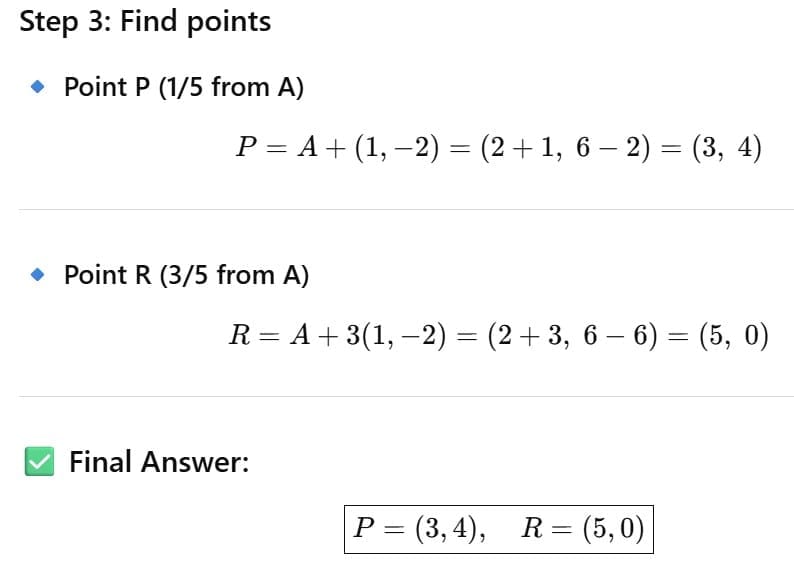
Q2: Points P, Q, R and S in this order, divide a line segment joining A(2, 6), B(7, - 4) in five equal parts. Find the coordinates of P and R.Ans:

Q3: Find the point on y-axis which is equidistant from the points (5, - 2) and (- 3, 2).
Ans: Let the required point be P (0, y). The given points are A (5, -2) and B (-3, 2).
∴ PA = PB
⇒ PA2 = PB2
⇒ (5 - 0)2 + (-2 - y)2 = (-3 - 0)2 + (2 - y)2
⇒ 25 + (y + 2)2 = 9 + (y - 2)2
⇒ 25 + (y2 + 4y + 4) = 9 + (y2 - 4y + 4)
⇒ 25 + 4y + 4 = 9 - 4y + 4
⇒ 29 + 4y = 13 - 4y
⇒ 8y = -16 ⇒ y = -2Thus, the required point is (0, -2).
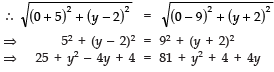
Q4: Find the point on y-axis which is equidistant from (- 5, 2) and (9, - 2).
Ans: Let the required point on Y-axis be P (0, y).
The given points are A (-5, 2) and B (9, -2).
∴ PA = PB ⇒ PA2 = PB2Compute:
(-5 - 0)2 + (2 - y)2 = (9 - 0)2 + (-2 - y)2
⇒ 25 + (y - 2)2 = 81 + (y + 2)2
⇒ 25 + (y2 - 4y + 4) = 81 + (y2 + 4y + 4)
⇒ 29 - 4y = 85 + 4y
⇒ -8y = 56⇒ y = -7
∴ The required point is (0, -7).
Q5: Find the value of x for which the distance between the points P (4, - 5) and Q (12, x) is 10 units.
Ans: The given points are P (4, -5) and Q (12, x) such that PQ = 10.Apply distance formula:
(12 - 4)2 + (x - (-5))2 = 102
⇒ 82 + (x + 5)2 = 100
⇒ 64 + x2 + 10x + 25 = 100
⇒ x2+ 10x + 89 - 100 = 0⇒ x2 + 10x - 11 = 0
⇒ (x - 1)(x + 11) = 0
⇒ x = 1 or x = -11Hence, x = 1 or x = -11.

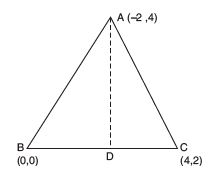
Q6: If A (- 2, 4), B (0, 0) and C (4, 2) are the vertices of Δ ABC, then find the length of the median through the vertex A.
Ans: ∵ AD is the median on BC.
So D is the mid-point of BC.
Coordinates of D = ((0 + 4)/2, (0 + 2)/2) = (2, 1).
Now, length of median AD = distance between A(-2, 4) and D(2, 1):
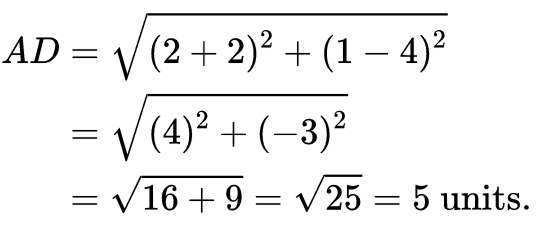
AD = √[(-2 - 2)2 + (4 - 1)2] = √[ (-4)2 + 32 ] = √(16 + 9) = √25 = 5.Thus, the length of the median through vertex A is 5 units.

Q7: If the points A (4, 3) and B (x, 5) are on the circle with the centre O (2, 3), find the value of x.
Ans: Let O (2, 3) be the centre of the circle.
∴ OA = OB ⇒ OA2 = OB2
⇒ (4 - 2)2 + (3 - 3)2 = (x - 2)2 + (5 - 3)2
⇒ 22 + 0 = (x - 2)2 + 22
⇒ (x - 2)2 = 0
⇒ x = 2Thus, the required value of x is 2.
Q8: Find the ratio in which the line 3x + 4y - 9 = 0 divides the line segment joining the points (1, 3) and (2, 7).
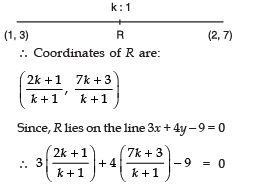
Ans: Let the ratio be k : 1 (taking the point as dividing AB in the ratio k:1 from A towards B).Coordinates of the point dividing in ratio k : 1 are ((2k + 1)/(k + 1), (7k + 3)/(k + 1)).
Substitute into 3x + 4y - 9 = 0:
3(2k + 1)/(k + 1) + 4(7k + 3)/(k + 1) - 9 = 0
⇒ (6k + 3 + 28k + 12)/(k + 1) - 9 = 0
⇒ (34k + 15) - 9(k + 1) = 0
⇒ 34k + 15 - 9k - 9 = 0 ⇒ 25k + 6 = 0
⇒ k = -6/25.Thus the line divides the segment in the ratio k : 1 = -6 : 25. Since k is negative, the division is external; it divides externally in the ratio 6 : 25.
Q9: If the point P (x, y) is equidistant from the points A (3, 6) and B (- 3, 4), prove that 3x+ y-5 = 0.
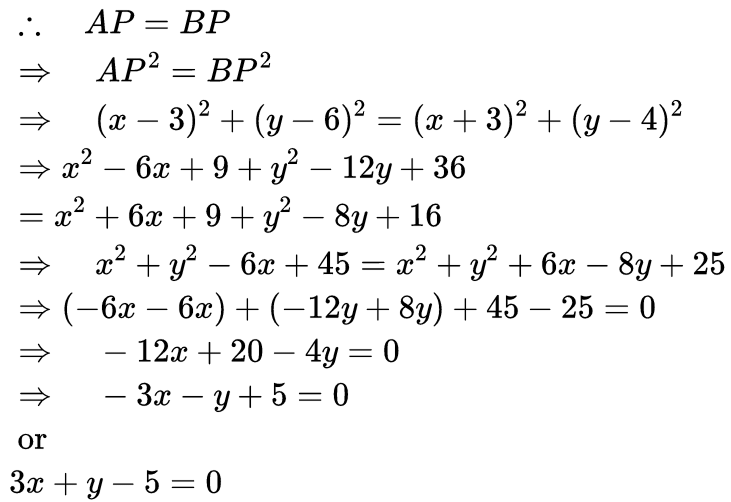
Ans:Since P is equidistant from A and B,
PA2 = PB2.
So (x - 3)2 + (y - 6)2 = (x + 3)2 + (y - 4)2.
Expand both sides:
x2 - 6x + 9 + y2 - 12y + 36 = x2 + 6x + 9 + y2 - 8y + 16.
Cancel x2, y2 and 9 from both sides:
-6x - 12y + 36 = 6x - 8y + 16.
Bring terms together:
-12x - 4y + 20 = 0 ⇒ divide by -1:
12x + 4y - 20 = 0 ⇒ divide by 4:
3x + y - 5 = 0.

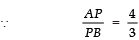
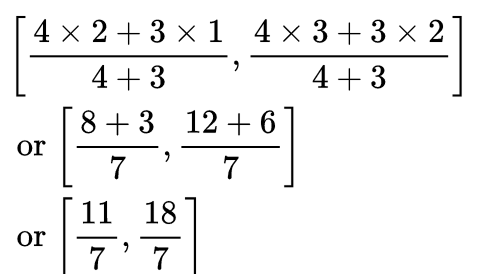
Q10: The coordinates of A and B are (1, 2) and (2, 3). If P lies on AB, then find the coordinates of P such that:
Ans:Using section formula coordinates of P are:

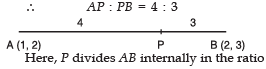
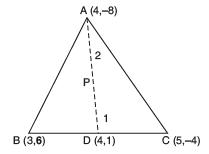
Q11: If A (4, - 8), B (3, 6) and C (5, - 4) are the vertices of a Δ ABC, D(4, 1) is the mid-point of BC and P is a point on AD joined such that AP/PD = 2 , find the coordinates of P.
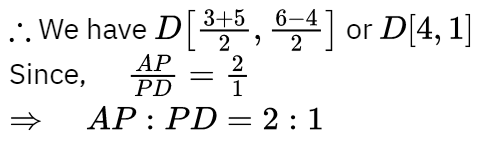
Ans: ∵ D is the mid-point of BC.
Coordinates of D = ((3 + 5)/2, (6 + (-4))/2) = (4, 1).
Point P divides AD in the ratio AP : PD = 2 : 1.
Using section formula for internal division, coordinates of P = ((1·xA + 2·xD)/(2+1), (1·yA + 2·yD)/(2+1)).
So xP = (1·4 + 2·4)/3 = (4 + 8)/3 = 12/3 = 4.
yP = (1·(-8) + 2·1)/3 = (-8 + 2)/3 = -6/3 = -2.Hence, P = (4, -2).
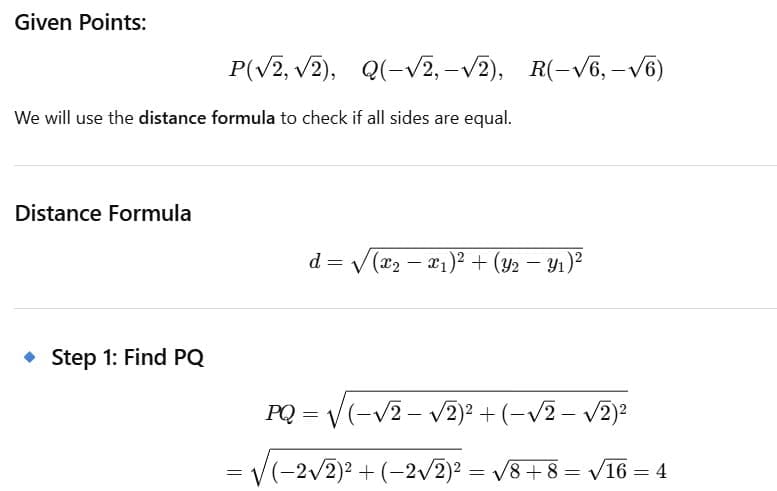
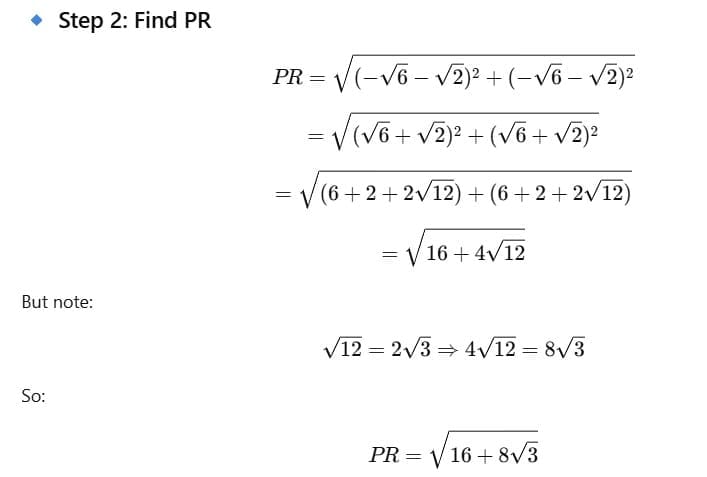
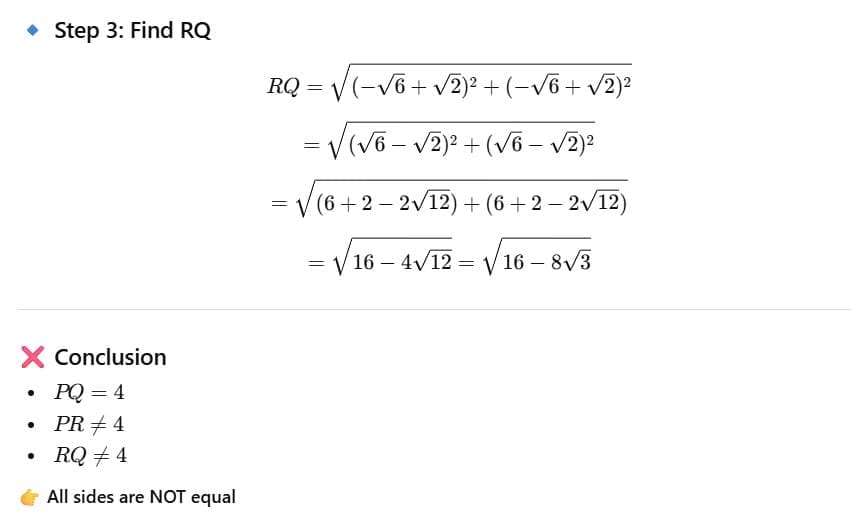
Q12: Show that the triangle PQR formed by the points
OR Name the type of triangle PQR formed by the points,
and is an equilateral triangle.
and
Ans:

Q13: The line joining the points (2, - 1) and (5, - 6) is bisected at P. If P lies on the line 2x + 4y + k = 0, find the value of k.
Ans: We have A (2, -1) and B (5, -6).
∵ P is the mid point of AB,
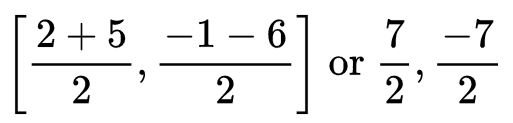
∴ Coordinates of P are:So P = ((2 + 5)/2, (-1 + (-6))/2) = (7/2, -7/2).
Since P lies on 2x + 4y + k = 0, substitute x = 7/2, y = -7/2:
2·(7/2) + 4·(-7/2) + k = 0 ⇒ 7 - 14 + k = 0 ⇒ k = 7.
Q14: Find the point on y-axis which is equidistant from the points (5, - 2) and (- 3, 2).
Ans: ∵ Let P be on the y-axis
∴ Coordinates of P are: (0, y)
Since PA = PB
∴ PA2 = PB2
⇒ (5 - 0)2 + (-2 - y)2 = (-3 - 0)2 + (2 - y)2
⇒ 25 + (y + 2)2 = 9 + (y - 2)2
⇒ 25 + (y2 + 4y + 4) = 9 + (y2 - 4y + 4)
⇒ 25 + 4y + 4 = 9 - 4y + 4
⇒ 29 + 4y = 13 - 4y
⇒ 8y = -16 ⇒ y = -2∴ The required point is (0, -2).
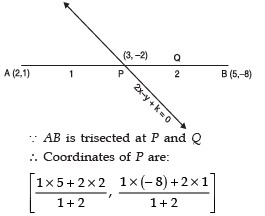
Q15: The line joining the points (2, 1) and (5, - 8) is trisected at the points P and Q. If point P lies on the line 2x - y + k = 0, find the value of k.
Ans:Vector AB = (5 - 2, -8 - 1) = (3, -9).
One-third of AB = (1, -3).
P is 1/3 from A: P = A + (1, -3) = (2 + 1, 1 - 3) = (3, -2).
Substitute P into 2x - y + k = 0:
2·3 - (-2) + k = 0 ⇒ 6 + 2 + k = 0 ⇒ k = -8.
Q16: Find the point on x-axis which is equidistant from the points (2, - 5) and (- 2, 9).
Ans: ∵ The required point 'P' is on x-axis.
∴ Coordinates of P are (x, 0).
∴ We haveAP = PB ⇒ AP2 = PB2
⇒ (2 - x)2 + (-5 - 0)2 = (-2 - x)2 + (9 - 0)2
⇒ (2 - x)2 + 25 = (-2 - x)2 + 81
⇒ (x2 - 4x + 4) + 25 = (x2 + 4x + 4) + 81
⇒ x2 - 4x + 29 = x2 + 4x + 85
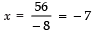
⇒ -8x = 56⇒ x = -7
∴ The required point is (-7, 0).
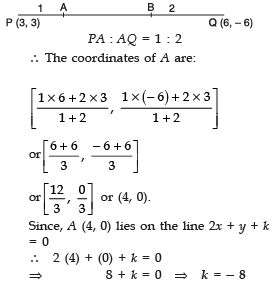
Q17: The line segment joining the points P (3, 3) and Q (6, - 6) is trisected at the points A and B such that A is nearer to P. It also lies on the line given by 2x + y + k = 0. Find the value of k.
Ans: ∵ PQ is trisected by A such that
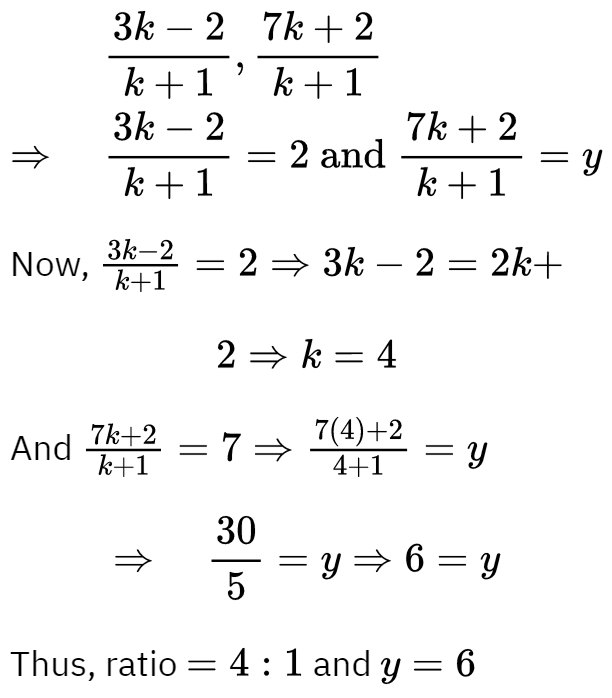
Q18: Find the ratio in which the points (2, 4) divides the line segment joining the points A (- 2, 2) and B (3, 7). Also find the value of y.
Ans: Let P (2, y) divides the join of A (- 2, 2) and B (3, 7) in the ratio k:1.
∴ Coordinates of P are:
Q19: Find the ratio in which the point (x, 2) divides the line segment joining the points (- 3, - 4) and (3, 5). Also find the value of x.
Ans: Let the required ratio = k : 1.
Using the y-coordinate (since y of the required point is given):
(5k - 4)/(k + 1) = 2 ⇒ 5k - 4 = 2k + 2 ⇒ 3k = 6 ⇒ k = 2.
Now x-coordinate of the point = (3k - 3)/(k + 1) = (6 - 3)/3 = 3/3 = 1.
Therefore, the ratio is 2 : 1 and x = 1.

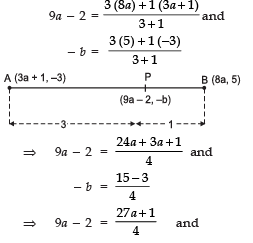
Q20: If P (9a - 2, -b) divides the line segment joining A (3a + 1, -3 ) and B (8a, 5) in the ratio 3 : 1, find the values of a and b.
Ans: ∵ P divides AB in the ratio 3 : 1.
∴ Using the section formula, we have:For the x-coordinate:
(1·(3a + 1) + 3·(8a))/(3 + 1) = 9a - 2.
⇒ (3a + 1 + 24a)/4 = 9a - 2 ⇒ (27a + 1)/4 = 9a - 2.
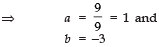
Multiply both sides by 4: 27a + 1 = 36a - 8 ⇒ 9a = 9 ⇒ a = 1.
For the y-coordinate:
(1·(-3) + 3·5)/4 = (-3 + 15)/4 = 12/4 = 3 = -b ⇒ -b = 3 ⇒ b = -3.Thus, a = 1 and b = -3.
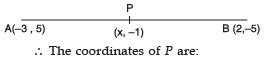
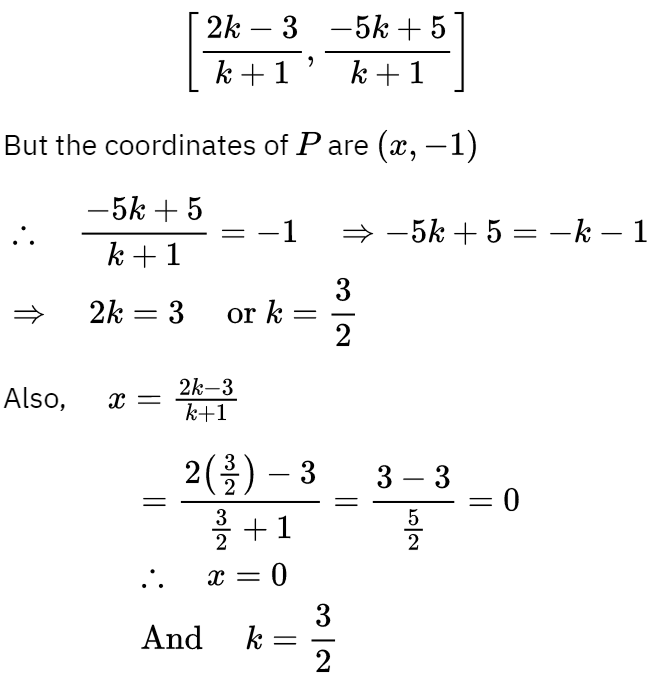
Q21: Find the ratio in which the point (x, - 1) divides the line segment joining the points (- 3, 5) and (2, - 5). Also find the value of x.
Ans: Let the required ratio be k : 1.Hence the ratio is 3 : 2 and x = 0.
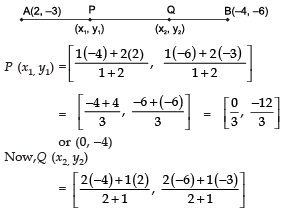
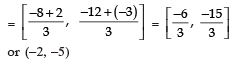
Q22: Find the co-ordinates of the points which divide the line segment joining A(2, -3) and B(-4, -6) into three equal parts.
Ans: Let the required points be P(x1, y1) and Q(x2, y2).
∴ Using section formula, we have:Vector AB = (-4 - 2, -6 - (-3)) = (-6, -3).
One-third of AB = (-2, -1).
P (1/3 from A) = A + (-2, -1) = (2 - 2, -3 - 1) = (0, -4).
Q (2/3 from A) = A + 2·(-2, -1) = (2 - 4, -3 - 2) = (-2, -5).Thus, the coordinates of the required points are (0, -4) and (-2, -5).
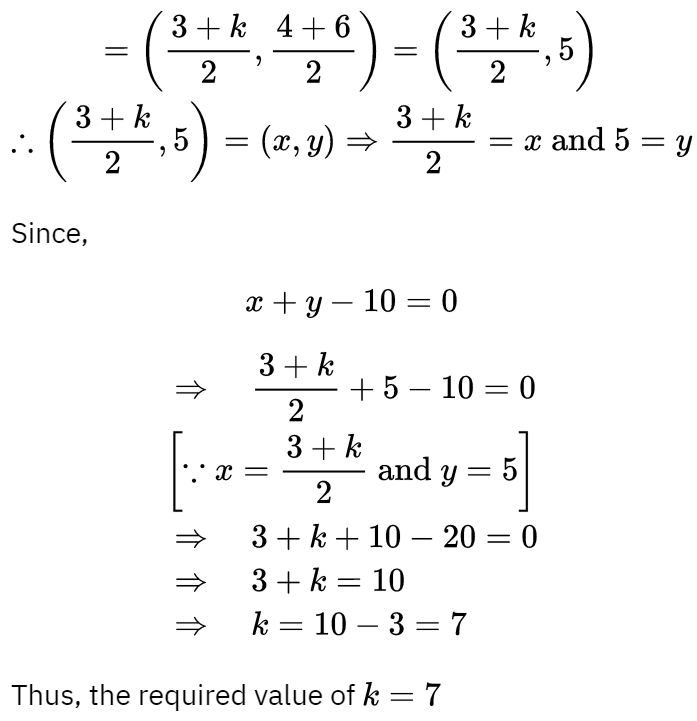
Q23: If the mid-point of the line segment joining the point A(3, 4) and B(k, 6) is P(x, y) and x + y - 10 = 0, then find the value of k.
Ans: ∵ Mid point of the line segment joining A(3, 4) and B(k, 6) is P whose coordinates are ((3 + k)/2, (4 + 6)/2).
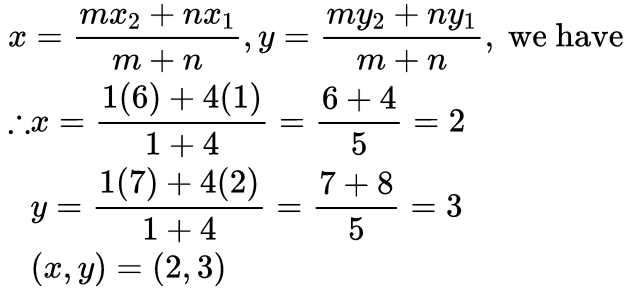
Q24: Point P, Q, R and S divide the line segment joining the points A (1, 2) and B (6, 7) in 5 equal parts. Find the co-ordinates of the points P, Q and R.
∴ P, Q, R and S divide AB into five equal parts.
∴ AP = PQ = QR = RS = SB
Vector AB = (6 - 1, 7 - 2) = (5, 5).
One-fifth of AB = (1, 1).Now,
P = A + 1·(1, 1) = (1 + 1, 2 + 1) = (2, 3).
Q = A + 2·(1, 1) = (1 + 2, 2 + 2) = (3, 4).
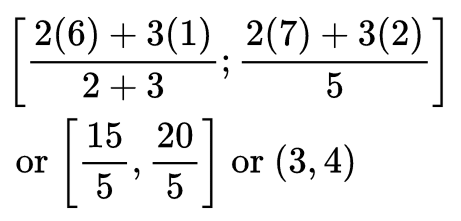
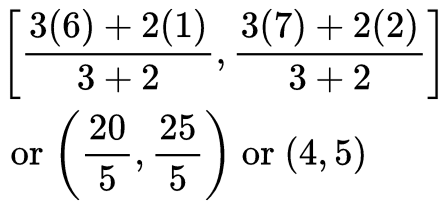
R = A + 3·(1, 1) = (1 + 3, 2 + 3) = (4, 5).Next, Q divides AB in the ratio 2 : 3
∴ Co-ordinates of Q are:Now, R divides AB in the ratio 3 : 2
⇒ Co-ordinates of R are:The co-ordinates of P, Q and R are respectively: (2, 3), (3, 4) and (4, 5).

FAQs on Short Answer Questions: Coordinate Geometry
| 1. What is the distance formula in coordinate geometry? |  |
| 2. How do you find the midpoint between two points? | |
| 3. What is the slope of a line and how is it calculated? | |
| 4. What is the equation of a line in slope-intercept form? | |
| 5. How do you determine if three points are collinear? | |





