NCERT Solutions - Index Numbers

Q1: An index number which accounts for the relative importance of the items is known as
(i) weighted index
(ii) simple aggregative index
(iii) simple average of relatives
Ans: (i)
Explanation: A weighted index gives different items different importance (weights) according to their relative significance. Instead of treating all items equally, it multiplies each item's price (or quantity) change by its weight and then averages these values. This method therefore reflects the real impact of price changes of important items more accurately than simple unweighted indices.
Q2: In most of the weighted index numbers the weight pertains to
(i) base year
(ii) current year
(iii) both base and current year
Ans: (ii)
Explanation: In many weighted index formulas the weights refer to the current year quantities or values. For example, Paasche's index uses current-year quantities as weights. By contrast, Laspeyres's index uses base-year quantities, and Fisher's index is a geometric mean of Laspeyres and Paasche and thus uses information from both years.
Q3: The impact of change in the price of a commodity with little weight in the index will be
(i) small
(ii) large
(iii) uncertain
Ans: (i)
Explanation: If a commodity has a very small weight in the index, changes in its price have only a minor effect on the overall index. The weight reflects the item's relative importance in the consumption or production basket, so a small weight means its price movement contributes little to the aggregate change.
Q4: A consumer price index measures changes in
(i) retail prices
(ii) wholesale prices
(iii) producers prices
Ans: (i)
Explanation: A Consumer Price Index (CPI) tracks changes in the retail prices that consumers pay for a specified basket of goods and services. It measures how the cost of living for consumers changes over time by comparing current retail prices with those in a base period.
Q5: The item having the highest weight in consumer price index for industrial workers is
(i) Food
(ii) Housing
(iii) Clothing
Ans: (i)
Explanation: In the CPI for Industrial Workers, food normally has the highest weight because it constitutes the largest share of expenditure for most workers. Therefore, changes in food prices have a significant impact on the overall CPI for industrial workers.
Q6: In general, inflation is calculated by using
(i) wholesale price index
(ii) consumer price index
(iii) producers' price index
Ans: (i)
Explanation: Broadly, official measures of inflation in many countries use the Wholesale Price Index (WPI) to capture price changes at the wholesale level across the economy. WPI reflects price movements before goods reach the retail stage and is commonly used for measuring general inflationary trends. However, CPI is often used to measure cost-of-living changes experienced by households.
Q7: Why do we need an index number?
Ans: An index number is a statistical tool used to measure and compare changes in economic variables over time or between places. Its importance is explained in the following points:
- To measure change in the price level: Index numbers, such as the Wholesale Price Index (WPI), summarise price changes across many commodities and provide a measure of inflation.
- To study a change in the standard of living: Cost-of-living indices show how the purchasing power and living standards of people change over time.
- Useful in planning and decision making: Businesses and governments use index numbers to plan, set wages, adjust contracts and design economic policy.
- To determine the level of production: Industrial production indices measure changes in physical output and help assess economic activity.
- To help the government in framing policy: Index numbers guide fiscal and monetary policies by indicating inflationary trends and cost-of-living pressures.
Q8: What are the desirable properties of the base period?
Ans: The base period should have the following desirable properties:
- The base year should not be either too short or too long: It should be a representative period, typically one year, rather than a month or many years.
- The base year should not be either too near or too far: The base should be close enough to allow meaningful comparison but not so close that it fails to show structural changes in consumption or production.
- The base year should be so selected that the data for the same should be available: Reliable and complete data for the base year must be obtainable for accurate calculation.
- The base period should be constantly updated: Periodic updating is necessary to reflect changes in tastes, technology, consumption patterns and the economy's structure.
Q9: Why is it essential to have different CPI for different categories of consumers?
Ans: The Consumer Price Index (CPI) in India has separate series because different groups have different consumption patterns. The main series are:
- CPI for Industrial Workers.
- CPI for Urban Non-manual Employees.
- CPI for Agricultural Labourers.
These indices are compiled separately because the baskets of goods and the relative importance of items differ across these groups. Separate CPIs allow a more accurate measurement of how price changes affect each group's cost of living.
Q10: What does a consumer price index for industrial workers measure?
Ans: A Consumer Price Index for Industrial Workers (CPI-IW) measures how changes in retail prices affect the cost of living of industrial workers. In India, CPI-IW is compiled by the Labour Bureau (Shimla) and includes categories such as food, fuel and lighting, housing, clothing and miscellaneous items. Because food typically has the largest weight, changes in food prices strongly influence the CPI-IW. This index is often used to determine dearness allowance (D.A.) for government employees.
Q11: What is the difference between a price index and a quantity index?
Ans: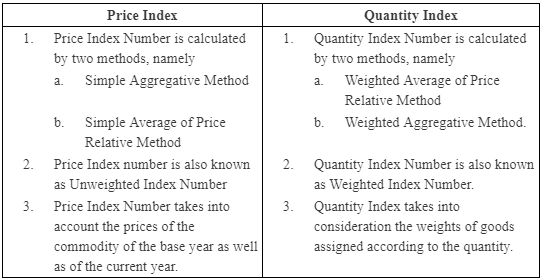
Q12: Is the change in any price reflected in a price index number?
Ans: Ans: False
Explanation: A price index does not reflect every single price change directly. It summarises the relative or percentage changes in a set of prices between two periods with reference to a chosen base period. The index shows how the general price level has moved rather than listing individual prices.
Q13: Can the CPI number for urban non-manual employees represent the changes in the cost of living of the President of India?
Ans: Ans: No
Explanation: The CPI for urban non-manual employees is based on a consumption basket typical of urban salaried workers. The President's consumption pattern is very different and not represented by that basket. Therefore, that CPI cannot accurately measure changes in the President's cost of living.
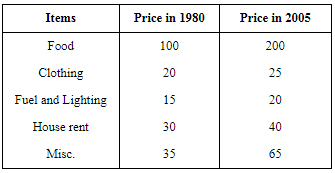
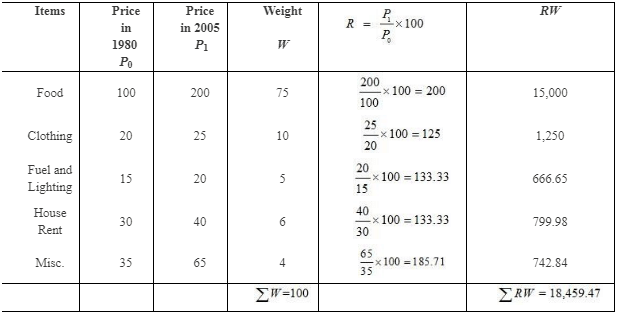
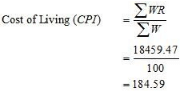
Q14: The monthly per capita expenditure incurred by workers for an industrial centre during 1980 and 2005 on the following items are given below. The weights of these items are 75, 10, 5, 6 and 4 respectively. Prepare a weighted index number for cost of living for 2005 with 1980 as the base.
Q15: Read the following table carefully and give your comments.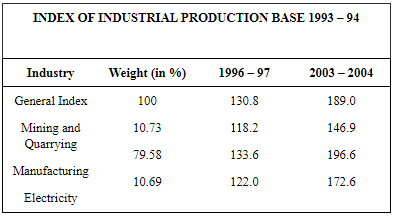
- Manufacturing Industry has the highest weight of 79.58% compared with Mining and Quarrying (10.73%) and Electricity (10.69%).
- The production of Manufacturing Industry is higher than that of Mining and Quarrying and Electricity in both 1996-97 and 2003-04.
- Mining and Quarrying shows the least growth performance, while Manufacturing shows the highest growth.
- The General Index is higher in 2003-04 than in 1996-97, indicating overall growth in output.
Q16: Try to list the important items of consumption in your family.
Ans: The following items constitute the main consumption needs of our family:
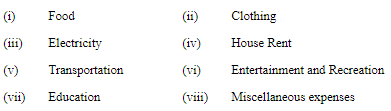
Q17: If the salary of a person in the base year is Rs 4,000 per annum and the current year salary is Rs 6,000, by how much should his salary rise to maintain the same standard of living if the CPI is 400?
Ans:
Base CPI = 100
Current CPI = 400
Base Year Salary = Rs 4,000
Current Year Salary = Rs 6,000

Solution and conclusion:
Since CPI has risen from 100 to 400, the cost of living has increased by a factor of 400/100 = 4.
So the salary required now to maintain the same standard of living = 4 × Base Year Salary = 4 × Rs 4,000 = Rs 16,000.
Current salary is Rs 6,000, so the required increase = Rs 16,000 - Rs 6,000 = Rs 10,000.
Q18: The consumer price index for June, 2005 was 125. The food index was 120 and that of other items 135. What is the percentage of the total weight given to food?
Ans: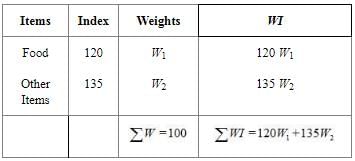
W1 = weight of food, W2 = weight of other items
W1 + W2 = 100 (i)
CPI = 125, so 125 × 100 = 120·W1 + 135·W2 (ii)
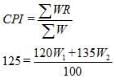
From (i): W2 = 100 - W1. Substituting in (ii):
12500 = 120·W1 + 135·(100 - W1)
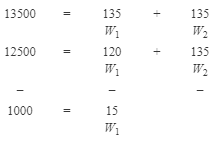
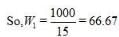
Solving gives W1 = 66.67 and W2 = 33.33.
Therefore, the percentage weight given to food is 66.67% and to other items is 33.33%.
Q19: An enquiry into the budgets of the middle class families in a certain city gave the following information;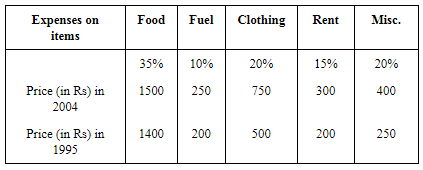
Ans: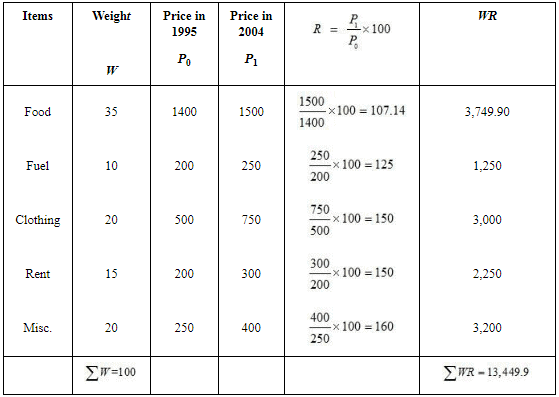

Cost of Living Index = 134.50
Thus, prices rose by 34.50% between 1995 and 2004.
Q20: Record the daily expenditure, quantities bought and prices paid per unit of the daily purchases of your family for two weeks. How has the price change affected your family?
Ans: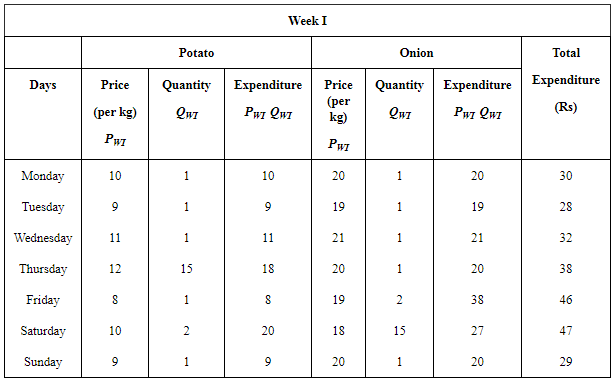
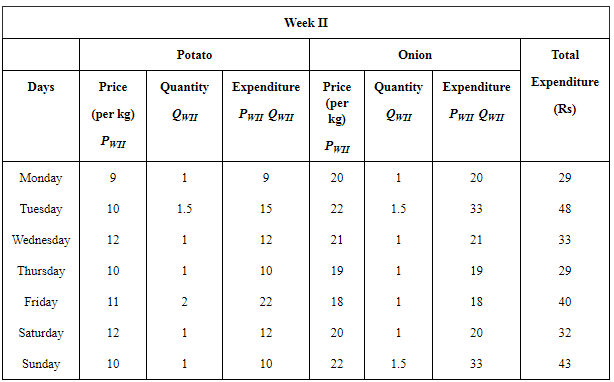
Q21: Given the following data: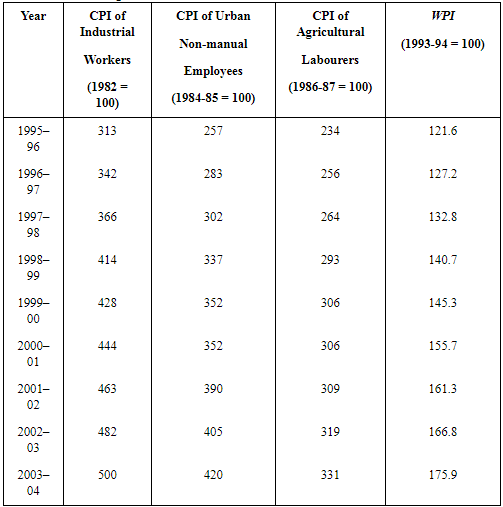
(i) Calculate the inflation rates using different index numbers.
(ii) Comment on the relative values of the index numbers.
(iii) Are they comparable?
Ans:
(i)
(a)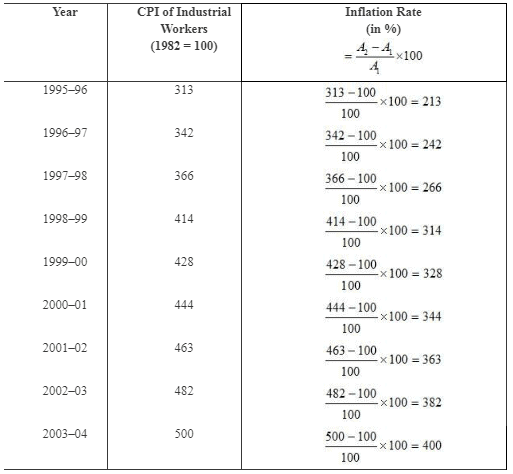
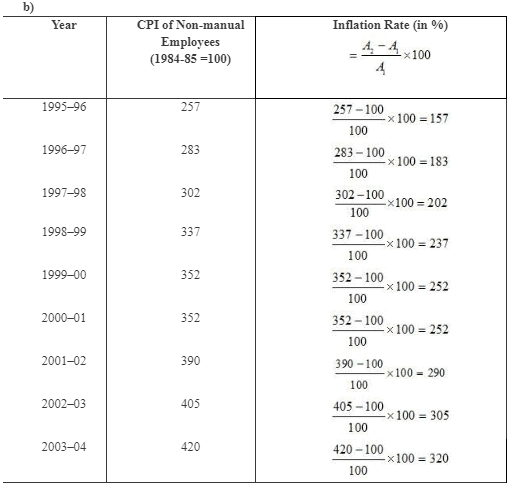
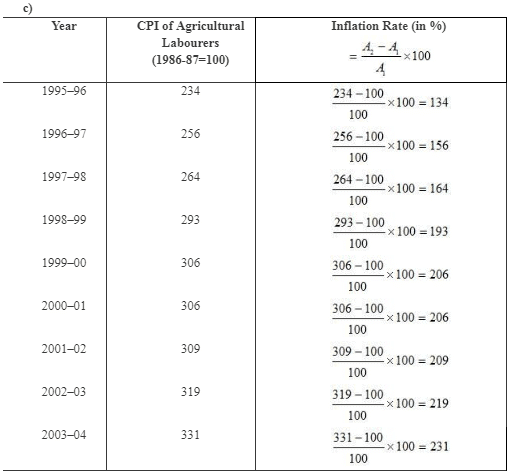
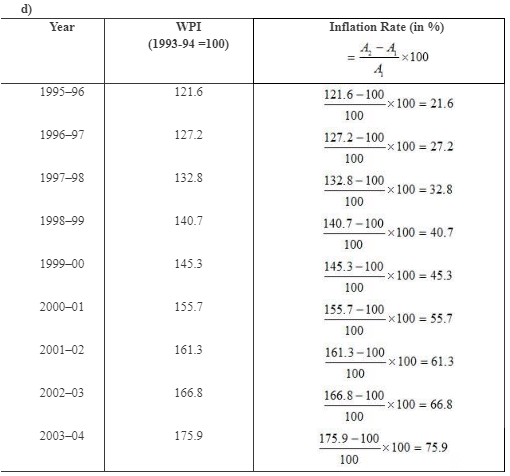
(ii) The calculated inflation rates show that the CPI for industrial workers (base 1982) indicates the highest inflation among the series presented, while the WPI with base 1993-94 shows the lowest rate. Differences arise because each index uses a different basket and base period.
(iii) No, the index numbers are not directly comparable because:
- They use different base periods, so percentage changes are measured relative to different reference years.
- The sets of commodities and the weights assigned to each item differ across indices, reflecting different coverage (consumer basket vs wholesale basket) and population groups.
FAQs on NCERT Solutions - Index Numbers
| 1. What are index numbers? |  |
| 2. How are index numbers calculated? | |
| 3. What is the importance of index numbers in economics? | |
| 4. How are index numbers used in business? | |
| 5. Can index numbers be negative? | |