Agricultural Engineering Exam  >  Agricultural Engineering Notes  >  Soil Mechanics Notes-   >  Indian Standard Soil Classification System(ISSCS) - Classification of Soil, Soil Mechanics

Indian Standard Soil Classification System(ISSCS) - Classification of Soil, Soil Mechanics

Indian Standard Soil Classification System (ISSCS)

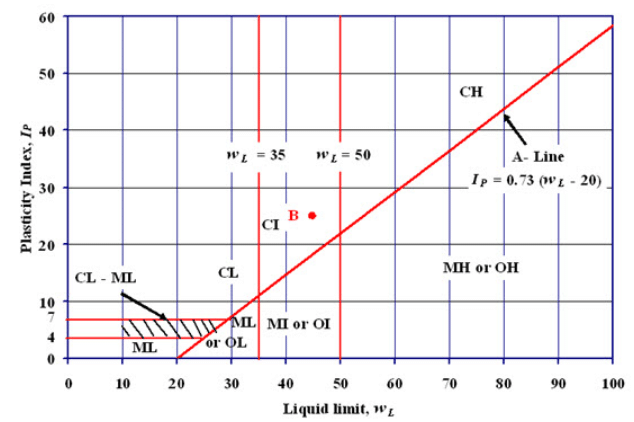
According to this system, the symbols of the various soils are as: Gravel (G), Sand (S), Silt or Silty (M), Clay or Clayey (C), Organic (O), Peat (Pt), Well graded (W), Poorly graded (P). To classify the fine-grained soil, plasticity chart (as shown in Figure 2) is used. The difference between the plasticity charts used for Unified Soil Classification System (USCS) and Indian Standard Soil Classification System (ISSCS) is that in USCS, the soil is classified as High Plasticity (if liquid limit >50%) or Low Plasticity (if liquid limit < 50%) soil, but in ISSCS, the soil is classified as High Plasticity (if liquid limit >50%) or Intermediate Plasticity (if liquid limit is in between 35% to 50%) or Low Plasticity (if liquid limit < 35%). For example, if a soil sample has liquid limit (wL) 45% and plasticity index (IP) 25, according to the Unified Soil Classification System (USCS) the point is above 'A' line (point A in Figure 4.1) and it is classified as CL. However, according to Indian Standard Soil Classification System (ISSCS) the point is also above 'A' line (point B in Figure 4.2), but it is classified as CI.
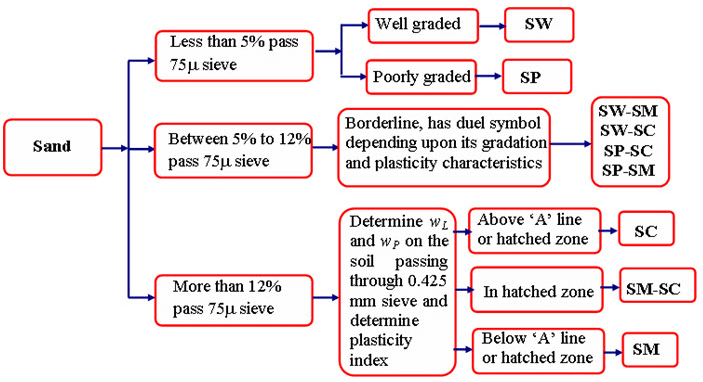
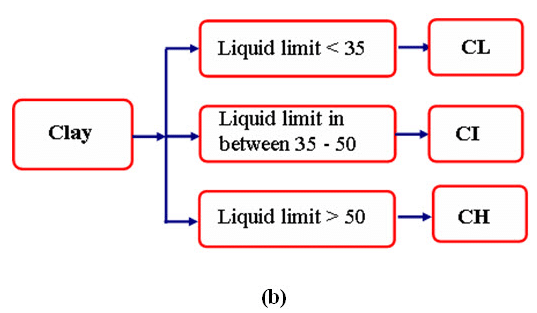
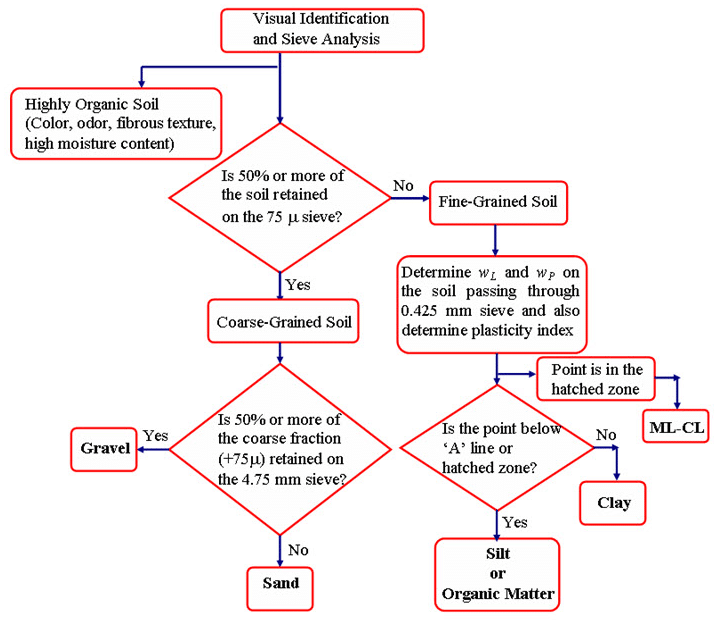
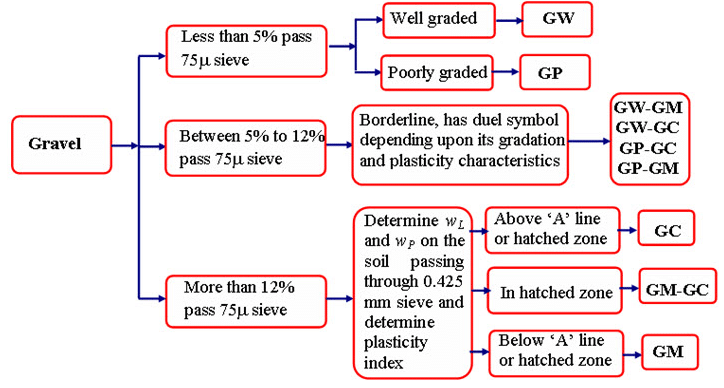
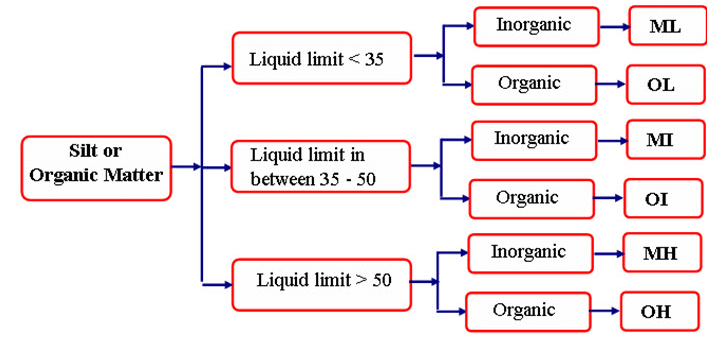
Figure 4.3 shows the flow chart to classify a soil according to the Indian Standard Soil Classification System. Figure 4.4 and Figure 4.5 show the classification of coarse-grained and fine-grained soil, respectively as per Indian Standard Soil Classification System.
Indian Standard Soil Classification System(ISSCS) - Classification of Soil, Soil Mechanics

Fig. 4.2. Plasticity chart as per Indian Standard Soil Classification System

(ISSCS).
 

Indian Standard Soil Classification System(ISSCS) - Classification of Soil, Soil Mechanics

Fig. 4.3. Flow chart to classify soil (as per ISSCS).


(a)
Indian Standard Soil Classification System(ISSCS) - Classification of Soil, Soil Mechanics

(b)
Indian Standard Soil Classification System(ISSCS) - Classification of Soil, Soil Mechanics


Fig. 4.4. Classification of coarse-grained soil: (a) Gravel (b) Sand (as per ISSCS).
 Indian Standard Soil Classification System(ISSCS) - Classification of Soil, Soil Mechanics

(a)

Indian Standard Soil Classification System(ISSCS) - Classification of Soil, Soil Mechanics

Fig. 4.5. Classification of fine-grained soil: (a) Silt or Organic matter (b) Clay (as per ISSCS).

The document Indian Standard Soil Classification System(ISSCS) - Classification of Soil, Soil Mechanics is a part of the Agricultural Engineering Course Soil Mechanics Notes- Agricultural Engineering.
All you need of Agricultural Engineering at this link: Agricultural Engineering

FAQs on Indian Standard Soil Classification System(ISSCS) - Classification of Soil, Soil Mechanics

1. What is the Indian Standard Soil Classification System (ISSCS)?
Ans. Indian Standard Soil Classification System (ISSCS) is a system developed by the Indian Standards Institution (ISI) for the classification of soils in India. It is based on the texture, structure, and composition of the soil and has been widely used in soil mechanics and agricultural engineering.
2. What are the different soil types classified under ISSCS?
Ans. ISSCS classifies soils into four main groups - coarse-grained soils, fine-grained soils, highly organic soils, and expansive soils. Coarse-grained soils include gravels and sands, while fine-grained soils include silts and clays. Highly organic soils are composed mainly of organic matter, and expansive soils have a high content of expansive minerals like montmorillonite.
3. How is ISSCS useful in soil mechanics and agricultural engineering?
Ans. ISSCS provides a basis for understanding the properties and behavior of different soil types. It helps in determining the suitability of soil for various engineering and agricultural purposes, such as foundation design, irrigation, and crop production. It also helps in predicting the behavior of soil under different conditions, such as changes in moisture content and load.
4. How does ISSCS differ from other soil classification systems?
Ans. ISSCS is specific to the soils found in India and takes into account the unique characteristics of these soils. It also incorporates aspects of other international soil classification systems such as the Unified Soil Classification System (USCS) and the American Association of State Highway and Transportation Officials (AASHTO) classification system.
5. What are the limitations of ISSCS?
Ans. ISSCS has been criticized for being too simplistic and not accounting for all the characteristics of soil. It also does not provide detailed guidelines for soil testing and analysis, which can lead to inconsistencies in classification. Moreover, it may not be suitable for all engineering and agricultural applications and may need to be supplemented with other classification systems.

Top Courses for Agricultural Engineering

Related Searches
mock tests for examination, Previous Year Questions with Solutions, Exam, Sample Paper, Free, MCQs, Soil Mechanics, study material, Soil Mechanics, Indian Standard Soil Classification System(ISSCS) - Classification of Soil, Semester Notes, Objective type Questions, Soil Mechanics, Indian Standard Soil Classification System(ISSCS) - Classification of Soil, shortcuts and tricks, ppt, Extra Questions, past year papers, Indian Standard Soil Classification System(ISSCS) - Classification of Soil, practice quizzes, pdf , video lectures, Summary, Important questions, Viva Questions;