Lakhmir Singh & Manjit Kaur: Electricity, Solutions- 2

Page No:11
Q.1: By what name is the physical quantity coulomb/second called ?
Ans : Ampere. One ampere (symbol A) is equal to one coulomb of charge passing a point in one second (1 A = 1 C/s).
Q.2: What is the flow of charge called ?
Ans : Electric current. It is the flow of electric charge (usually electrons in metals) through a conductor.
Q.3: What actually travels through the wires when you switch on a light ?
Ans : Electrons. In metallic conductors, electrons move and constitute the electric current.
Q.4: Which particles constitute the electric current in a metallic conductor ?
Ans : Electrons. Free electrons in the metal move under the influence of an electric field and form the current.
Q.5: (a) In which direction does conventional current flow around a circuit ?
(b) In which direction do electrons flow ?
Ans : (a) Conventional current flows from the positive terminal of a battery to the negative terminal through the external circuit.
(b) Electrons flow from the negative terminal to the positive terminal of the battery, that is, opposite to the direction of conventional current.
Q.6: Which of the following equation shows the correct relationship between electrical units ?
1 A = 1 C/s or 1 C = 1 A/s
Ans : 1 A = 1 C/s. One ampere is one coulomb of charge passing a point every second.
Q.7: What is the unit of electric current ?
Ans : Ampere (A).
Q.8: (a) How many milliamperes are there in 1 ampere ?
(b) How many microamperes are there in 1 ampere ?
Ans :
(a) 1 A = 103 milliampere (mA).
(b) 1 A = 106 microampere (μA).
Q.9: Which of the two is connected in series : ammeter or voltmeter ?
Ans : An ammeter is connected in series in a circuit so that it measures the current passing through the component.
Q.10: Compare how an ammeter and a voltmeter are connected in a circuit.
Ans : An ammeter is connected in series with the component whose current is to be measured, while a voltmeter is connected in parallel across the component whose potential difference is to be measured.
Q.11: What do the following symbols mean in circuit diagrams ?

Ans : (i) Variable resistance (also called a rheostat). It allows the resistance in the circuit to be varied.
(ii) A closed plug key (closed switch), indicating a complete path for current to flow.
Q.12: If 20 C of charge pass a point in a circuit in 1 s, what current is flowing ?
Ans : Given: Q = 20 C, t = 1 s.
Use I = Q/t.
I = 20/1 = 20 A.
Therefore the current flowing is 20 ampere.
Q.13: A current of 4 A flows around a circuit for 10 s. How much charge flows past a point in the circuit in this time ?
Ans : Given: I = 4 A, t = 10 s.
Using Q = I × t.
Q = 4 × 10 = 40 C.
So 40 coulombs of charge flow past the point.
Q.14: What is the current in a circuit if the charge passing each point is 20 C in 40 s ?
Ans : Given: Q = 20 C, t = 40 s.
I = Q/t = 20/40 = 0.5 A.
The current is 0.5 ampere.
Q.15: Fill in the following blanks with suitable words :
(a) A current is a flow of........... For this to happen there must be a.............
(b) Current is measured in......... using an............ placed in......... in a circuit.
Ans : (a) electrons; closed (circuit).
(b) amperes; ammeter; series.
Q.16: (a) Name a device which helps to maintain potential difference across a conductor (say, a bulb).
If a potential difference of 10 V causes a current of 2 A to flow for 1 minute, how much energy is
transferred ?
Ans : (a) A cell or a battery helps to maintain a potential difference across a conductor.
(b) Given: V = 10 V, I = 2 A, t = 1 minute = 60 s.
First find charge moved: Q = I × t = 2 × 60 = 120 C.
Energy transferred (work done) = V × Q = 10 × 120 = 1 200 J.
Therefore 1 200 joules of energy are transferred.
Q.17: (a) What is an electric current ? What makes an electric current flow in a wire ?
(b) Define the unit of electric current (or Define ampere).
Ans : (a) An electric current is a flow of electric charge (electrons) through a conductor. A potential difference (voltage) applied across the ends of a wire produces an electric field that drives the electrons and makes current flow.
(b) One ampere is the current when one coulomb of charge passes through any cross-section of a conductor in one second. In other words, 1 A = 1 C/s.
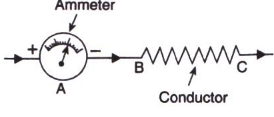
Q.18: What is an ammeter ? How is it connected in a circuit ? Draw a diagram to illustrate your answer.
Ans : An ammeter is an instrument used to measure electric current in a circuit. It is always connected in series with the part of the circuit whose current is to be measured so that the same current passes through the ammeter. An ideal ammeter has very low resistance so that it does not appreciably change the current in the circuit.
Q.19: (a) Write down the formula which relates electric charge, time and electric current.
(b) A radio set draws a current of 0.36 A for 15 minutes. Calculate the amount of electric charge that flows through the circuit.
Ans : (a) The relation is I = Q/t, where I is current, Q is charge and t is time. Equivalently Q = I × t.
(b) Given: I = 0.36 A, t = 15 minutes = 15 × 60 = 900 s.
Q = I × t = 0.36 × 900 = 324 C.
So 324 coulombs of charge flow through the circuit.
Q.20: Why should the resistance of :
(a) an ammeter be very small ?
(b) a voltmeter be very large ?
Ans : (a) The resistance of an ammeter should be very small so that it does not appreciably change the current in the circuit when inserted in series.
(b) The resistance of a voltmeter should be very large so that it draws only a negligible current when connected in parallel across a component; this prevents the voltmeter from altering the circuit condition.
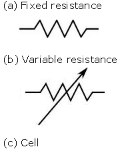
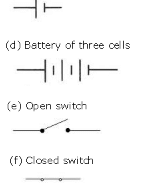
Q.21: Draw circuit symbols for (a) fixed resistance (b) variable resistance (c) a cell (d) a battery of three cells (e) an open switch (f) a closed switch.
Ans :
Q.22: What is a circuit diagram ? Draw the labelled diagram of an electric circuit comprising of a cell, a resistor, an ammeter, a voltmeter and a closed switch (or closed plug key). Which of the two has a large resistance : an ammeter or a voltmeter ?
Ans : A circuit diagram is a drawing that shows how electrical components are connected using standard circuit symbols. It represents the arrangement of cells, resistors, meters and switches in the circuit.
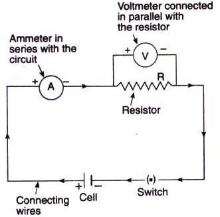
A voltmeter has a large resistance compared to an ammeter.
Q.23: If the charge on an electron is 1.6 x 10⁻¹⁹ coulombs, how many electrons should pass through a conductor in 1 second to constitute 1 ampere current ?
Ans : Given: charge on one electron e = 1.6 × 10⁻¹⁹ C.
For a current of 1 A, charge passing per second Q = 1 C.
Number of electrons per second = Q / e = 1 / (1.6 × 10⁻¹⁹) ≈ 6.25 × 10¹⁸ electrons.
Thus, about 6.25 × 10¹⁸ electrons must pass per second to produce 1 A.
Q.24:
The p.d. across a lamp is 12 V. How many joules of electrical energy are changed into heat and light when :
(a) a charge of 1 C passes through it ?
(b) a charge of 5 C passes through it ?
(c) a current of 2 A flows through it for 10 s ?
Ans :
Energy (work done) = potential difference × charge moved = V × Q.
(a) For Q = 1 C: Energy = 12 V × 1 C = 12 J.
(b) For Q = 5 C: Energy = 12 V × 5 C = 60 J.
(c) Given I = 2 A, t = 10 s.
First find charge: Q = I × t = 2 × 10 = 20 C.
Energy = V × Q = 12 × 20 = 240 J.
Therefore (a) 12 J, (b) 60 J, (c) 240 J of electrical energy are converted to heat and light.
Page No:12
Q.25:
In 10 s, a charge of 25 C leaves a battery, and 200 j of energy are delivered to an outside circuit as a result.
(a) What is the p.d. across the battery ?
(b) What current flows from the battery ?
Ans :
Given: Q = 25 C, t = 10 s, energy delivered W = 200 J.
(a) Potential difference V = W / Q = 200 / 25 = 8 V.
(b) Current I = Q / t = 25 / 10 = 2.5 A.
So the p.d. across the battery is 8 V and the current is 2.5 A.
Q.26:
(a) Define electric current. What is the SI unit of electric current.
(b) One coulomb of charge flows through any cross-section of a conductor in 1 second. What is the current flowing through the conductor ?
(c) Which instrument is used to measure electric current ? How should it be connected in a circuit ?
(d) What is the conventional direction of the flow of electric current ? How does it differ from the direction of flow of electrons ?
(e) A flash of lightning carries 10 C of charge which flows for 0.01 s. What is the current ? If the voltage is 10 MV, what is the energy ?
Ans :
(a) Electric current is the flow of electric charges (electrons) in a conductor. The SI unit is ampere (A).
(b) If 1 C flows in 1 s, current I = Q/t = 1/1 = 1 A.
(c) An ammeter is used to measure electric current. It must be connected in series with the circuit so that the current to be measured passes through it.
(d) The conventional direction of current is from the positive terminal to the negative terminal of a battery through the external circuit. Electrons actually move from the negative terminal to the positive terminal, i.e. opposite to the conventional direction.
(e) Given Q = 10 C, t = 0.01 s.
I = Q / t = 10 / 0.01 = 1 000 A.
Voltage V = 10 MV = 10 × 106 V.
Energy W = V × Q = (10 × 106) × 10 = 100 × 106 J = 100 MJ.
Thus I = 1 000 A and energy delivered is 100 MJ.
Q.32:
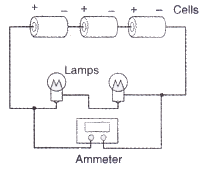
A student made an electric circuit shown here to measure the current through two lamps.
(a) Are the lamps in series or parallel ?
(b) The student has made a mistake in this circuit.
What is the mistake ?
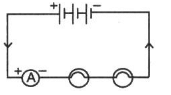
(c) Draw a circuit diagram to show the correct way to connect the circuit.
Use the proper circuit symbols in your diagram.
Ans :
(a) The two lamps are connected in series, so the same current flows through each lamp.
(b) The student has connected the ammeter incorrectly in parallel with the lamps. An ammeter must be connected in series so that the circuit current passes through it. Connecting it in parallel would short-circuit the lamps and damage the meter.
(c)
Q.33:
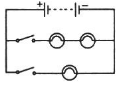
Draw a circuit diagram to show how 3 bulbs can be lit from a battery so that 2 bulbs are controlled by the same switch while the third bulb has its own switch.
Ans :
Q.34:
An electric heater is connected to the 230 V mains supply. A current of 8 A flows through the heater.
(a) How much charge flows around the circuit each second ?
(b) How much energy is transferred to the heater each second ?
Ans :
Given: V = 230 V, I = 8 A.
(a) Charge per second Q = I × 1 s = 8 C. So 8 coulombs flow each second.
(b) Energy transferred per second = Power = V × I = 230 × 8 = 1 840 J/s (i.e. 1 840 W).
Therefore 8 C flow each second and 1 840 joules of energy are delivered to the heater every second.
Q.35:
How many electrons are flowing per second past a point in a circuit in which there is a current of 5 amp ?
Ans :
Given: I = 5 A, t = 1 s.
Charge per second Q = I × t = 5 × 1 = 5 C.
Charge on one electron e = 1.6 × 10⁻¹⁹ C.
Number of electrons = Q / e = 5 / (1.6 × 10⁻¹⁹) = 3.125 × 10¹⁹ electrons.
So about 3.125 × 10¹⁹ electrons pass the point each second.
Page No:18
Q.1:
Name the law which relates the current in a conductor to the potential difference across its ends.
Ans :
Ohm's law.
Q.2:
Name the unit of electrical resistance and give its symbol.
Ans :
The unit of electrical resistance is ohm. Its symbol is Ω.
Q.3:
Name the physical quantity whose unit is "ohm".
Ans :
Electric resistance.
Q.4:
What is the general name of the substances having infinitely high electrical resistance ?
Ans :
Insulators.
Q.5:
Keeping the resistance constant, the potential difference applied across the ends of a component is halved. By how much does the current change ?
Ans :
Using V = I R and keeping R constant, V ∝ I.
If V is halved, I is also halved.
Q.6:
State the factors on which the strength of electric current flowing in a given conductor depends.
Ans :
The strength of electric current in a given conductor depends on:
(i) the potential difference (voltage) across the ends of the conductor;
(ii) the resistance of the conductor.
Q.7:
Which has less electrical resistance : a thin wire or a thick wire (of the same length and same material) ?
Ans :
A thick wire has less electrical resistance than a thin wire of the same length and material because its cross-sectional area is larger.
Q.8:
Keeping the potential difference constant, the resistance of a circuit is halved. By how much does the current change ?
Ans :
From V = I R, with V constant, I ∝ 1/R.
If resistance is halved, current doubles.
Q.9:
A potential difference of 20 volts is applied across the ends of a resistance of 5 ohms. What current will flow in the resistance ?
Ans :
Given: V = 20 V, R = 5 Ω.
Using V = I R, I = V / R = 20 / 5 = 4 A.
Q.10:
A resistance of 20 ohms has a current of 2 amperes flowing in it. What potential difference is there between its ends ?
Ans :
Given: R = 20 Ω, I = 2 A.
V = I R = 2 × 20 = 40 V.
Q.11:
A current of 5 amperes flows through a wire whose ends are at a potential difference of 3 volts. Calculate the resistance of the wire.
Ans :
Given: I = 5 A, V = 3 V.
Using R = V / I = 3 / 5 = 0.6 Ω.
Q.12:
Fill in the following blank with a suitable word :
Ohm's law states a relation between potential difference and........................
Ans :
current.
Q.13:
Distinguish between good conductors, resistors and insulators. Name two good conductors, two resistors and two insulators.
Ans :
Good conductors have very low electrical resistance; examples: copper and aluminium.
Resistors are materials with moderate or comparatively high resistance used to limit current; examples: nichrome and manganin.
Insulators have very high (practically infinite) resistance and do not allow current to flow; examples: rubber and wood.
Q.14:
Classify the following into good conductors, resistors and insulators :
Rubber, Mercury, Nichrome, Polythene, Aluminium, Wood, Manganin, Bakelite, Iron, Paper, Thermocol, Metal coin
Ans :
Conductor :- mercury, aluminium, iron, metal coin.
Resistor :- manganin, nichrome.
Insulator :- rubber, polythene, wood, bakelite, paper, thermocol.
Page No:19
Q.15:
What is Ohm's law ? Explain how it is used to define the unit of resistance.
Ans :
Ohm's law states that at a constant temperature the current (I) flowing through a conductor is directly proportional to the potential difference (V) across its ends. Mathematically, V = I R, where R is the resistance of the conductor. The unit of resistance is the ohm. One ohm is the resistance of a conductor when a potential difference of 1 volt across it produces a current of 1 ampere.

Thus, 1 Ω is the resistance that allows 1 A to flow when 1 V is applied.
Q.16:
(a) What is meant by the "resistance of a conductor" ? Write the relation between resistance, potential
difference and current.
(b) When a 12 V battery is connected across an unknown resistor, there is a current of 2.5 mA in the circuit. Calculate the value of the resistance of the resistor.
Ans :
(a) Resistance of a conductor is the property that causes it to oppose the flow of electric current. The relation between potential difference V, current I and resistance R is V = I R.
(b) Given: V = 12 V, I = 2.5 mA = 2.5 × 10⁻³ A.
R = V / I = 12 / (2.5 × 10⁻³) = 4.8 × 10³ Ω = 4 800 Ω.
Q.17:
(a) Define the unit of resistance (or Define the unit "ohm").
What happens to the resistance as the conductor is made thinner ?
Keeping the potential difference constant, the resistance of a circuit is doubled. By how much does the current change ?
Ans :
(a) One ohm is the resistance of a conductor when a potential difference of 1 volt across it causes a current of 1 ampere to flow.
(b) If a conductor is made thinner (smaller cross-sectional area), its resistance increases.
(c) Using V = I R with V constant, I ∝ 1/R. If R is doubled, the current becomes half of its previous value.
Q.18:
(a) Why do electricians wear rubber hand gloves while working with electricity ?
(b) What p.d. is needed to send a current of 6 A through an electrical appliance having a resistance of 40 Ω ?
Ans :
(a) Electricians wear rubber gloves because rubber is an insulator and prevents electric current from passing through their body, reducing the risk of electric shock.
(b) Given: I = 6 A, R = 40 Ω.
V = I R = 6 × 40 = 240 V.
Q.19:
An electric circuit consisting of a 0.5 m long nichrome wire XY, an ammeter, a voltmeter, four cells of 1.5 V each and a plug key was set up.
(i) Draw a diagram of this electric circuit to study the relation between the potential difference maintained between the points 'X' and 'Y' and the electric current flowing through XY.
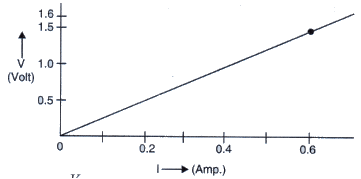
(ii) Following graph was plotted between V and I values :
(iii) What is the resistance of the wire ?
Ans :
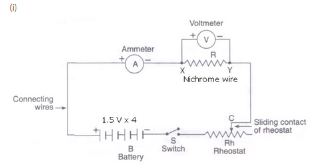
(ii) The graph is a straight line passing through the origin, showing that current is directly proportional to potential difference. Hence V/I is constant for the wire at the given temperature.
From the graph: when V = 1.5 V, I = 0.6 A.
Resistance R = V / I = 1.5 / 0.6 = 2.5 Ω.
Therefore the resistance of the wire is 2.5 ohm.


Q.20:
(a) What is the ratio of potential difference and current known as ?
(b) The values of potential difference V applied across a resistor and the corresponding values of current I
flowing in the resistor are given below :


Plot a graph between V and I, and calculate the resistance of the resistor.
(c) Name the law which is illustrated by the above V-I graph.
(d) Write down the formula which states the relation between potential difference, current and resistance,
(e) The potential difference between the terminals of an electric iron is 240 V and the current is 5.0 A. What is the resistance of the electric iron ?
Ans :
(a) The ratio V / I is known as the resistance.
(c) Ohm's law.
(d) V = I R.
(e) Given V = 240 V, I = 5.0 A.
R = V / I = 240 / 5 = 48 Ω.
PAGE 30:
Q.30:
An electric room heater draws a current of 2.4 A from the 120 V supply line. What current will this room heater draw when connected to 240 V supply line ?
Ans :
First find the resistance of the heater using the first situation.
Given: I1 = 2.4 A, V1 = 120 V.
R = V1 / I1 = 120 / 2.4 = 50 Ω.
Now with V2 = 240 V and the same resistance:
I2 = V2 / R = 240 / 50 = 4.8 A.
The heater will draw 4.8 A at 240 V.
Q.31:
Name the electrical property of a material whose symbol is "omega".
Ans :
Resistance (symbol: Ω).
Q.32:
The graph between V and 1 for a conductor is a straight line passing through the origin.
Which law is illustrated by such a graph ?
What should remain constant in a statement of this law ?
Ans :
(a) Ohm's law.
(b) Temperature should remain constant for Ohm's law to hold in this form.
Q.33:
A p.d. of 10 V is needed to make a current of 0.02 A flow through a wire. What p.d. is needed to make a current of 250 mA flow through the same wire ?
Ans :
From the first case, given V1 = 10 V, I1 = 0.02 A.
Resistance R = V1 / I1 = 10 / 0.02 = 500 Ω.
Now I2 = 250 mA = 250 × 10-3 A = 0.25 A.
V2 = I2 × R = 0.25 × 500 = 125 V.
Q.34:
A current of 200 mA flows through a 4 kΩ resistor. What is the p.d. across the resistor ?
Ans :
Given I = 200 mA = 0.2 A, R = 4 kΩ = 4 × 10³ Ω = 4 000 Ω.
V = I R = 0.2 × 4 000 = 800 V.
Page No:27
Q.22:
How does the resistance of a wire change when :
(i) its length is tripled ?
(ii) its diameter is tripled ?
(iii) its material is changed to one whose resistivity is three times ?
Ans :
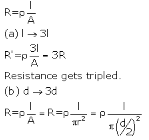
Using R = ρ L / A, where ρ is resistivity, L is length and A is cross-sectional area:
(i) If length L is tripled (L → 3L) and other factors unchanged, R → 3 R (resistance triples).
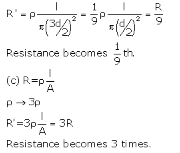
(ii) If diameter d is tripled, area A ∝ d² so A becomes 9 times larger. Therefore R becomes 1/9 of its original value (resistance decreases by factor 9).
(iii) If resistivity ρ is made three times larger, R becomes 3 R (resistance triples).
Q.23:
Calculate the area of cross-section of a wire if its length is 1.0 m, its resistance is 23 Ω and the resistivity of the material of the wire is 1.84 x 10⁻⁶ Ωm.
Ans :
Given: L = 1.0 m, R = 23 Ω, ρ = 1.84 × 10⁻⁶ Ω·m.
Use R = ρ L / A → A = ρ L / R.
A = (1.84 × 10-6 × 1.0) / 23 = 1.84 × 10⁻⁶ / 23 ≈ 8.00 × 10⁻⁸ m2.
Therefore the cross-sectional area is 8.00 × 10⁻⁸ m2.
Q.24:
(a) Define resistivity. Write an expression for the resistivity of a substance. Give the meaning of each symbol
which occurs in it.
(b) State the SI unit of resistivity.
(c) Distinguish between resistance and resistivity.
(d) Name two factors on which the resistivity of a substance depends and two factors on which it does not depend.
(e) The resistance of a metal wire of length 1 m is 26 Ω at 20°C. If the diameter of the wire is 0.3 mm, what will be the resistivity of the metal at that temperature ?
Ans :
(a) Resistivity (ρ) is a material property that quantifies how strongly the material opposes current. The relation is ρ = R A / L where R is the resistance of a uniform rod of the material, A is its cross-sectional area and L is its length.
(b) SI unit of resistivity is ohm-metre (Ω·m).
(c) Resistance is a property of a particular object and depends on its dimensions and material. Resistivity is a property of the material itself and does not depend on the object's size or shape.
(d) Resistivity depends on the nature of the material and its temperature. It does not depend on the length or the cross-sectional area of the sample.
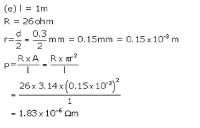
(e) Given: R = 26 Ω, L = 1.0 m, diameter d = 0.3 mm = 0.3 × 10⁻³ m = 3.0 × 10⁻⁴ m.
Area A = π (d/2)2 = π × (1.5 × 10⁻⁴)2 = π × 2.25 × 10⁻⁸ ≈ 7.07 × 10⁻⁸ m2.
ρ = R A / L = 26 × 7.07 × 10-8 / 1 ≈ 1.84 × 10⁻⁶ Ω·m.
So the resistivity is approximately 1.84 × 10⁻⁶ Ω·m.
Q.33:
A piece of wire of resistance 20 Ω is drawn out so that its length is increased to twice its original length. Calculate the resistance of the wire in the new situation.
Ans :
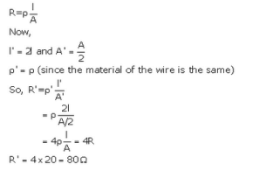
If the wire is drawn out keeping its volume constant, then when length L becomes 2L, cross-sectional area A becomes A/2.
Original R = ρ L / A = 20 Ω.
New resistance R' = ρ (2 L) / (A/2) = ρ × 2 L × 2 / A = 4 × (ρ L / A) = 4 × R = 4 × 20 = 80 Ω.
Therefore the new resistance is 80 ohm.
Q.34:
The electrical resistivities of three materials P, Q and R are given below :
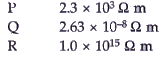
Which material will you use for making (a) electric wires (b) handle for soldering iron, and (c) solar cells ? Give reasons for your choices.
Ans :
(a) Use material Q (ρ = 2.63 × 10⁻⁸ Ω·m) for electric wires because it has very low resistivity and conducts electricity well.
(b) Use material R (ρ = 1.0 × 10¹⁵ Ω·m) for the handle of a soldering iron because it has very high resistivity and thus acts as an insulator, protecting the user from heat and current.
(c) Use material P (ρ = 2.3 × 10³ Ω·m) for solar cells because it has resistivity typical of a semiconductor, which is suitable for photovoltaic devices.
Q.35:
The electrical resistivities of four materials A, B, C and D are given below :
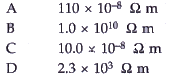
Which material is : (a) good conductor (b) resistor (c) insulator, and (d) semiconductor ?
Ans :
(a) Good conductor: C (10 × 10-8 Ω·m) - lowest resistivity.
(b) Resistor: A (110 × 10-8 Ω·m) - moderate resistivity suitable for resistive applications.
(c) Insulator: B (1 × 10¹⁰ Ω·m) - very high resistivity.
(d) Semiconductor: D (2.3 × 10³ Ω·m) - resistivity typical of semiconductors.
Q.36:
The electrical resistivities of five substances A, B, C, D and E are given below :
A 5.20 x l0-8 Ω m
Ans :
(a) Substance E is the best conductor since it has the least resistivity.
(b) Substance C is a better conductor than A because C has a lower resistivity than A.
(c) Substance B has the highest resistivity and so is the best insulator among the five.
(d) Substances C and E are the best choices where low resistivity (good conduction) is required.
Page No:37
Q.1:
Give the law of combination of resistances in series.
Ans :
When resistances are connected in series, the equivalent resistance is the sum of the individual resistances: R = R1 + R2 + ... + Rn.
Q.2:
If five resistances, each of value 0.2 ohm, are connected in series, what will be the resultant resistance ?
Ans :
R = 0.2 + 0.2 + 0.2 + 0.2 + 0.2 = 1.0 Ω.
Q.3:
State the law of combination of resistances in parallel.
Ans :
For resistances connected in parallel, the reciprocal of the equivalent resistance equals the sum of the reciprocals of the individual resistances: 1/R = 1/R1 + 1/R2 + ... + 1/Rn.
Q.4:
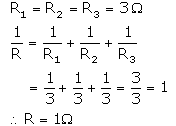
If 3 resistances of 3 ohm each are connected in parallel, what will be their total resistance ?
Ans :
For three equal resistances R each in parallel, Req = R / 3.
Here R = 3 Ω, so Req = 3 / 3 = 1 Ω.
Q.5:
How should the two resistances of 2 ohms each be connencted so as to produce an equivalent resistance of 1 ohm ?
Ans :
Connect the two 2 Ω resistances in parallel. For two equal resistances R in parallel, Req = R/2 = 2/2 = 1 Ω.
Q.6:
Two resistances X and Y are connected turn by turn : (i) in parallel, and (ii) in series. In which case the resultant resistance will be less than either of the individual resistances ?
Ans :
If X and Y are connected in parallel, the resultant resistance is less than either individual resistance. In series the resultant is greater than each individual resistance.
Q.7:
What possible values of resultant resistance one can get by combining two resistances, one of value 2 ohm and the other 6 ohm ?
Ans :
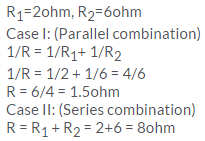
Possible combinations:
Series: R = 2 + 6 = 8 Ω.
Parallel: 1/R = 1/2 + 1/6 = (3 + 1)/6 = 4/6 = 2/3 ⇒ R = 3/2 = 1.5 Ω.
Thus the possible resultant resistances are 8 Ω (series) and 1.5 Ω (parallel).
FAQs on Lakhmir Singh & Manjit Kaur: Electricity, Solutions- 2
| 1. What are the different types of solutions in the field of electricity? |  |
| 2. How does a conductive solution allow the flow of electric current? | |
| 3. Why is distilled water considered a non-conductive solution? | |
| 4. What are some examples of conductive solutions in daily life? | |
| 5. Can non-conductive solutions be used to complete an electric circuit? | |




