Lakhmir Singh & Manjit Kaur: Electricity, Solutions- 4

Page No:47
Question 1:
Are the lights in your house wired in series ?
Solution :
No. Household lights are normally wired in parallel. In a parallel circuit each light gets the full supply voltage and can be switched on or off independently without affecting the others.
Question 2:
What happens to the other bulbs in a series circuit if one bulb blows off ?
Solution :
All the other bulbs stop glowing. In a series circuit the same current passes through every bulb; if the circuit is broken at any point (one bulb blows) the current stops flowing and all bulbs go out.
Question 3:
What happens to the other bulbs in a parallel circuit if one bulb blows off ?
Solution :
The other bulbs keep glowing. In a parallel circuit each bulb has its own path to the supply, so a break in one path does not stop current through the remaining paths.
Question 4:
Which type of circuit, series or parallel, is preferred while connecting a large number of bulbs :
(a) for decorating a hotel building from outside ?
(b) for lighting inside the rooms of the hotel ?
Solution :
(a) Series (often used in some decorative strings) - This arrangement is cheaper for simple decorative strings but has the disadvantage that if one bulb fuses the whole string may go out.
(b) Parallel - This is preferred for internal lighting because each lamp gets full supply voltage and can be controlled independently.
Question 5:
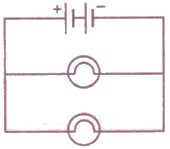
Draw a circuit diagram to show how two 4 V electric lamps can be lit brightly from two 2 V cells.
Solution :
First connect the two 2 V cells in series to make a total supply of 4 V (2 V + 2 V = 4 V). Then connect the two 4 V lamps in parallel across this 4 V supply so each lamp receives the required 4 V and lights brightly.
Question 6:
Why is a series arrangement not used for connecting domestic electrical appliances in a circuit ?
Solution :
A series arrangement is not used because if one appliance stops working (or a fuse blows) the whole circuit is broken and all other appliances on that circuit will stop working. Series wiring also forces every appliance to share the supply voltage, which is undesirable.
Question 7:
Give three reasons why different electrical appliances in a domestic circuit are connected in parallel.
Solution :
Different appliances are connected in parallel because:
(i) If one appliance fails, other appliances continue to work since each appliance has its own path to the supply.
(ii) Each appliance can have its own switch and can be turned on or off independently without affecting others.
(iii) Each appliance receives the full supply voltage, so they operate correctly and at their intended brightness or power.
Question 8:
Ten bulbs are connected in a series circuit to a power supply line. Ten identical bulbs are connected in a
(a) parallel circuit to an identical power supply line.
(b) Which circuit would have the highest voltage across each bulb ?
(c) In which circuit would the bulbs be brighter ?
(d) In which circuit, if one bulb blows out, all others will stop glowing ?
(e) Which circuit would have less current in it ?
Solution :
(a) Parallel circuit
(b) Parallel circuit - Each bulb in the parallel circuit gets the full supply voltage, whereas in the series circuit the supply voltage is divided among all bulbs.
(c) Parallel circuit - Because each bulb gets the full supply voltage, they are brighter than the same bulbs in series.
(d) Series circuit - In series the same current flows through every bulb so if one bulb blows the circuit opens and all go out.
(e) Series circuit - The equivalent resistance of ten bulbs in series is larger, so for the same supply voltage the total current is smaller in the series arrangement.
Question 9:
Consider the circuits given below :
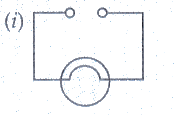
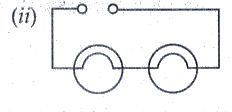
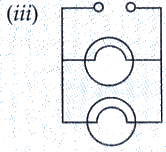
(a) In which circuit are the lamps dimmest ?
(b) In which circuit or circuits are the lamps of equal brightness to the lamps in circuit (/) ?
(c) Which circuit gives out the maximum light ?
Solution :
(a) Circuit (ii) - In that circuit the lamps share the supply so each gets less current or voltage and appears dimmer.
(b) Circuit (iii) - The lamps in circuit (iii) have the same arrangement as in circuit (i) with respect to voltage across each lamp, so they have equal brightness.
(c) Circuit (iii) - This circuit provides the highest voltage/current to the lamps shown and therefore gives the maximum light.
Page No:48
Question 10:
If you were going to connect two light bulbs to one battery, would you use a series or a parallel arrangement ? Why ? Which arrangement takes more current from the battery ?
Solution :
Parallel arrangement, because if one bulb fails the other will still keep glowing. The parallel arrangement draws more current from the battery for the same battery voltage because the equivalent resistance of two bulbs in parallel is less than the resistance when they are in series.
Question 11:
(a) Which is the better way to connect lights and other electrical appliances in domestic wiring : series circuits or parallel circuits ? Why ?
(b) Christmas tree lamps are usually wired in series. What happens if one lamp breaks ?
(c) An electrician has wired a house in such a way that if a lamp gets fused in one room of the house, all the lamps in other rooms of the house stop working. What is the defect in the wiring ?
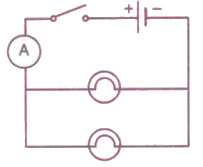
(d) Draw a circuit diagram showing two electric lamps connected in parallel together with a cell and a switch that works both lamps. Mark an 
Solution :
(a) Parallel circuits - Because each appliance works independently and receives full supply voltage; a fault in one does not affect the others.
(b) All the other lamps stop glowing because the series string becomes an open circuit when one lamp breaks.
(c) The defect is that the lamps are connected in series across rooms; they should be wired in parallel so each room has an independent supply.
(d)
Question 14:
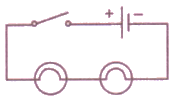
(a) Draw a circuit diagram showing two lamps, one cell and a switch connected in series.
(b) How can you change the brightness of the lamps ?
Solution :
(a)
(b) The brightness of the lamps can be changed by altering the current through them. This may be done by:
- changing the supply voltage,
- inserting a variable resistor (dimmer) in series to reduce the current,
- or by changing the connection so that each lamp gets the full supply voltage (for example by connecting them in parallel rather than in series).
Question 15:
Consider the circuit given below where A, B and C are three identical light bulbs of constant resistance.
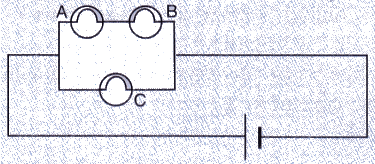
(a) List the bulbs in order of increasing brightness.
(b) If C burns out, what will be the brightness of A now compared with before ?
(c) If B burns out instead, what will be the brightness of A and C compared with before ?
Solution :
(a) C is brightest; A and B have equal brightness and are dimmer than C. This is because C has the full supply voltage across it while A and B share the remaining voltage.
(b) If C burns out, A is unaffected and keeps the same brightness as before because its path to the supply is unchanged.
(c) If B burns out, A and B's series path is broken so A will stop glowing. The brightness of C remains the same because C has its own path and is not affected by the break in A-B series.
Question 16:
How do you think the brightness of two lamps arranged in parallel compares with the brightness of two lamps arranged in series (both arrangements having one cell) ?
Solution :
The brightness of two identical lamps in parallel is much greater than when they are arranged in series. In parallel each lamp receives the full supply voltage; in series the supply voltage is shared and each lamp receives less voltage, so they are dimmer.
Question 17:
If current flows through two lamps arranged :
(a) in series,
(b) in parallel,
and the filament of one lamps breaks, what happens to the other lamp ? Explain your answer.
Solution :
(a) Series: If the filament of one lamp breaks the circuit is opened and the other lamp will stop glowing.
(b) Parallel: If the filament of one lamp breaks the other lamp will keep glowing because its path to the supply is still complete.
Page No:49
Question 18:
The figure below shows a variable resistor in a dimmer switch.
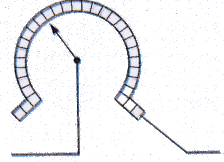
How would you turn the switch to make the lights : (a) brighter, and (b) dimmer ? Explain your answer.
Solution :
(a) Turn the knob so that the resistance decreases (move it towards the right as shown). Lower resistance allows more current to flow and the lights become brighter.
(b) Turn the knob so that the resistance increases (move it towards the left). Higher resistance reduces the current and the lights become dimmer.
Page No:58
Question 1:
State two factors on which the electrical energy consumed by an electrical appliance depends.
Solution :
Electrical energy consumed depends on:
1. The power rating of the appliance (how much energy it uses per second).
2. The time for which the appliance is used.
Question 2:
Which one has a higher electrical resistance : a 100 watt bulb or a 60 watt bulb ?
Solution :
The 60 watt bulb has a higher electrical resistance (when both are designed for the same supply voltage). For the same voltage V, power P = V2/R, so lower power means larger resistance.
Question 3:
Name the commercial unit of electric energy.
Solution :
Answer: Kilowatt-hour (kWh) is the commercial unit of electrical energy.
Question 4:
An electric bulb is rated at 220 V, 100 W. What is its resistance ?
Solution :
V = 220 V, P = 100 W
We know that P = V2/R
Thus R = V2/P = 2202/100 = 48 400/100 = 484 Ω
Question 5:
What is the SI unit of (i) electric energy, and (ii) electric power ?
Solution :
(i) Joule (J)
(ii) Watt (W)
Question 6:
Name the quantity whose unit is (i) kilowatt, and (ii) kilowatt-hour.
Solution :
(i) Kilowatt is a unit of electric power.
(ii) Kilowatt-hour is a unit of electric energy.
Question 7:
Which quantity has the unit of watt ?
Solution :
Electric power has the unit watt (W).
Question 8:
What is the meaning of the symbol kWh ? Which quantity does it represent ?
Solution :
kWh stands for kilowatt-hour. It represents electrical energy equal to the energy used by a 1 kW appliance running for 1 hour. It is the commercial unit of electrical energy.
Question 9:
If the potential difference between the end of a wire of fixed resistance is doubled, by how much does the electric power increase ?
Solution :
P = V2/R. If V is doubled, P becomes (2V)2/R = 4V2/R, so the electric power increases by four times.
Question 10:
An electric lamp is labelled 12 V, 36 W. This indicates that it should be used with a 12 V supply. What other information does the label provide ?
Solution :
It also shows the lamp consumes electrical energy at the rate of 36 J every second (i.e., 36 W = 36 J/s) when used at 12 V.
Question 11:
What current will be taken by a 920 W appliance if the supply voltage is 230 V ?
Solution :
P = 920 W, V = 230 V, I = ?
P = V × I
920 = 230 × I
I = 920/230 = 4 A
Question 12:
Define watt. Write down an equation linking watts, volts and amperes.
Solution :
One watt is the power when an appliance consumes energy at the rate of 1 joule per second.
Relation: 1 watt = 1 volt × 1 ampere, or P = V × I.
Question 13:
Define watt-hour. How many joules are equal to 1 watt-hour ?
Solution :
One watt-hour is the energy consumed by a 1 W appliance running for 1 hour.
1 watt-hour = 1 W × 3600 s = 3600 J.
Question 14:
How much energy is consumed when a current of 5 amperes flows through the filament (or element) of a heater having resistance of 100 ohms for two hours ? Express it in joules.
Solution :
I = 5 A, R = 100 Ω, t = 2 h = 2 × 3600 s = 7200 s
Power P = I2R = 52 × 100 = 25 × 100 = 2500 W = 2500 J/s
Energy consumed = P × t = 2500 × 7200 = 18 000 000 J = 1.8 × 10⁷ J
In kWh: P = 2.5 kW, t = 2 h → energy = 5 kWh (which equals 5 × 3.6 × 106 J = 1.8 × 10⁷ J).
Question 15:
An electric bulb is connected to a 220 V power supply line. If the bulb draws a current of 0.5 A, calculate the power of the bulb.
Solution :
V = 220 V, I = 0.5 A
P = V × I = 220 × 0.5 = 110 W
Question 16:
In which of the following cases more electrical energy is consumed per hour ?
(i) A current of 1 ampere passed through a resistance of 300 ohms.
(ii) A current of 2 amperes passed through a resistance of 100 ohms.
Solution :
(i) R = 300 Ω, I = 1 A
P = I2R = 12 × 300 = 300 W
Energy in 1 h = 300 Wh = 0.3 kWh
(ii) R = 100 Ω, I = 2 A
P = I2R = 22 × 100 = 400 W
Energy in 1 h = 400 Wh = 0.4 kWh
Hence case (ii) uses more energy per hour.
Question 17:
An electric kettle rated at 220 V, 2.2 kW, works for 3 hours. Find the energy consumed and the current drawn.
Solution :
V = 220 V, P = 2.2 kW = 2200 W, t = 3 h
Energy consumed = P × t = 2.2 kW × 3 h = 6.6 kWh
Current I = P / V = 2200 / 220 = 10 A
Page No:59
Question 18:
In a house two 60 W electric bulbs are lighted for 4 hours, and three 100 W bulbs for 5 hours everyday. Calculate the electric energy consumed in 30 days.
Solution :
Case 1:
Power, P1 = 60 W, Number n1 = 2, Time each day t1 = 4 h
Daily energy E1 = n1 × P1 × t1 = 2 × 60 × 4 = 480 Wh = 0.48 kWh
Energy in 30 days = 30 × 0.48 = 14.4 kWh
Case 2:
Power, P2 = 100 W, Number n2 = 3, Time each day t2 = 5 h
Daily energy E2 = 3 × 100 × 5 = 1500 Wh = 1.5 kWh
Energy in 30 days = 30 × 1.5 = 45 kWh
Total energy in 30 days = 14.4 kWh + 45 kWh = 59.4 kWh
Question 19:
A bulb is rated as 250 V; 0.4 A. Find its : (i) power, and (ii) resistance.
Solution :
V = 250 V, I = 0.4 A
(i) Power P = V × I = 250 × 0.4 = 100 W
(ii) Resistance R = V / I = 250 / 0.4 = 625 Ω
Question 20:
For a heater rated at 4 kW and 220 V, calculate :
(a) the current,
(b) the resistance of the heater,
(c) the energy consumed in 2 hours, and
(d) the cost if 1 kWh is priced at ₹ 60.
Solution :
Given: P = 4 kW = 4000 W, V = 220 V
(a) Current I = P / V = 4000 / 220 ≈ 18.18 A
(b) Resistance R = V / I = 220 / 18.18 ≈ 12.1 Ω
(c) Energy in 2 hours = P × t = 4 kW × 2 h = 8 kWh
(d) Cost = 8 kWh × ₹ 60 per kWh = ₹ 480
Question 21:
An electric motor takes 5 amperes current from a 220 volt supply line. Calculate the power of the motor and electrical energy consumed by it in 2
Solution :
I = 5 A, V = 220 V, t = 2 h
Power P = V × I = 220 × 5 = 1100 W = 1.1 kW
Energy consumed E = P × t = 1.1 kW × 2 h = 2.2 kWh
Question 22:
Which uses more energy : a 250 W TV set in 1 hour or a 1200 W toaster in 10 minutes ?
Solution :
TV: P = 250 W = 0.25 kW, t = 1 h → Energy = 0.25 kWh
Toaster: P = 1200 W = 1.2 kW, t = 10 min = 10/60 h = 1/6 h → Energy = 1.2 × 1/6 = 0.2 kWh
Therefore the TV uses more energy (0.25 kWh > 0.2 kWh).
Question 23:
Calculate the power used in the 2 Ω resistor in each of the following circuits :
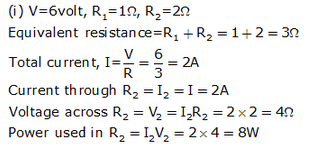
(i) a 6 V battery in series with 1 Ω and 2 Ω resistors.
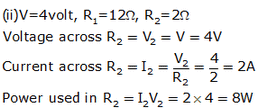
(ii) a 4 V battery in parallel with 12 Ω and 2 Ω resistors.
Solution :
(i) Series: Total resistance Rtot = 1 Ω + 2 Ω = 3 Ω
Current I = V / Rtot = 6 / 3 = 2 A
Power in 2 Ω resistor P = I2 × R = 22 × 2 = 4 × 2 = 8 W
(ii) Parallel: The 2 Ω resistor is directly across the 4 V battery, so voltage across it is 4 V.
Power P = V2 / R = 42 / 2 = 16 / 2 = 8 W
In both cases the 2 Ω resistor dissipates 8 W.
Question 24:
Two lamps, one rated 40 W at 220 V and the other 60 W at 220 V, are connected in parallel to the electric supply at 220 V.
(a) Draw a circuit diagram to show the connections.
(b) Calculate the current drawn from the electric supply.
(c) Calculate the total energy consumed by the two lamps together when they operate for one hour.
Solution : Given two lamps: P1 = 40 W, P2 = 60 W, V = 220 V
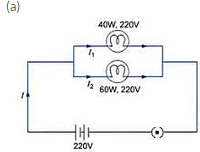
(b) Current through 40 W lamp: I1 = P1/V = 40 / 220 A = 0.1818 A (approx.)
Current through 60 W lamp: I2 = P2/V = 60 / 220 A = 0.2727 A (approx.)
Total current from supply = I1 + I2 ≈ 0.1818 + 0.2727 = 0.4545 A ≈ 0.45 A
(c) Energy by 40 W lamp in 1 h = 40 Wh = 0.04 kWh = 144 kJ (40 × 3.6 kJ)
Energy by 60 W lamp in 1 h = 60 Wh = 0.06 kWh = 216 kJ
Total energy in 1 h = 40 Wh + 60 Wh = 100 Wh = 0.1 kWh = 360 kJ
Question 25:
An electric kettle connected to the 230 V mains supply draws a current of 10 A. Calculate :
(a) the power of the kettle.
(b) the energy transferred in 1 minute.
Solution :
V = 230 V, I = 10 A
(a) Power P = V × I = 230 × 10 = 2300 W = 2.3 kW
(b) Energy in 1 minute (60 s): E = P × t = 2300 J/s × 60 s = 138 000 J (or 0.0383 kWh)
Question 26:
A 2 kW heater, a 200 W TV and three 100 W lamps are all switched on from 6 p.m. to 10 p.m. What is the total cost at Rs. 5.50 per kWh ?
Solution :
Time t = 4 h (6 p.m. to 10 p.m.)
Heater: P = 2 kW, E = 2 × 4 = 8 kWh
TV: P = 0.2 kW, E = 0.2 × 4 = 0.8 kWh
Lamps: each 0.1 kW, three lamps → P = 0.3 kW, E = 0.3 × 4 = 1.2 kWh
Total energy = 8 + 0.8 + 1.2 = 10 kWh
Cost = 10 × Rs. 5.50 = Rs. 55
Question 27:
What is the maximum power in kilowatts of the appliance that can be connected safely to a 13 A ; 230 V mains socket ?
Solution :
I = 13 A, V = 230 V
Maximum power P = V × I = 230 × 13 = 2990 W ≈ 2.99 kW
Question 28:
An electric fan runs from the 230 V mains. The current flowing through it is 0.4 A. At what rate is electrical energy transferred by the fan ?
Solution :
V = 230 V, I = 0.4 A
Power P = V × I = 230 × 0.4 = 92 W = 92 J/s
Question 29:
(a) What is meant by "electric power" ? Write the formula for electric power in terms of potential difference and current.
(b) The diagram below shows a circuit containing a lamp L, a voltmeter and an ammeter. The voltmeter reading is 3 V and the ammeter reading is 0.5 A
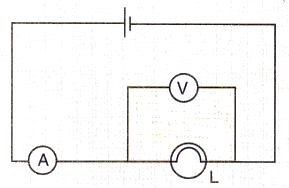
(i) What is the resistance of the lamp ?
(ii) What is the power of the lamp ?
(c) Define kilowatt-hour. How many joules are there in one kilowatt-hour ?
(d) Calculate the cost of operating a heater of 500 W for 20 hours at the rate of ? Rs 3.90 per unit.
Solution :
(a) Electric power is the rate at which electrical energy is used or converted into other forms. Formula: P = V × I
(b) Given V = 3 V, I = 0.5 A
(i) Resistance R = V / I = 3 / 0.5 = 6 Ω
(ii) Power P = V × I = 3 × 0.5 = 1.5 W
(c) One kilowatt-hour (kWh) is the energy used by a 1 kW appliance running for 1 hour. 1 kWh = 3.6 × 10⁶ J.
(d) Heater: P = 500 W = 0.5 kW, t = 20 h
Energy = 0.5 × 20 = 10 kWh
Cost = 10 × Rs. 3.90 = Rs. 39
Page No:60
Question 41:
State whether an electric heater will consume more electrical energy or less electrical energy per second when the length of its heating element is reduced. Give reasons for your answer.
Solution :
If the length of the heating element is reduced, its resistance decreases (resistance is proportional to length). For the same supply voltage a smaller resistance leads to a larger current and therefore the power P = V2/R (or P = I2R) increases. So the heater will consume more electrical energy per second.
Question 42:
The table below shows the current in three different electrical appliances when connected to the 240 V mains supply :
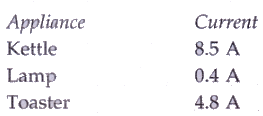
(a) Which appliance has the greatest electrical resistance ? How does the data show this ?
(b) The lamp is connected to the mains supply by using a thin, twin-cored cable consisting of live and neutral wires. State two reasons why this cable should not be used for connecting the kettle to the mains supply.
(c) Calculate the power rating of the kettle when it is operated from the 240 V mains supply.
(d) A man takes the kettle abroad where the mains supply is 120 V. What is the current in the kettle when it is operated from the 120 V supply ?
Solution :
(a) Lamp has the greatest resistance because it draws the least current at the same supply voltage (R = V / I).
(b) A thin twin-cored cable should not be used for the kettle because:
- The kettle draws a large current and the thin cable may overheat causing a fire risk.
- The kettle should have an earth connection and a thicker, properly insulated cable for safety.
(c) P = V × I = 240 × 8.5 = 2040 W = 2.04 kW
(d) First find R from P = V2/P: R = V2/P = 2402/2040 ≈ 28.24 Ω
At 120 V, I = V / R = 120 / 28.24 ≈ 4.25 A
Question 43:
A boy noted the readings on his home's electricity meter on Sunday at 8 AM and again on Monday at 8 AM (see figure below).
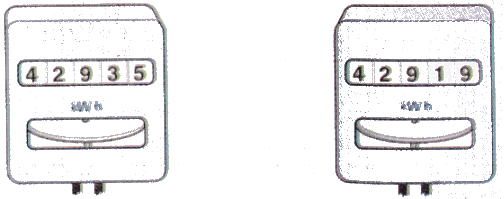
(a) What was the meter reading on Sunday ?
(b) What was the meter reading on Monday ?
(c) How many units of electricity have been used ?
(d) In how much time these units have been used ?
(e) If the rate is Rs. 5 per unit, what is the cost of electricity used during this time ?
Solution :
(a) 42919
(b) 42935
(c) Units used = 42935 - 42919 = 16 units
(d) Time = 24 hours (from Sunday 8 AM to Monday 8 AM)
(e) Cost = 16 × Rs. 5 = Rs. 80
Question 44:
An electric bulb is rated as 10 W, 220 V. How many of these bulbs can be connected in parallel across the two wires of 220 V supply line if the maximum current which can be drawn is 5 A ?
Solution :
P (total allowed) = V × I = 220 × 5 = 1100 W
Power of one bulb = 10 W
Number of bulbs = 1100 / 10 = 110 bulbs
Question 45:
Two exactly similar electric lamps are arranged (i) in parallel, and (ii) in series. If the parallel and series combination of lamps are connected to 220 V supply line one by one, what will be the ratio of electric power consumed by them ?
Solution :
Let the resistance of each lamp be R.
Case 1 - Parallel: Equivalent resistance Rp = R/2. Power from supply Pp = V2 / Rp = V2 / (R/2) = 2 V2 / R.
Case 2 - Series: Equivalent resistance Rs = 2R. Power from supply Ps = V2 / Rs = V2 / (2R) = (1/2) V2 / R.
Ratio Pp : Ps = (2 V2 / R) : (0.5 V2 / R) = 4 : 1
Page No:66
Question 1:
How does the heat H produced by a current passing through a fixed resistance wire depend on the magnitude of current I ?
Solution :
The heat produced is directly proportional to the square of the current, H ∝ I2 (for fixed R and t).
Question 2:
If the current passing through a conductor is doubled, what will be the change in heat produced ?
Solution :
Since H ∝ I2, doubling the current (I → 2I) increases the heat produced by a factor of 4 (because (2I)2 = 4I2).
Question 3:
Name two effects produced by electric current.
Solution :
Two effects produced by electric current are:
(a) Heating effect
(b) Magnetic effect
Question 4:
Which effect of current is utilised in an electric light bulb ?
Solution :
Heating effect (the filament heats up and emits light).
Question 5:
Which effect of current is utilised in the working of an electric fuse ?
Solution :
Heating effect - the fuse wire melts when excess current causes it to heat up, breaking the circuit to protect appliances.
Question 6:
Name two devices which work on the heating effect of electric current.
Solution :
Electric heater and electric fuse (also electric irons, toasters, kettles etc.).
Question 7:
Name two gases which are filled in filament type electric light bulbs.
Solution :
Argon and nitrogen are commonly used to fill filament bulbs because they are chemically inert and slow down filament evaporation.
Question 8:
Explain why, filament type electric bulbs are not power efficient.
Solution :
Filament bulbs are not power efficient because most of the electrical energy converted by the filament appears as heat rather than visible light. Only a small fraction is emitted as visible light, so a lot of energy is wasted as heat.
Question 9:
Why does the connecting cord of an electric heater not glow hot while the heating element does ?
Solution :
The connecting cord is usually made of copper which has a very low resistance, so it produces very little heat for the same current. The heating element is made of a high-resistance alloy (e.g. nichrome), so it produces large amounts of heat and glows hot.
Question 10:
(a) Write down the formula for the heat produced when a current I is passed through a resistor R for time
(b) An electric iron of resistance 20 ohms draws a current of 5 amperes. Calculate the heat produced in 30 seconds.
Solution :
(a) Heat produced H = I2 R t
(b) Given R = 20 Ω, I = 5 A, t = 30 s
H = I2 R t = 52 × 20 × 30 = 25 × 20 × 30 = 15 000 J
Question 11:
State three factors on which the heat produced by an electric current depends. How does it depend on these factors ?
Solution :
Heat produced H depends on:
(i) Current I - H ∝ I2 (directly proportional to the square of the current).
(ii) Resistance R - H ∝ R (directly proportional to resistance).
(iii) Time t - H ∝ t (directly proportional to the time the current flows).
Question 12:
(a) State and explain Joule's law of heating.
(b) A resistance of 40 ohms and one of 60 ohms are arranged in series across 220 volt supply. Find the heat in joules produced by this combination of resistances in half a minute.
Solution :
(a) Joule's law of heating: The heat produced when a current I flows through a resistance R for time t is H = I2 R t. Thus heat is proportional to I2, R and t.
(b) Rtot = 40 + 60 = 100 Ω, V = 220 V, t = 30 s
Current I = V / Rtot = 220 / 100 = 2.2 A
H = I2 Rtot t = (2.2)2 × 100 × 30 ≈ 14520 J
Question 13:
Why is an electric light bulb not filled with air ? Explain why argon or nitrogen is filled in an electric bulb.
Solution :
If air (which contains oxygen) were inside the bulb, the hot tungsten filament would quickly oxidise and burn away. Chemically unreactive gases such as argon or nitrogen are used instead because they do not react with the hot filament and so they increase the life of the filament.
Question 14:
Explain why, tungsten is used for making the filaments of electric bulbs.
Solution :
Tungsten is used because it has a very high melting point and low rate of evaporation at high temperature. This allows the filament to become very hot and emit light without melting. Tungsten is also strong and flexible enough to form a fine filament.
Question 15:
Explain why, the current that makes the heater element very hot, only slightly warms the connecting wires leading to the heater.
Solution :
The heater element has a much higher resistance than the connecting wires. For the same current, most heat is produced in the high-resistance element (H = I2R), while the low-resistance wires produce very little heat and remain only slightly warm.
Question 16:
When a current of 4.0 A passes through a certain resistor for 10 minutes, 2.88 x 10⁴ J of heat are produced. Calculate :
(a) the power of the resistor.
(b) the voltage across the resistor.
Solution : Given I = 4 A, t = 10 min = 600 s, H = 2.88 × 10⁴ J
(a) H = I2 R t → R = H / (I2 t) = 2.88 × 10⁴ / (42 × 600) = 28800 / (16 × 600) = 28800 / 9600 = 3 Ω
Power P = I2 R = 42 × 3 = 16 × 3 = 48 W
(b) Voltage V = I × R = 4 × 3 = 12 V
Question 17:
A heating coil has a resistance of 200 Ω. At what rate will heat be produced in it when a current of 2.5 A flows through it ?
Solution :
R = 200 Ω, I = 2.5 A, t = 1 s (rate means per second)
H = I2 R t = 2.52 × 200 × 1 = 6.25 × 200 = 1250 J/s
Question 18: An electric heater of resistance 8Ω, takes a current of 15 A from the mains supply line. Calculate the rate at which heat is developed in the heater.
Solution :
R = 8 Ω, I = 15 A
H (per second) = I2 R = 152 × 8 = 225 × 8 = 1800 J/s
Question 19:
A resistance of 25 Ω is connected to a 12 V battery. Calculate the heat energy in joules generated per minute.
Solution : R = 25 Ω, V = 12 V, t = 60 s
Current I = V / R = 12 / 25 = 0.48 A
H per minute = I2 R t = (0.48)2 × 25 × 60 ≈ 0.2304 × 25 × 60 = 345.6 J
Question 20:
100 joules of heat is produced per second in a 4 ohm resistor. What is the potential difference across the resistor ?
Solution : H = 100 J/s, R = 4 Ω, t = 1 s
H = I2 R t → 100 = I2 × 4 × 1 → I2 = 25 → I = 5 A
Voltage V = I × R = 5 × 4 = 20 V
Question 21:
(a) Derive the expression for the heat produced due to a current 'I' flowing for a time interval 't' through a resistor 'R' having a potential difference 'V' across its ends. With which name is this relation known ?
(b) How much heat will an instrument of 12 W produce in one minute if it is connected to a battery of 12 V ?
(c) The current passing through a room heater has been halved. What will happen to the heat produced by it ?
(d) What is meant by the heating effect of current ? Give two applications of the heating effect of current.
(e) Name the material which is used for making the filaments of an electric bulb.
Solution :
(a) Work done in moving charge Q through p.d. V is W = Q × V. But Q = I × t, and V = I × R. So W = I × t × I × R = I2 R t. Assuming all electrical work becomes heat, heat H = I2 R t. This is Joule's law of heating.
(b) P = 12 W, V = 12 V, t = 60 s
Current I = P / V = 12 / 12 = 1 A
Heat H = I2 R t. First find R = V / I = 12 / 1 = 12 Ω
H = 12 × 12 × 60 = 720 J
(c) If current is halved, heat produced becomes one quarter (since H ∝ I2).
(d) Heating effect: When current flows through a resistor it produces heat because electrical energy is converted into heat energy. Applications include electric heaters, electric irons, toasters, kettles and fuses.
(e) Tungsten is used for filaments of electric bulbs.
Page No:67
Question 31:
The electrical resistivities of four materials P, Q, R and S are given below :
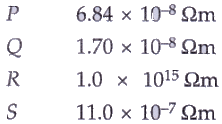
Which material will you use for making : (a) heating element of electric iron (b) connecting wires of electric iron (c) covering of connecting wires ? Give reason for your choice in each case.
Solution :
(a) S - It has a relatively high resistivity (this corresponds to nichrome) so it will produce heat and is suitable for a heating element.
(b) Q - It has a very low resistivity (this corresponds to copper) so it is suitable for connecting wires as it conducts well and heats little.
(c) R - It has a very high resistivity and is an electrical insulator (this corresponds to rubber); it is suitable as an insulating covering for wires.
Question 32:
(a) How does the wire in the filament of a light bulb behave differently to the other wires in the circuit when the current flows ?
(b) What property of the filament wire accounts for this difference ?
Solution :
(a) The filament becomes white hot and emits light, while other wires remain comparatively cool.
(b) The filament wire has a much higher resistance than the other circuit wires; this causes it to produce more heat and reach a high temperature.
Question 33:
Two exactly similar heating resistances are connected (i) in series, and (ii) in parallel, in two different circuits, one by one. If the same current is passed through both the combinations, is more heat obtained per minute when they are connected in series or when they are connected in parallel ? Give reason for your answer.
Solution :
More heat is obtained when they are connected in series for the same current because the total resistance is larger in series (Rseries = R + R = 2R) and heat H = I2 Rtotal t. Larger Rtotal gives larger H for the same I and t.
Question 34:
An electric iron is connected to the mains power supply of 220 V. When the electric iron is adjusted at 'minimum heating' it consumes a power of 360 W but at 'maximum heating' it takes a power of 840 W. Calculate the current and resistance in each case.
Solution :
V = 220 V
Minimum heating: Pmin = 360 W
Imin = P / V = 360 / 220 ≈ 1.636 A
Rmin = V / Imin = 220 / 1.636 ≈ 134.5 Ω
Maximum heating: Pmax = 840 W
Imax = 840 / 220 ≈ 3.818 A
Rmax = 220 / 3.818 ≈ 57.6 Ω
Question 35:
Which electric heating devices in your home do you think have resistors which control the flow of electricity ?
Solution :
Examples include electric irons, electric ovens, water heaters (geyser), room heaters and electric kettles. These devices have heating elements whose resistance controls how much electrical energy is converted into heat.
FAQs on Lakhmir Singh & Manjit Kaur: Electricity, Solutions- 4
| 1. What is electricity? |  |
| 2. How is electricity generated? | |
| 3. What are the types of electric circuits? | |
| 4. What are the safety precautions while handling electricity? | |
| 5. How does electricity help in our daily lives? | |





