Lakhmir Singh & Manjit Kaur: Reflection of Light, Solutions- 2

Page No:175
Question 36: A man stands 10 m in front of a large plane mirror. How far must he walk before he is 5 m away from his image ?
Ans: Let the distance of the man from the mirror be x. The distance between the man and his image = x + x = 2x.
We want 2x = 5 m, so x = 2.5 m.
Initially x = 10 m, so he must walk 10 m - 2.5 m = 7.5 m towards the mirror. Hence, he must walk 7.5 m towards the mirror.
Question 37: An object is placed 20 cm in front of a plane mirror. The mirror is moved 2 cm towards the object. The distance between the positions of the original and final images seen in the mirror is :
(a) 2 cm,
(b) 4 cm
(c) 10 cm
(d) 22 cm
Ans: (b)
Explanation: When the object is 20 cm from the mirror, its image is 20 cm behind the mirror. If the mirror is moved 2 cm towards the object, the object-mirror separation becomes 18 cm, so the new image is 18 cm behind the new mirror position. The original image location moved 2 cm (because the mirror moved) and the new image is 2 cm closer to the mirror than the original image, so the total shift between original and final image positions = 2 cm + 2 cm = 4 cm.
Question 38: A man sits in an optician's chair, looking into a plane mirror which is 2 m away from him and views the image of a chart which faces the mirror and is 50 cm behind his head. How far away from his eyes does the chart appear to be ?
Ans: Distance between the man and the mirror = 2 m.
Distance between the chart and the man = 50 cm = 0.5 m (the chart is behind his head).
So distance between the chart and the mirror = 0.5 m + 2.0 m = 2.5 m. For a plane mirror, the image of the chart is the same distance behind the mirror, i.e. 2.5 m behind it.
Therefore, the apparent distance of the chart from the man's eyes = distance from man to mirror + distance from mirror to image = 2.0 m + 2.5 m = 4.5 m.
Question 39: A ray of light strikes a plane mirror PQ at an angle of incidence of 30°, is reflected from the plane mirror and then strikes a second plane mirror QR placed at right angles to the first mirror. The angle of reflection at the second mirror is :
(a) 30° (b) 45° (c) 60° (d) 90°
Draw a ray-diagram to illustrate your answer.
Ans: (c)
Explanation: Ray AB strikes mirror PQ at B with angle of incidence 30° and is reflected along BC. Mirror QR is at right angles to PQ. The ray BC makes 30° with the plane of mirror QR, so the angle between the ray and the normal to QR is 90° - 30° = 60°. Thus the angle of incidence on QR is 60°, and by the law of reflection the angle of reflection at QR is also 60°. (See the given ray diagram.)
Solution :
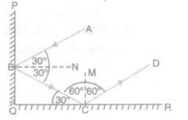
Ray AB strikes the mirror PQ at B and gets reflected along BC according to the laws of reflection. The ray BC incident on mirror QR makes an angle of 30o with the mirror. So, the angle of incidence on this mirror is 90o - 30o = 60o. Hence, the angle of reflection is also 60o.
Question 40: Explain how to read the following message which was found on some blotting paper :

Ans: The impression on the blotting paper is a mirror image (laterally inverted) of the original writing. To read it correctly, hold the blotting paper in front of a plane mirror; the mirror will produce a laterally inverted image of the impression and the writing will appear in its correct readable form.
Page No:178
Question 1: Name the spherical mirror which has :
virtual principal focus.
real principal focus.
Ans: (a) Convex mirror has a virtual principal focus.
(b) Concave mirror has a real principal focus.
Question 2: Out of convex mirror and concave mirror, whose focus is situated behind the mirror ?
Ans: Convex mirror.
Question 3: Find the focal length of a concave mirror whose radius of curvature is 32 cm.
Ans: Radius of curvature R = 32 cm.
Focal length f = R/2 = 32/2 = 16 cm.
Question 4: If the focal length of a convex mirror is 25 cm, what is its radius of curvature ?
Ans: For a spherical mirror f = R/2.
Given f = 25 cm ⇒ R = 2f = 50 cm.
Page No:179
Question 5: Fill in the following blanks with suitable words :
Parallel rays of light are reflected by a concave mirror to a point called the...........
The focal length of a concave mirror is the distance from the.......... to the mirror.
A concave mirror........ rays of light whereas a convex mirror......... rays of light.
For a convex mirror, parallel rays of light appear to diverge from a point called the............
Ans: (a) principal focus.
(b) principal focus (distance measured from the pole to the mirror).
(c) converges; diverges.
(d) principal focus.
Question 6: What is a spherical mirror ? Distinguish between a concave mirror and a convex mirror.
Ans: A spherical mirror is a mirror whose reflecting surface is a part of a hollow sphere of glass.
Difference:
• Concave mirror: The reflecting surface is the inner (bent-in) part of the sphere; it converges parallel rays and is called a converging mirror.
• Convex mirror: The reflecting surface is the outer (bulging-out) part of the sphere; it diverges parallel rays and is called a diverging mirror.
Question 7: Name the two types of spherical mirrors. What type of mirror is represented by the :
(a) back side of a shining steel spoon ?
(b) front side of a shining steel spoon ?
Ans: Two types: (i) Concave mirror, (ii) Convex mirror.
(a) Back side of a shining steel spoon - convex mirror.
(b) Front side of a shining steel spoon - concave mirror.
Question 8: What is the relation between the focal length and radius of curvature of a spherical mirror (concave mirror or convex mirror) ? Calculate the focal length of a spherical mirror whose radius of curvature is 25 cm.
Ans: Relation: f = R/2.
Given R = 25 cm ⇒ f = 25/2 = 12.5 cm.
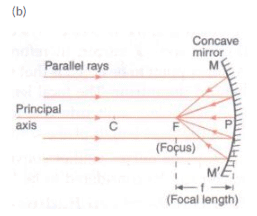
Question 9: Explain with a suitable diagram, how a concave mirror converges a parallel beam of light rays. Mark clearly the pole, focus and centre of curvature of concave mirror in this diagram.
Ans: All rays parallel to the principal axis of a concave mirror are reflected so that they meet (converge) at the principal focus F. Because it brings parallel rays to a point, a concave mirror is called a converging mirror. (Refer to the labelled diagram.)
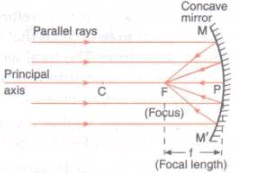
All the light rays which are parallel to the principal axis of a concave mirror, converge at the principal focus (F) after reflection from the mirror. Since a concave mirror converges a parallel beam of light rays, it is also called a converging mirror.
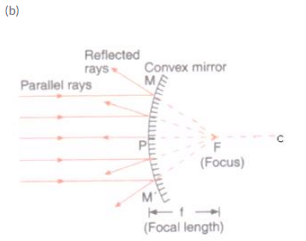
Question 10: Describe with a suitable diagram, how a convex mirror diverges a parallel beam of light rays. Mark clearly the pole, focus and centre of curvature of convex mirror in this diagram.
Ans: Parallel rays falling on a convex mirror are reflected such that they appear to come from a point (the principal focus) behind the mirror. Thus, the reflected rays diverge and the focus is virtual. (Refer to the labelled diagram.)
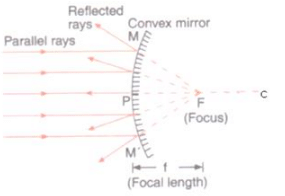
All the light rays which are parallel to the principal axis of a convex mirror, appear to diverge from the principal focus (F) after reflection from the mirror. Since a convex mirror diverges a parallel beam of light rays, it is also called a diverging mirror.
Question 11: Define (a) centre of curvature (b) radius of curvature (c) pole (d) principal axis, and (e) aperture, of a spherical mirror with the help of a labelled diagram.
Ans:
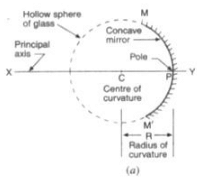
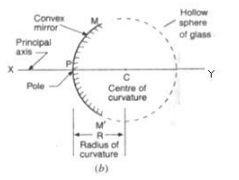
(a) Centre of curvature: The centre of the hollow sphere of which the mirror is a part.
(b) Radius of curvature: The radius of that hollow sphere.
(c) Pole: The central point of the mirror surface.
(d) Principal axis: The straight line joining the pole and the centre of curvature.
(e) Aperture: The portion of the mirror surface from which reflection actually takes place.
Question 12: (a) Define (i) principal focus of a concave mirror, and (ii) focal length of a concave mirror.
Draw diagram to represent the action of a concave mirror on a beam of parallel light rays. Mark on this diagram principal axis, focus F, centre of curvature C, pole P and focal length ƒ, of the concave mirror.
Ans: (i) Principal focus of a concave mirror: The point on the principal axis where rays parallel and close to the axis meet after reflection.
(ii) Focal length of a concave mirror: The distance between the pole and the principal focus.
Question 13: (a) What is meant by (i) principal focus of a convex mirror, and (ii) focal length of a convex mirror ?
(b) Draw diagram to show the action of convex mirror on a beam of parallel light rays. Mark on this diagram principal axis, focus F, centre of curvature C, pole P and focal length ƒ, of the convex mirror.
Ans: (i) Principal focus of a convex mirror: The point on the principal axis from which rays, initially parallel to the axis, appear to diverge after reflection (the focus is virtual).
(ii) Focal length of a convex mirror: The distance from the pole P to its principal focus F.
Question 19: A communications satellite in orbit sends a parallel beam of signals down to earth. If these signals obey the same laws of reflection as light and are to be focussed onto a small receiving aerial, what should be the best shape of the metal 'dish' used to collect them ?
Ans: A concave metal dish (parabolic/concave) should be used. A concave reflector collects parallel incoming rays and brings them to its focus, where the small receiving aerial can be placed to receive strong signals.
Question 20: When a spherical mirror is held towards the sun and its sharp image is formed on a piece of carbon paper for some time, a hole is burnt in the carbon paper.
(a) What is the nature of spherical mirror ?
(b) Why is a hole burnt in the carbon paper ?
(c) At which point of the spherical mirror the carbon paper is placed ?
(d) What name is given to the distance between spherical mirror and carbon paper ?
(e) What is the advantage of using a carbon paper rather than a white paper ?
Ans: (a) Concave mirror.
(b) Parallel sun rays are concentrated (converged) at the focus, producing intense heat that burns a hole.
(c) The carbon paper is placed at the focus of the mirror.
(d) That distance is called the focal length.
(e) Black carbon paper absorbs more heat than white paper, so it heats and burns more easily.
Page No:189
Question 1: For what position of an object, a concave mirror forms a real image equal in size to the object ?
Ans: At the centre of curvature (C) of the concave mirror.
Question 2: Where should an object be placed in front of the concave mirror so as to obtain its virtual, erect and magnified image ?
Ans: Between the pole (P) and the focus (F) of the concave mirror.
Question 3: For which positions of the object does a concave mirror produce an inverted, magnified and real image ?
Ans: When the object is placed between the focus (F) and the centre of curvature (C) of the concave mirror.
Question 4: If an object is placed at the focus of a concave mirror, where is the image formed ?
Ans: At infinity (the reflected rays are parallel and do not meet).
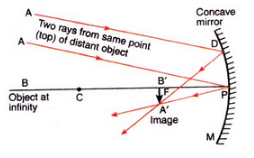
Question 5: If an object is at infinity (very large distance) in front of a concave mirror, where is the image formed ?
Ans: At the principal focus (F) of the concave mirror.
Question 6: For what position of an object, a real and diminished image is formed by a concave mirror ?
Ans: When the object is placed beyond the centre of curvature (i.e. farther than C), the image is real and diminished and lies between F and C.
Question 7: Copy this figure in your answer book and show the direction of the light ray after reflection :
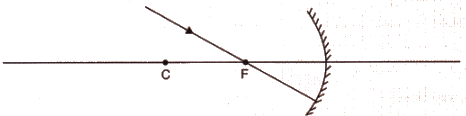
Solution :
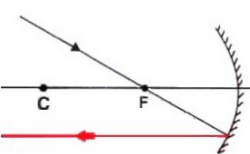
Direction of light ray after reflection
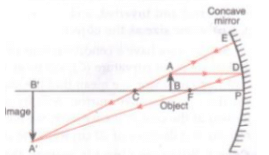
Question 8: Draw the following diagram in your answer book and show the formation of image of the object AB with the help of suitable
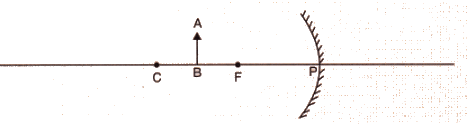
Ans:
Question 9: Draw the following diagram in your answer book and show the formation of image with the help of suitable rays
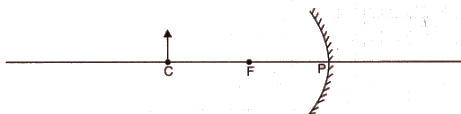
Ans:
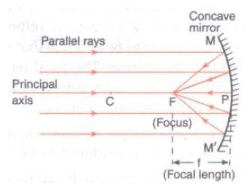
Fig. formation of image of AC
Question 10: Which type of mirror could be used as a dentist's mirror ?
Ans: Concave mirror.
Question 11: Which kind of mirror is used in the headlights of a car ? Why is it used for this purpose ?
Ans: Concave mirror. When a bulb is placed at the focus of a concave reflector, the diverging light from the bulb is reflected as a strong, nearly parallel beam that can travel a long distance, which is useful for car headlights.
Question 12: Explain why, a ray of light passing through the centre of curvature of a concave mirror gets reflected back along the same path.
Ans: A ray through the centre of curvature strikes the mirror along the radius and so meets the surface at right angles; the angle of incidence is 0°, so the ray is reflected back along the same path.
Question 13: What is the minimum number of rays required for locating the image formed by a concave mirror for an object ? Draw a ray diagram to show the formation of a virtual image by a concave mirror.
Ans: Minimum two rays are sufficient to locate the image. (Ray diagram for virtual image is shown.)
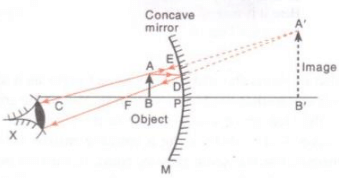
Question 14: With the help of a ray diagram, determine the position, nature and size of the image formed of an object
placed at the centre of curvature of a concave mirror.
Ans: When the object is at the centre of curvature C of a concave mirror, the image is formed at C, is real and inverted, and is of the same size as the object.
Question 15: Describe with the help of a diagram, the nature, size and position of the image formed when an object is placed beyond the centre of curvature of a concave mirror.
Ans: If the object is beyond C, the image forms between F and C, is real and inverted, and is smaller (diminished) than the object.
Question 16: If an object is placed at a distance of 8 cm from a concave mirror of focal length 10 cm, discuss the nature of the image formed by drawing the ray diagram.
Ans: Object distance = 8 cm, focal length = 10 cm, so the object lies between the pole and the focus (P and F). The image formed is virtual, erect and enlarged (magnified).
Question 17: Draw a ray diagram showing how a concave mirror can be used to produce a real, inverted and diminished image of an object.
Ans:
Page No:190
Question 18: Which mirror is used as a torch reflector ? Draw a labelled diagram to show how a torch reflector can be used to produce a parallel beam of light. Where is the bulb placed in relation to the torch reflector ?
Ans: A concave mirror is used as a torch reflector. The bulb is placed at (or very near) the focus of the concave reflector so that light from the bulb is reflected as a parallel beam.
Question 19: State where an object must be placed so that the image formed by a concave mirror is :
(a) erect and virtual.
(b) at infinity.
(c) the same size as the object.
Ans: (a) Between the pole and the focus of the mirror.
(b) At the focus of the mirror.
(c) At the centre of curvature of the mirror.
Question 20: With the help of a labelled ray diagram, describe how a converging mirror can be used to give an enlarged upright image of an object.
Ans: Place the object between the pole P and the focus F of a concave mirror. Rays from the object reflect and diverge; on producing the reflected rays backwards they appear to meet behind the mirror, forming a virtual, upright and magnified image. (Refer to the labelled diagram.)
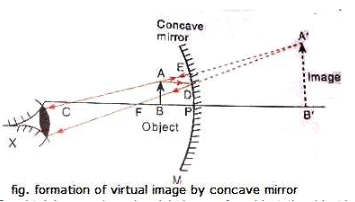
For obtaining an enlarged upright image of an object, the object is placed between focus (F) and pole (P) of the concave mirror.
A ray AD parallel to the principal axis, gets reflected at D and then passes through the focus F. A second ray AE passing through the centre of curvature C strikes the mirror normally at point E and gets reflected back along the same path.
Now, two reflected rays DF and EC are diverging rays and, therefore, do not intersect each other on the left side. The reflected rays DF and EC are produced backwards (as shown by dotted lines). On producing backwards, they appear to intersect at point A' behind the concave mirror. Thus, A' is the virtual image of point A of the object. To get the complete image of the object we draw A'B' perpendicular to the axis. Thus, A'B' is the image of the object AB formed by the concave mirror. The image is bigger in size than the object, hence it is an enlarged image.
Question 21: Make labelled ray diagrams to illustrate the formation of :
(a) a real image by a converging mirror.
(b) a virtual image by a converging mirror.
Mark clearly the pole, focus, centre of curvature and position of object in each case.
Ans: (a) See the ray diagram for a real image by a converging mirror.
(b) See the ray diagram for a virtual image by a converging mirror.
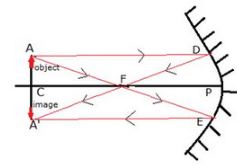
(b) A virtual image by a converging mirror
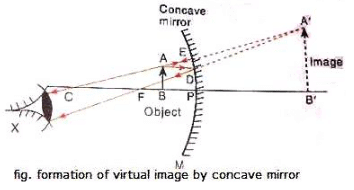
Question 22: Briefly describe how you would find the focal length of a concave mirror quickly but approximately.
Ans: Direct a concave mirror at a distant object (effectively at infinity), and place a screen so that a sharp image is formed. The screen will be at the focus of the mirror; measure the distance from the mirror to the screen with a scale to obtain the approximate focal length.
Question 23: Which type of mirror is used in a solar furnace ? Support your answer with reason.
Ans: A concave mirror (large concave reflector) is used. Parallel sunlight falling on the concave surface is reflected and converged at the focus, producing very high temperatures at the focal point; the furnace is placed at that focus.
Question 24: Name the type of mirror used by dentists. How does it help ?
Ans: Dentists use small concave mirrors. When the tooth is within the focal length the mirror produces a magnified, upright image, which helps the dentist to view small defects clearly.
Question 25: Explain why, concave mirrors are used as shaving mirrors.
Ans: When the face is placed close to a concave mirror (within its focal length), the mirror forms an enlarged, erect image of the face. The larger image makes it easier to see details while shaving.
Question 26: Give two uses of concave mirrors. Explain why you would choose concave mirrors for these uses.
Ans: (i) Shaving mirrors: placed close to the face to give a magnified, erect image, aiding careful shaving.
(ii) Dentist's mirrors: to obtain enlarged images of teeth, making inspection easier. In both uses the converging property of concave mirrors gives magnified, upright images when the object is within the focus.
Question 27: (a) Draw ray-diagrams to show the formation of images when the object is placed in front of a concave
mirror (converging mirror) :
(i) between its pole and focus
(ii) between its centre of curvature and focus Describe the nature, size and position of the image formed in each case.
(b) State one use of concave mirror based on the formation of image as in case (z) above.
Ans:
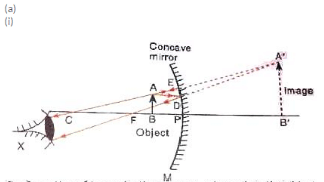
When the object is placed between the pole and focus, the image is formed behind the mirror; it is virtual, erect and larger than the object.
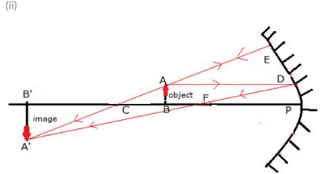
When the object is between the centre of curvature and focus, the image is formed beyond the centre of curvature; it is real, inverted and larger than the object.
(b) One use based on case (i): A shaving mirror (to see an enlarged erect image).
Question 28: (a) Give two circumstances in which a concave mirror can form a magnified image of an object placed in
front of it. Illustrate your answer by drawing labelled ray diagrams for both.
(b) Which one of these circumstances enables a concave mirror to be used as a shaving mirror ?
Ans: (a) Two circumstances giving magnified images:
(i) Object between pole and focus → virtual, erect and magnified image behind the mirror. (See diagram.)
(ii) Object between focus and centre of curvature → real, inverted and magnified image beyond C. (See diagram.)
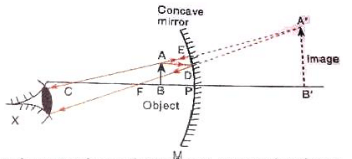
fig. formation of image by the concave mirror when the object is placed between its pole and focus.
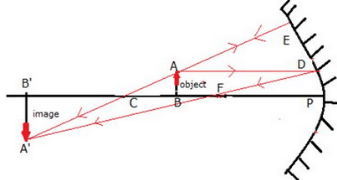
(b) The case (i) (object between pole and focus) is used for shaving mirrors because it gives a magnified upright image.
FAQs on Lakhmir Singh & Manjit Kaur: Reflection of Light, Solutions- 2
| 1. What is the law of reflection of light? |  |
| 2. How does reflection of light occur? | |
| 3. What is the difference between regular reflection and diffuse reflection? | |
| 4. How does the angle of incidence affect the angle of reflection? | |
| 5. What are the applications of reflection of light in everyday life? | |





