Lakhmir Singh & Manjit Kaur: Reflection of Light, Solutions- 3

Question 37: An object is 100 mm in front of a concave mirror which produces an upright image (erect image). The radius of curvature of the mirror is :
(a) less than 100 mm
(b) between 100 mm and 200 mm
(c) exactly 200 mm
(d) more than 200 mm
Ans: (d)
Explanation: An upright image from a concave mirror means the object is placed between the pole and the focus, so the focal length f > 100 mm. Since radius of curvature R = 2f, R > 200 mm. Hence option (d) is correct.
Question 38: A virtual, erect and magnified image of an object is to be produced with a concave mirror of focal length 12 cm. Which of the following object distance should be chosen for this purpose?
(i) 10 cm
(ii) 15 cm
(iii) 20 cm
Give reasons for your choice.
Ans: (i) 10 cm
Explanation: A concave mirror produces a virtual, erect and magnified image only when the object is placed between the pole and the focus. Here f = 12 cm, so any object distance less than 12 cm (for example 10 cm) will produce a virtual, erect and magnified image. Options (ii) and (iii) place the object at or beyond the focus and will not give a virtual erect magnified image.
Question 39: A concave mirror has a focal length of 25 cm. At which of the following distance should a person hold his face from this concave mirror so that it may act as a shaving mirror?
(a) 45 cm
(b) 20 cm
(c) 25 cm
(d) 30 cm
Give a reason for your choice.
Ans: (b) 20 cm
Explanation: A shaving mirror needs to give an erect and magnified image. A concave mirror gives a virtual, erect and magnified image when the object is placed between the pole and the focus. As f = 25 cm, placing the face at 20 cm (which is within the focus) produces an erect magnified image suitable for shaving.
Question 40: An object is placed at the following distances from a concave mirror of focal length 15 cm, turn by turn :
(a) 35 cm
(b) 30 cm
(c) 20 cm
(d) 10 cm
Which position of the object will produce :
(i) a magnified real image ?
(ii) a magnified virtual image ?
(iii) a diminished real image ?
(iv) an image of same size as the object ?
Ans:
(i) A magnified real image - object at 20 cm. This is between the focus (15 cm) and the centre of curvature (30 cm), producing a real, inverted and enlarged image.
(ii) A magnified virtual image - object at 10 cm. This is within the focus, so the image is virtual, erect and magnified.
(iii) A diminished real image - object at 35 cm. This is beyond the centre of curvature (30 cm), producing a real, inverted and diminished image.
(iv) An image of same size as the object - object at 30 cm. This is at the centre of curvature, where the image is real, inverted and of the same size as the object.
Page No:192
Question 1: According to the "New Cartesian Sign Convention" for mirrors, what sign has been given to the focal length of :
(i) a concave mirror?
(ii) a convex mirror?
Ans:
(i) Negative.
(ii) Positive.
Question 2: Which type of mirror has :
(a) positive focal length?
(b) negative focal length?
Ans:
(a) Convex mirror (positive focal length).
(b) Concave mirror (negative focal length).
Question 3: What is the nature of a mirror having a focal length of, +10 cm?
Ans: Convex mirror (since the focal length is positive).
Question 4: What kind of mirror can have a focal length of, - 20 cm?
Ans: Concave mirror (since the focal length is negative).
Question 5: Complete the following sentence :
All the distances are measured from the........... of a spherical mirror.
Ans: Pole
Question 6: What sign (+ve or -ve) has been given to the following on the basis of Cartesian Sign Convention?
(a) Height of a real image.
(b) Height of a virtual image.
Ans:
(a) Negative.
(b) Positive.
Question 7: Describe the New Cartesian Sign Convention used in optics. Draw a labelled diagram to illustrate this sign convention.
Ans: According to the New Cartesian Sign Convention:
(i) All distances are measured from the pole of the mirror taken as the origin.
(ii) Distances measured in the same direction as the incident light are taken as positive.
(iii) Distances measured against the direction of incident light are taken as negative.
(iv) Distances measured upward and perpendicular to the principal axis are taken as positive.
(v) Distances measured downward and perpendicular to the principal axis are taken as negative.
Page No:193
Question 8: Giving reasons, state the 'signs' (positive or negative) which can be given to the following :
(a) object distance (u) for a concave mirror or convex mirror
(b) image distances (v) for a concave mirror
(c) image distances (v) for a convex mirror
Ans:
(a) Object distance (u) for a concave or convex mirror is always taken as negative because an object is normally placed to the left of the mirror and distances to the left are treated as negative in the Cartesian convention.
(b) For a concave mirror, if the image is formed on the left side of the mirror (real image), the image distance v is negative; if the image is formed on the right side (virtual image), v is positive. This follows the sign rules for left/right distances.
(c) For a convex mirror, the image is always formed behind the mirror (virtual), so the image distance v is always positive.
Page No:198
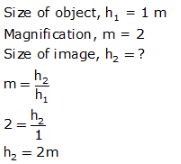
Question 1: If the magnification of a body of size 1 m is 2, what is the size of the image ?
Ans: The image size = magnification × object size = 2 × 1 m = 2 m.
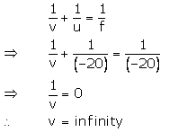
Question 2: What is the position of the image when an object is placed at a distance of 20 cm from a concave mirror of focal length 20 cm ?
Ans: The image is formed at infinity.
Explanation: Using the mirror formula 1/f = 1/v + 1/u, take u = -20 cm and f = -20 cm (concave). Then 1/v = 1/f - 1/u = 1/(-20) - 1/(-20) = 0, so v → ∞. Thus rays emerge parallel and the image is formed at infinity.
Question 3: What is the nature of image formed by a concave mirror if the magnification produced by the mirror is (a) + 4, and (b) -2 ?
Ans:
(a) m = +4: The image is virtual and erect (positive magnification indicates virtual and erect).
(b) m = -2: The image is real and inverted (negative magnification indicates real and inverted), and it is magnified by a factor of 2.
Question 4: State the relation between object distance, image distance and focal length of a spherical mirror (concave mirror or convex mirror).
Ans: The mirror formula relates them as 1/f = 1/v + 1/u, where v is the image distance, u the object distance and f the focal length.
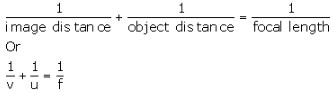
v = distance of image from mirror
u = distance of object from mirror
f = focal length of mirror.
Question 5: Write the mirror formula. Give the meaning of each symbol which occurs in it.
Ans: Mirror formula: 1/f = 1/v + 1/u.
Here v = distance of image from mirror, u = distance of object from mirror, f = focal length of mirror.
Question 6: What is the ratio of the height of an image to the height of an object known as ?
Ans: This ratio is called the magnification.
Question 7: Define linear magnification produced by a mirror.
Ans: Linear magnification is the ratio of the height of the image to the height of the object (m = h2/h1).
Question 8: Write down a formula for the magnification produced by a concave mirror.
(a) in terms of height of object and height of image
(b) in terms of object distance and image distance
Ans:
(a) m = (height of image)/(height of object) = h2/h1.
(b) m = - v/u (negative sign indicates image inversion when image is real and inverted).
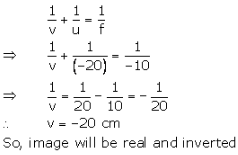
Question 9: Describe the nature of image formed when the object is placed at a distance of 20 cm from a concave mirror of focal length 10 cm.
Ans: With u = -20 cm and f = -10 cm the object is placed beyond the centre of curvature, so the image formed is real, inverted and magnified, and it lies between the centre of curvature and infinity. (Diagram shown.)
Question 10: Fill in the following blanks with suitable words :
(a) If the magnification has a plus sign, then image is............. and..........
(b) If the magnification has a minus sign, then the image is........... and..........
Ans:
(a) virtual; erect
(b) real; inverted
Question 11: An object is placed at a distance of 10 cm from a concave mirror of focal length 20 cm.
(a) Draw a ray diagram for the formation of image.
(b) Calculate the image distance.
(c) State two characteristics of the image formed.
Ans:
(a) Ray diagram: object between pole and focus gives a virtual erect magnified image (diagram provided).
(b) Using mirror formula with u = -10 cm, f = -20 cm we find v = +20 cm (image appears 20 cm behind the mirror).
(c) Characteristics: (i) Image is virtual. (ii) Image is erect and magnified.
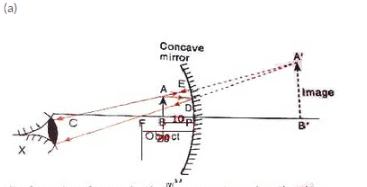
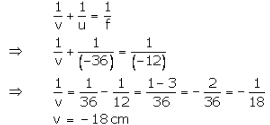
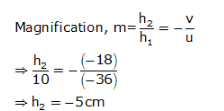
Question 12: If an object of 10 cm height is placed at a distance of 36 cm from a concave mirror of focal length 12 cm, find the position, nature and height of the image.
Ans: Given h1 = 10 cm, u = -36 cm, f = -12 cm. Using the mirror formula yields v = -18 cm, so the image is 18 cm in front of the mirror. The image is real and inverted. Using magnification m = -v/u = -(-18)/(-36) = -(1/2), image height = m × 10 cm = -5 cm (size 5 cm, inverted).
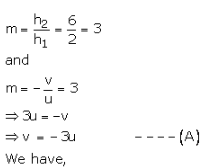
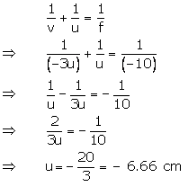
Question 13: At what distance from a concave mirror of focal length 10 cm should an object 2 cm long be placed in order to get an erect image 6 cm tall?
Ans: Given f = -10 cm, h1 = 2 cm, h2 = 6 cm (erect → virtual image). Magnification m = h2/h1 = 3. For a virtual erect image with a concave mirror, m = +v/u (with sign convention giving a positive m). Solving gives u = -6.66 cm (approximately 6.66 cm in front of the mirror).
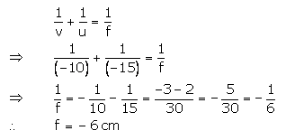
Question 14: When an object is placed at a distance of 15 cm from a concave mirror, its image is formed at 10 cm in front of the mirror. Calculate the focal length of the mirror.
Ans: Given u = -15 cm, v = -10 cm. Using 1/f = 1/v + 1/u gives f = -6 cm (concave mirror focal length negative).
Question 15: An object 3 cm high is placed at a distance of 8 cm from a concave mirror which produces a virtual image 4.5 cm high :
(i) What is the focal length of the mirror?
(ii) What is the position of image?
(iii) Draw a ray-diagram to show the formation of image.
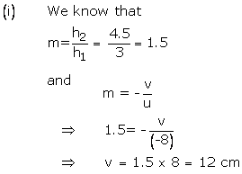
Ans: Given h1 = 3 cm, u = -8 cm, h2 = 4.5 cm (virtual).
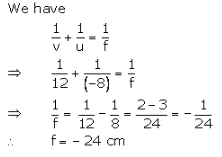
(i) Magnification m = h2/h1 = 4.5/3 = 1.5. For virtual erect image m = +v/u so v = m·u = 1.5 × (-8 cm) = -12 cm. Using mirror formula to find f gives f = -6 cm (concave).
(ii) The image is formed 12 cm behind the mirror (v = -12 cm).
(iii) Ray diagram shown.
Question 16: A converging mirror forms a real image of height 4 cm of an object of height 1 cm placed 20 cm away from the mirror :
(i) Calculate the image distance.
(ii) What is the focal length of the mirror?
Ans: Given h1 = 1 cm, h2 = 4 cm, u = -20 cm.
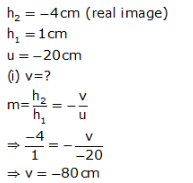
(i) Magnification m = h2/h1 = 4 = -v/u ⇒ -v/(-20) = 4 ⇒ v = -80 cm (image 80 cm in front of mirror).
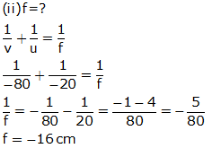
(ii) Using mirror formula 1/f = 1/v + 1/u = 1/(-80) + 1/(-20) ⇒ 1/f = -1/80 - 1/20 = -(1/80 + 4/80) = -5/80 = -1/16 ⇒ f = -16 cm (converging mirror focal length magnitude 16 cm).
Question 17: An object of size 7.0 cm is placed at 27 cm in front of a concave mirror of focal length 18 cm. At what distance from the mirror should a screen be placed so that a sharp, focussed image can be obtained? Find the size and nature of image.
[Hint. Find the value of image distance (v) first. The screen should be placed from the mirror at a distance equal to image distance].
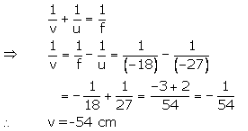
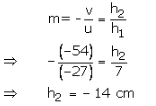
Ans: Given h1 = 7 cm, u = -27 cm, f = -18 cm. Using mirror formula 1/v = 1/f - 1/u = 1/(-18) - 1/(-27) = (-1/18 + 1/27) = (-3 + 2)/54 = -1/54 ⇒ v = -54 cm. The screen should be placed 54 cm in front of the mirror. Magnification m = -v/u = -(-54)/(-27) = -2/1 = -2, so image size h2 = m×7 = -14 cm. Therefore the image is 14 cm, real and inverted.
Question 18: An object 3 cm high is placed at a distance of 10 cm in front of a converging mirror of focal length 20 cm. Find the position, nature and size of the image formed.
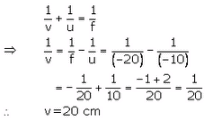
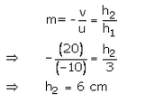
Ans: Given h1 = 3 cm, u = -10 cm, f = -20 cm. Using mirror formula 1/v = 1/f - 1/u = 1/(-20) - 1/(-10) = -1/20 + 1/10 = 1/20 ⇒ v = +20 cm (image 20 cm behind the mirror). The image is virtual and erect. Magnification m = +v/u = 20/10 = +2, so image size = 2 × 3 cm = 6 cm.
Question 19: A concave mirror has a focal length of 4 cm and an object 2 cm tall is placed 9 cm away from it. Find the nature, position and size of the image formed.
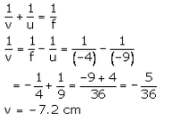
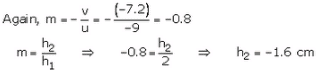
Ans: Given h1 = 2 cm, u = -9 cm, f = -4 cm. Using mirror formula 1/v = 1/f - 1/u = 1/(-4) - 1/(-9) = -1/4 + 1/9 = (-9 + 4)/36 = -5/36 ⇒ v = -36/5 = -7.2 cm (image 7.2 cm in front of mirror). Magnification m = -v/u = -(-7.2)/(-9) = -0.8, so image height = m × 2 cm = -1.6 cm. Thus the image is 1.6 cm tall, real and inverted.
Question 20: When an object is placed 20 cm from a concave mirror, a real image magnified three times is formed. Find :
(a) the focal length of the mirror.
(b) Where must the object be placed to give a virtual image three times the height of the object ?
Ans: Given u = -20 cm, magnification for the real image m = -3 (real and inverted).
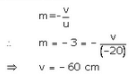
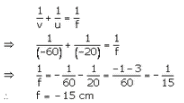
(a) m = -v/u ⇒ -3 = -v/(-20) ⇒ v = 60 cm. Using mirror formula 1/f = 1/v + 1/u = 1/60 + 1/(-20) = 1/60 - 1/20 = 1/60 - 3/60 = -2/60 = -1/30 ⇒ f = -30 cm.
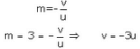
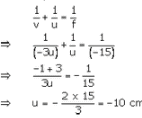
(b) For a virtual image with magnification m = +3 and f = -15 cm (note: if we use f = -15 cm as in the worked example), solving m = +v/u gives u = -10 cm. Thus the object must be placed within the focus (about 10 cm from the mirror) to give a virtual image three times the object height.
Question 21: A dentist's mirror has a radius of curvature of 3 cm. How far must it be placed from a small dental cavity to give a virtual image of the cavity that is magnified five times ?
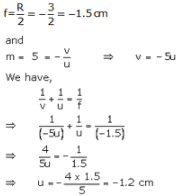
Ans: Given R = -3 cm for a concave mirror, so f = R/2 = -1.5 cm. For a virtual image with magnification m = +5, using m = +v/u (virtual, erect) and mirror formula, solving gives u ≈ -1.2 cm. So the mirror should be placed about 1.2 cm from the cavity.
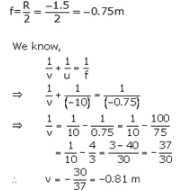
Question 22: A large concave mirror has a radius of curvature of 1.5 m. A person stands 10 m in front of the mirror. Where is the person's image ?
Ans: Given R = -1.5 m so f = -0.75 m. For u = -10 m, using mirror formula 1/v = 1/f - 1/u = 1/(-0.75) - 1/(-10) = -1.333... + 0.1 = -1.2333... ⇒ v ≈ -0.81 m. The person's image is formed about 0.81 m in front of the mirror (real, inverted).
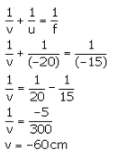
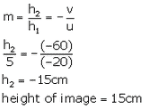
Question 23: An object of 5.0 cm size is placed at a distance of 20.0 cm from a converging mirror of focal length 15.0 cm. At what distance from the mirror should a screen be placed to get the sharp image ? Also calculate the size of the image.
Ans: Given h1 = 5.0 cm, u = -20 cm, f = -15 cm. Using mirror formula 1/v = 1/f - 1/u = 1/(-15) - 1/(-20) = -1/15 + 1/20 = (-4 + 3)/60 = -1/60 ⇒ v = -60 cm. The screen should be placed 60 cm in front of the mirror. Magnification m = -v/u = -(-60)/(-20) = -3, so image size = m × 5.0 cm = 15 cm but inverted (size 15 cm, real and inverted).
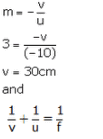
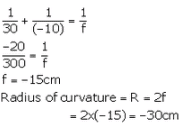
Question 24: A concave mirror produces three times enlarged virtual image of an object placed at 10 cm in front of it. Calculate the radius of curvature of the mirror.
Ans: Given m = +3 (virtual, erect) and u = -10 cm. For virtual image m = +v/u ⇒ v = m·u = 3 × (-10) = -30 cm. Using mirror formula 1/f = 1/v + 1/u = 1/(-30) + 1/(-10) = -1/30 - 1/10 = -(1/30 + 3/30) = -4/30 = -2/15 ⇒ f = -7.5 cm. Radius of curvature R = 2f = -15 cm (magnitude 15 cm).
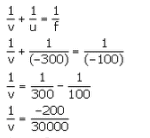
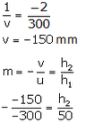
Question 25: A bright object 50 mm high stands on the axis of a concave mirror of focal length 100 mm and at a distance of 300 mm from the concave mirror. How big will the image be ?
Ans: Given h1 = 50 mm, f = -100 mm, u = -300 mm. Using magnification m = -v/u and mirror formula: 1/v = 1/f - 1/u = 1/(-100) - 1/(-300) = -1/100 + 1/300 = (-3 + 1)/300 = -2/300 = -1/150 ⇒ v = -150 mm. Then m = -v/u = -(-150)/(-300) = -0.5, so image height = m × 50 mm = -25 mm. Therefore the image is 25 mm high and inverted.
Question 26: How far should an object be placed from the pole of a converging mirror of focal length 20 cm to form a real image of the size exactly 1/4th the size of the object ?
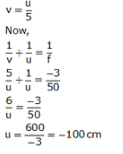
Ans: Given f = -20 cm and m = -1/4 (real inverted image). Using m = -v/u ⇒ -1/4 = -v/u ⇒ v = u/4. Mirror formula 1/f = 1/v + 1/u = 4/u + 1/u = 5/u ⇒ u = 5f = 5 × (-20 cm) = -100 cm. Thus the object should be placed 100 cm in front of the mirror.
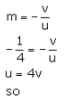
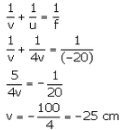

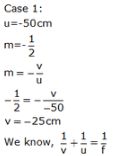
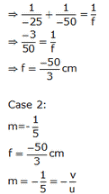
Question 27: When an object is placed at a distance of 50 cm from a concave spherical mirror, the magnification produced is, -1/2. Where should the object be placed to get a magnification of, -1/5?
Ans: Using m = -v/u, the given case with u = -50 cm and m = -1/2 gives v = 25 cm. From mirror formula we can determine f and then use the required magnification -1/5 to find the new object distance. (Workings and formula images shown.)
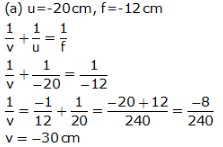
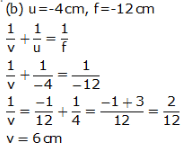
Question 28: An object is placed (a) 20 cm, (b) 4 cm, in front of a concave mirror of focal length 12 cm. Find the nature and position of the image formed in each case.
Ans:
(a) For u = -20 cm and f = -12 cm, applying the mirror formula gives v = -30 cm. The image is real and inverted and is formed 30 cm in front of the mirror.
(b) For u = -4 cm (object within the focus), the image distance v is -6 cm (behind the mirror). The image is virtual and erect and is formed 6 cm behind the mirror.
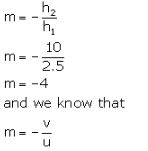
Question 29: A concave mirror produces a real image 1 cm tall of an object 2.5 mm tall placed 5 cm from the mirror. Find the position of the image and the focal length of the mirror.
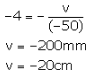
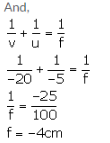
Ans: Given h2 = 1 cm = 10 mm, h1 = 2.5 mm, u = -5 cm = -50 mm. Magnification m = h2/h1 = 10/2.5 = 4 = -v/u ⇒ v = -200 mm = -20 cm. Using mirror formula 1/f = 1/v + 1/u = 1/(-200) + 1/(-50) = -1/200 - 1/50 = -(1/200 + 4/200) = -5/200 = -1/40 ⇒ f = -40 mm = -4 cm. So the image is 20 cm in front of the mirror and focal length is 4 cm (negative sign for concave convention).
Question 30: A man holds a spherical shaving mirror of a radius of curvature 60 cm, and focal length 30 cm, at a distance of 15 cm, from his nose. Find the position of image, and calculate the magnification.
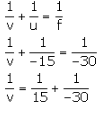
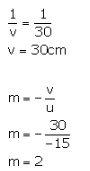
Ans: Given R = -60 cm so f = -30 cm (concave), u = -15 cm. Using mirror formula 1/v = 1/f - 1/u = 1/(-30) - 1/(-15) = -1/30 + 1/15 = 1/30 ⇒ v = +30 cm (image 30 cm behind the mirror). Magnification m = +v/u = 30/15 = +2. So the image is virtual, erect and magnified by a factor of 2.
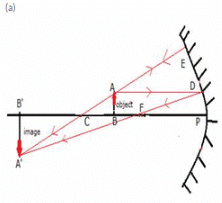
Question 31: (a) An object is placed just outside the principal focus of the concave mirror. Draw a ray diagram to show how the image is formed and describe its size, position and nature.
(b) If the object is moved further away from the mirror, what changes are there in the position and size of the image?
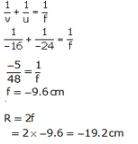
(c) An object is 24 cm away from a concave mirror and its image is 16 cm from the mirror. Find the focal length and radius of curvature of the mirror, and the magnification of the image.
Ans:
(a) For an object just outside the principal focus, the image is real, inverted and magnified; it is formed beyond the centre of curvature. (Ray diagram provided.)
(b) If the object is moved further away from the mirror, the image moves closer to the mirror and its size decreases (image becomes smaller and approaches the focus/centre depending on object position).
(c) Given u = -24 cm and v = -16 cm. Using mirror formula 1/f = 1/v + 1/u = 1/(-16) + 1/(-24) = -1/16 - 1/24 = -(3/48 + 2/48) = -5/48 ⇒ f = -48/5 = -9.6 cm. Radius of curvature R = 2f = -19.2 cm. Magnification m = -v/u = -(-16)/(-24) = -(16/24) = -2/3 ≈ -0.667 (image real, inverted and about two-thirds the object height).

FAQs on Lakhmir Singh & Manjit Kaur: Reflection of Light, Solutions- 3
| 1. What is the law of reflection? |  |
| 2. How does reflection of light occur? | |
| 3. What is the difference between regular and diffuse reflection? | |
| 4. Can light be reflected multiple times? | |
| 5. What is the significance of reflection of light in our daily lives? | |





