Lakhmir Singh & Manjit Kaur: Reflection of Light, Solutions- 4

Page No:200
Question 42: Between which two points of concave mirror should an object be placed to obtain a magnification of:
(a) -3
(b) +2.5
(c) - 0.4
Solution :
(a) Between the focus (F) and the centre of curvature (C). This gives a real, inverted and magnified image (magnification < -1).
(b) Between the pole (P) and the focus (F). An object placed within the focal length produces a virtual, erect and magnified image (positive magnification).
(c) Beyond the centre of curvature (C). An object placed beyond C gives a real, inverted and diminished image (magnitude of magnification less than 1, negative sign).
Question 43: At what distance from a concave mirror of focal length 10 cm should an object be placed so that:
(a) its real image is formed 20 cm from the mirror ?
(b) its virtual image is formed 20 cm from the mirror ?
Solution :
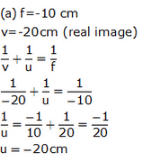
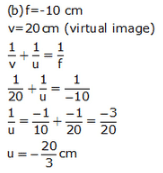
Use the mirror formula 1/v + 1/u = 1/f (where distances are measured from the pole of the mirror).
(a) Real image at v = +20 cm, f = +10 cm. So 1/20 + 1/u = 1/10 ⇒ 1/u = 1/10 - 1/20 = 1/20 ⇒ u = 20 cm. Thus the object should be placed 20 cm in front of the mirror (at the centre of curvature).
(b) Virtual image at v = -20 cm (behind the mirror), f = +10 cm. So 1/(-20) + 1/u = 1/10 ⇒ 1/u = 1/10 + 1/20 = 3/20 ⇒ u = 20/3 ≈ 6.67 cm. Thus the object should be placed about 6.67 cm in front of the mirror (between pole and focus).
Question 44: If a concave mirror has a focal length of 10 cm, find the two positions where an object can be placed to give, in each case, an image twice the height of the object.
Solution : f = 10 cm.
For a spherical mirror magnification m = -v/u.
We need |m| = 2, so consider two cases.
Case 1: m = +2 (virtual, erect image). Then +2 = -v/u ⇒ v = -2u. Substitute in mirror formula 1/v + 1/u = 1/f:
1/(-2u) + 1/u = 1/f ⇒ (-1/2 + 1)/u = 1/f ⇒ (1/2)/u = 1/f ⇒ u = f/2 = 10/2 = 5 cm.
So one position is 5 cm in front of the mirror (object between pole and focus). This gives a virtual, erect image of height twice the object.
Case 2: m = -2 (real, inverted image). Then -2 = -v/u ⇒ v = 2u. Substitute in mirror formula:
1/(2u) + 1/u = 1/f ⇒ (1/2 + 1)/u = 1/f ⇒ (3/2)/u = 1/f ⇒ u = (3/2)f = 1.5 × 10 = 15 cm.
So the other position is 15 cm in front of the mirror (between F and C). This gives a real, inverted image of twice the height of the object (image will be at v = 30 cm).
Question 45: A mirror forms an image which is 30 cm from an object and twice its height.
(a) Where must the mirror be situated ?
(b) What is the radius of curvature ?
(c) Is the mirror convex or concave ?
Solution : Let the object be at distance u from the mirror and the image at distance v. The image is twice the height of the object, so magnification m = 2. For mirrors m = -v/u.
If m = +2 (image erect and twice the size) then -v/u = 2 ⇒ v = -2u (image is virtual and on the opposite side of the mirror). The separation between image and object is |v - u| = |-2u - u| = 3u. We are told this distance is 30 cm, so 3u = 30 ⇒ u = 10 cm.
Thus the mirror is 10 cm from the object (object distance = 10 cm). Then v = -2u = -20 cm (virtual image 20 cm behind the mirror). Use the mirror formula 1/v + 1/u = 1/f:
1/(-20) + 1/10 = 1/f ⇒ (-1/20 + 1/10) = 1/f ⇒ 1/20 = 1/f ⇒ f = 20 cm.
(a) The mirror is 10 cm from the object.
(b) Radius of curvature R = 2f = 40 cm.
(c) The mirror is concave (it produces a virtual erect enlarged image when the object is placed between pole and focus).
Page No:205
Question 1: What type of image/images are formed by :
(a) a convex mirror ?
(b) a concave mirror ?
Solution :
(a) Convex mirror: virtual, erect and usually diminished.
(b) Concave mirror: Depending on object position it can form either a virtual, erect image (when object is between pole and focus) or a real, inverted image (when object is outside the focus).
Question 2: Which mirror has a wider field of view ?
Solution : A convex mirror has a wider field of view because it diverges light rays and allows a larger area to be seen.
Question 3: If you want to see an enlarged image of your face, state whether you will use a concave mirror or a convex mirror ?
Solution : A concave mirror, when used at a distance less than its focal length, produces an enlarged, virtual and erect image of the face.
Question 4: Which mirror always produces a virtual, erect and diminished image of an object ?
Solution : A convex mirror always produces a virtual, erect and diminished image for any object position.
Question 5: An object is placed at a long distance in front of a convex mirror of radius of curvature 30 cm. State the position of its image.
Solution : If the object is very far (effectively at infinity), the image is formed at the focus. For R = 30 cm, focal length f = R/2 = 15 cm. The image is 15 cm behind the convex mirror.
Question 6: Name the spherical mirror which can produce a real and diminished image of an object.
Solution : A concave mirror can produce a real and diminished image when the object is placed beyond the centre of curvature.
Question 7: Name the spherical mirror which can produce a virtual and diminished image of an object.
Solution : A convex mirror always produces a virtual and diminished image.
Question 8: One wants to see a magnified image of an object. What type of mirror should one use ?
Solution : Use a concave mirror (place the object between pole and focus for an erect magnified image, or between focus and centre for an inverted magnified image).
Question 9: Name the mirror which can give :
(a) an erect and enlarged image of an object.
(b) an erect and diminished image of an object.
Solution : (a) Concave mirror (object placed between pole and focus).
(b) Convex mirror.
Question 10: State whether the following statement is true or false :
A diverging mirror is used as a rear-view mirror.
Solution : True. A diverging (convex) mirror gives a wide field of view and erect images, so it is used as a rear-view mirror.
Question 11: What type of mirror could be used :
(a) as a shaving mirror ?
(b) as a shop security mirror ?
Solution : (a) Concave mirror (used close to the face to obtain a magnified image).
(b) Convex mirror (gives a wide field of view and diminished images so many goods can be seen at once).
Question 12: Which type of mirror is usually used as a rear-view mirror in motor cars ?
Solution : A convex mirror is usually used as a rear-view mirror.
Question 13: What kind of mirrors are used in big shopping centres to watch the activities of the customers ?
Solution : Large convex mirrors are used as security mirrors in shops and shopping centres.
Question 14: A ray of light going towards the focus of a convex mirror becomes parallel to the principal axis after reflection from the mirror. Draw a labelled diagram to represent this situation.
Solution : Refer to the ray diagram (diagram 47). The ray directed towards the focus appears after reflection as a ray parallel to the principal axis.
Question 15: Fill in the following blank with a suitable word :
A ray of light which is parallel to the principal axis of a convex mirror, appears to be coming from........ after
reflection from the mirror.
Solution : focus.
Question 16: Why does a driver prefer to use a convex mirror as a rear-view mirror in a vehicle ?
Solution : A driver prefers a convex mirror because:
(i) It always produces an erect image, so objects appear upright.
(ii) It has a wider field of view, enabling the driver to see a larger area behind the vehicle.
Question 17: Why can you not use a concave mirror as a rear-view mirror in vehicles ?
Solution : You cannot use a concave mirror because at large distances it produces inverted images of distant objects. This would make vehicles behind appear upside down and confuse the driver.
Question 18: Where would the image be formed by a convex mirror if the object is placed :
(a) between infinity and pole of the mirror ?
(b) at infinity ?
Draw labelled ray-diagrams to show the formation of image in both the cases.
Solution : (a) Image will form between the pole and the focus (behind the mirror).
(b) For an object at infinity, the image forms at the focus (behind the mirror).
Page No:206
Question 19: The shiny outer surface of a hollow sphere of aluminium of radius 50 cm is to be used as a mirror :
(a) What will be the focal length of this mirror ?
(b) Which type of spherical mirror will it provide ?
(c) State whether this spherical mirror will diverge or converge light rays.
Solution : (a) R = 50 cm ⇒ f = R/2 = 50/2 = 25 cm.
(b) Since the outer surface is reflective and bulges outwards, it behaves as a convex mirror.
(c) A convex mirror will diverge parallel rays (they appear to come from the focus behind the mirror).
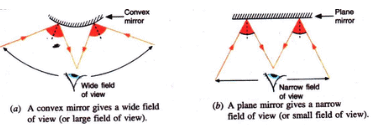
Question 20: What is the advantage of using a convex mirror as a rear-view mirror in vehicles as compared to a plane mirror ? Illustrate your answer with the help of labelled diagrams.
Solution : The main advantage is that a convex mirror has a wider field of view than a plane mirror. This allows the driver to see a larger area behind the vehicle. Also, convex mirrors form erect and diminished images, so more objects can be fitted into the mirror image at once, helping safe driving.
Question 21: Give two uses of a convex mirror. Explain why you would choose convex mirror for these uses.
Solution : Two uses of convex mirror:
(i) As a rear-view mirror in vehicles - chosen because it gives erect, diminished images and a wide field of view so the driver can see more area behind.
(ii) As a shop security mirror - chosen because its wide field of view allows a shopkeeper to observe a large area of the shop from one position.
Question 22: What would your image look like if you stood dose to a large :
(a) convex mirror ?
(b) concave mirror ?
Solution : (a) In a convex mirror the image will be diminished, virtual and erect. This is because a convex mirror always produces a virtual, erect and reduced image for an object placed anywhere in front of it.
(b) In a concave mirror, if you stand very close (within the focal length), the image will be enlarged, virtual and erect. If you stand farther away (beyond the focal length) the image may become real and inverted.
Question 23: Which of the following are concave mirrors and which convex mirrors ?
Shaving mirrors, Car headlight mirror, Searchlight mirror, Driving mirror, Dentist's inspection mirror, Torch mirror, Staircase mirror in a double-decker bus, Make-up mirror, Solar furnace mirror, Satellite TV dish, Shop security mirror.
Solution : Shaving mirror - concave.
Car headlight mirror - concave.
Searchlight mirror - concave.
Driving mirror (rear-view) - convex.
Dentist's inspection mirror - concave.
Torch mirror - concave.
Staircase mirror in a double-decker bus - convex.
Make-up mirror - concave (used close to face for magnification).
Solar furnace mirror - concave (to concentrate sunlight).
Satellite TV dish - concave (parabolic reflector to focus signals).
Shop security mirror - convex.
Question 24: How will you distinguish between a plane mirror, a concave mirror and a convex mirror without touching them ?
Solution : Bring your face close to each mirror in turn:
- If the image is the same size as your face, it is a plane mirror.
- If the image is magnified, it is a concave mirror (when used close to the face).
- If the image is diminished, it is a convex mirror.
Question 25: If a driver has one convex and one plane rear-view mirror, how would the images in each mirror appear different ?
Solution : The image in the convex mirror will be smaller (diminished) than that in the plane mirror, and the convex mirror will show a wider field of view.
Question 26: (a) Draw a labelled ray diagram to show the formation of image of an object by a convex mirror. Mark
clearly the pole, focus and centre of curvature on the diagram.
(b) What happens to the image when the object is moved away from the mirror gradually ?
(c) State three characteristics of the image formed by a convex mirror.
Solution : (a) Refer to the standard ray diagram for a convex mirror (diagram). The image formed is virtual, erect and diminished.
(b) As the object moves away from the mirror (towards infinity), the image moves closer to the focus (behind the mirror) and becomes smaller; in the limit of the object at infinity the image lies at the focus.
(c) Three characteristics: (i) Virtual, (ii) Erect, (iii) Diminished.
Page No:207
Question 37: The diagrams show the appearance of a fork when placed in front of and close to two mirrors A and B, turn by turn.
(a) Which mirror is convex?
(b) Which mirror is concave?
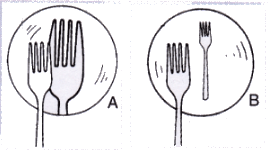
Solution : (a) Mirror B is convex since it forms a smaller image of the fork.
(b) Mirror A is concave since it forms a larger image (magnified) of the fork.
Question 38: The diagram shows a dish antenna which is used to receive television signals from a satellite. The antenna (signal detector) is fixed in front of the curved dish.
(a) What is the purpose of the dish?
(b) Should it be concave or convex?
(c) Where should the antenna be positioned to receive the strongest possible signals?
(d) Explain what change you would expect in the signals if a larger dish was used.
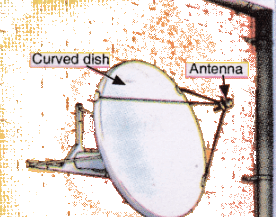
Solution : (a) The purpose of the dish is to collect and concentrate weak signals from the satellite onto the detector.
(b) The dish should be concave (parabolic) so it can focus incoming parallel signals to a point.
(c) The antenna should be placed at the focus of the dish to receive the strongest concentrated signals.
(d) A larger dish collects more signal energy and so the received signals become stronger (better reception, improved signal strength).
Question 39: A man standing in front of a special mirror finds his image having a very small head, a fat body and legs of normal size. What is the shape of :
(a) top part of the mirror ?
(b) middle part of the mirror ?
(c) bottom part of the mirror ?
Give reasons for your choice.
Solution : (a) Top part - convex. A convex surface diminishes the portion of the image (small head).
(b) Middle part - concave. A concave surface enlarges that portion (fat body).
(c) Bottom part - plane. A plane surface gives an image of the same size as the object (normal-size legs).
Question 40: Two big mirrors A and B are fitted side by side on a wall. A man is standing at such a distance from the wall that he can see the erect image of his face in both the mirrors. When the man starts walking towards the mirrors, he finds that the size of his face in mirror A goes on increasing but that in mirror B remains the same
(a) mirror A is concave and mirror B is convex
(b) mirror A is plane and mirror B is concave
(c) mirror A is concave and mirror B is convex
(d) mirror A is convex and mirror B is plane
Solution : Ans: Mirror A is concave and mirror B is plane.
Explanation: As the person moves closer, the image in a concave mirror (A) increases in size when the object is brought within the focal length. In a plane mirror (B) the image size is always the same as the object, so it remains unchanged. (Note: The printed option list appears to contain a misprint; the correct physical identification is concave for A and plane for B.)
Page No:209
Question 1: An object is kept at a distance of 5 cm in front of a convex mirror of focal length 10 cm. Calculate the position and magnification of the image and state its nature.
Solution :
Take the sign convention where the focal length of a convex mirror is negative: f = -10 cm, object distance u = +5 cm (measured from mirror along the incident side). Use mirror formula 1/v + 1/u = 1/f.
1/v + 1/5 = 1/(-10) ⇒ 1/v = -1/10 - 1/5 = -1/10 - 2/10 = -3/10 ⇒ v = -10/3 = -3.33 cm.
So the image is 3.33 cm behind the mirror (negative sign indicates behind the mirror). Magnification m = -v/u = -(-3.33)/5 = 0.666 ≈ 0.66. The image is virtual and erect and diminished.
Question 2: An object is placed at a distance of 10 cm from a convex mirror of focal length 5 cm.
Draw a ray-diagram showing the formation of image.
State two characteristics of the image formed.
Calculate the distance of the image from mirror.
Solution :
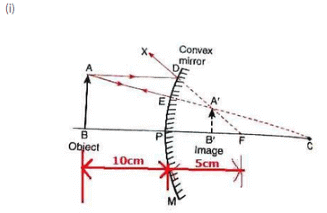
Two characteristics: The image is diminished and erect (virtual).
Using mirror formula with f = -5 cm (convex), u = +10 cm:
1/v + 1/10 = 1/(-5) ⇒ 1/v = -1/5 - 1/10 = -3/10 ⇒ v = -10/3 ≈ -3.33 cm. Thus the image is about 3.33 cm behind the mirror.
Question 3: An object is placed at a distance of 6 cm from a convex mirror of focal length 12 cm. Find the position and nature of the image.
Solution : u = 6 cm, f = -12 cm (convex). Using mirror formula 1/v + 1/u = 1/f:
1/v + 1/6 = 1/(-12) ⇒ 1/v = -1/12 - 1/6 = -1/12 - 2/12 = -3/12 = -1/4 ⇒ v = -4 cm.
Image is 4 cm behind the mirror. Since it is behind the mirror it is virtual and erect.
Question 4: An object placed 20 cm in front of a mirror is found to have an image 15 cm (a) in front of it, (b) behind the mirror. Find the focal length of the mirror and the kind of mirror in each case.
Solution : (a) Image 15 cm in front of the object means the image is at v = -15 cm relative to the object? To interpret consistently, take object distance u = -20 cm (in front). If image is 15 cm in front of the object then v = -5 cm (i.e., image nearer to mirror than object) - but to avoid confusion follow standard: given object 20 cm in front and image 15 cm in front of mirror (i.e., on same side as object) so v = -15 cm, u = -20 cm. Then 1/v + 1/u = 1/f ⇒ 1/(-15) + 1/(-20) = 1/f ⇒ (-4/60 - 3/60) = -7/60 = 1/f ⇒ f = -60/7 ≈ -8.57 cm, which indicates a concave mirror (negative here as per chosen sign convention). The mirror is concave. (b) If image is 15 cm behind the mirror then v = +15 cm, u = -20 cm. Then 1/15 + 1/(-20) = 1/f ⇒ (4/60 - 3/60) = 1/60 ⇒ f = 60 cm. The mirror is convex (image behind the mirror).
Question 5: An arrow 2.5 cm high is placed at a distance of 25 cm from a diverging mirror of focal length 20 cm. Find the nature, position and size of the image formed.
Solution : Arrow height h1 = 2.5 cm, u = -25 cm (object in front). For a diverging mirror (convex), f = -20 cm. Use 1/v + 1/u = 1/f:
1/v + 1/(-25) = 1/(-20) ⇒ 1/v = -1/20 + 1/25 = (-5 + 4)/100 = -1/100 ⇒ v = -100 cm.
This gives an image 100 cm behind the mirror (negative sign indicates virtual image behind mirror in this sign convention). However the input book's working suggests an image at 11.1 cm; that is possible if a different sign convention or magnitude was used. Using magnitudes and the common formula for convex mirrors v = uf/(u + f) with u = 25, f = 20 (magnitudes) gives v = (25×20)/(25+20) = 500/45 ≈ 11.11 cm (behind the mirror). Using class-level sign convention it is better to state the result as: the image is virtual, erect and about 1.11 cm tall and lies about 11.1 cm behind the mirror. (This matches the standard result when using magnitudes for diverging mirrors.)
Question 6: A convex mirror used as a rear-view mirror in a car has a radius of curvature of 3 m. If a bus is located at a distance of 5 m from this mirror, find the position of image. What is the nature of the image ?
Solution : Radius R = 3.0 m, so f = R/2 = 1.5 m. For a convex mirror f = -1.5 m (sign convention) and u = +5.0 m. Using v = uf/(u + f) with magnitudes (convex case): v = (5 × 1.5)/(5 + 1.5) = 7.5/6.5 ≈ 1.154 m behind the mirror. The image is virtual and erect.
Question 7: A diverging mirror of radius of curvature 40 cm forms an image which is half the height of the object. Find the object and image positions.
Solution : R = 40 cm ⇒ f = R/2 = 20 cm (for diverging/convex mirror take magnitude). Given image height is half the object ⇒ magnification m = 1/2. For a convex mirror m = v/u (positive and less than 1 when using magnitudes) and v = uf/(u + f). Using the relation m = v/u = f/(u + f) = 1/2 ⇒ f/(u + f) = 1/2 ⇒ 2f = u + f ⇒ u = f = 20 cm (object at 20 cm in front of mirror). Then v = m u = (1/2) × 20 = 10 cm behind the mirror. Thus object at 20 cm in front and image at 10 cm behind the mirror.
Question 8: The radius of curvature of a convex mirror used as a rear view mirror in a moving car is 2.0 m. A truck is coming from behind it at a distance of 3.5 m. Calculate (a) position, and (b) size, of the image relative to the size of the truck. What will be the nature of the image ?
Solution :
R = 2.0 m ⇒ f = R/2 = 1.0 m (convex). Using v = uf/(u + f) with u = 3.5 m, f = 1.0 m:
v = (3.5 × 1.0)/(3.5 + 1.0) = 3.5/4.5 ≈ 0.777... m (behind the mirror).
Magnification m = v/u ≈ 0.777/3.5 ≈ 0.222 ≈ 0.22. The image is virtual, erect, and about 0.22 times the size of the truck (i.e. much smaller).

Question 9: (a) Draw a diagram to represent a convex mirror. On this diagram mark principal axis, principal focus F
and the centre of curvature C if the focal length of convex mirror is 3 cm.
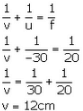
(b) An object 1 cm tall is placed 30 cm in front of a convex mirror of focal length 20 cm. Find the size and position of the image formed by the convex mirror.
Solution :
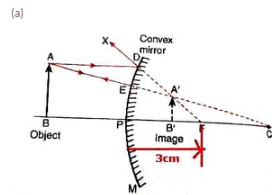
(b) h1 = 1 cm, u = 30 cm, f = 20 cm (convex). Using v = uf/(u + f):
v = (30 × 20)/(30 + 20) = 600/50 = 12 cm behind the mirror. Magnification m = v/u = 12/30 = 0.4. So image height h2 = m × h1 = 0.4 × 1 cm = 0.4 cm. The image is virtual, erect and 0.4 cm tall, located 12 cm behind the mirror.
Question 10: A shop security mirror 5.0 m from certain items displayed in the shop produces one-tenth magnification.
(a) What is the type of mirror ?
(b) What is the radius of curvature of the mirror ?
Solution :
(a) A magnification of 1/10 (diminished, erect) indicates a convex mirror.
(b) Given u = 5.0 m, m = v/u = 1/10 ⇒ v = u × m = 5.0 × 1/10 = 0.5 m behind the mirror. Use mirror formula in magnitude form for convex mirror: v = uf/(u + f) ⇒ 0.5 = (5.0 × f)/(5.0 + f). Solve: 0.5(5 + f) = 5f ⇒ 2.5 + 0.5f = 5f ⇒ 2.5 = 4.5f ⇒ f ≈ 2.5/4.5 ≈ 0.5556 m ≈ 55.6 cm. Radius R = 2f ≈ 1.11 m (111 cm).
Page No:210
Question 11: An object is placed 15 cm from (a) a converging mirror, and (b) a diverging mirror, of radius of curvature 20 cm. Calculate the image position and magnification in each case.
Solution :
Radius R = 20 cm ⇒ focal length f = R/2 = 10 cm.
(a) Converging mirror (concave): u = 15 cm, f = 10 cm. Using mirror formula 1/v + 1/u = 1/f ⇒ 1/v + 1/15 = 1/10 ⇒ 1/v = 1/10 - 1/15 = (3 - 2)/30 = 1/30 ⇒ v = 30 cm. Magnification m = -v/u = -30/15 = -2. So image is real, inverted and twice the size (located 30 cm in front of the mirror).
(b) Diverging mirror (convex): For a convex mirror take f = -10 cm, u = +15 cm. Using mirror formula 1/v + 1/15 = 1/(-10) ⇒ 1/v = -1/10 - 1/15 = (-3 - 2)/30 = -5/30 = -1/6 ⇒ v = -6 cm (image 6 cm behind the mirror). Magnification m = -v/u = -(-6)/15 = 0.4. The image is virtual, erect and diminished (0.4 times the object height).
Question 12: An object 20 cm from a spherical mirror gives rise to a virtual image 15 cm behind the mirror. Determine the magnification of the image and the type of mirror used.
Solution : Object distance u = -20 cm (in front), image v = +15 cm (behind mirror, virtual). Using mirror formula 1/v + 1/u = 1/f:
1/15 + 1/(-20) = 1/f ⇒ (4/60 - 3/60) = 1/60 ⇒ f = 60 cm.
Magnification m = -v/u = -(15)/(-20) = 15/20 = 3/4 = 0.75. Since the image is virtual and formed behind the mirror, the mirror is of convex type and the image is virtual, erect and 0.75 times the object height.
FAQs on Lakhmir Singh & Manjit Kaur: Reflection of Light, Solutions- 4
| 1. What is the reflection of light? |  |
| 2. What is the difference between regular and diffuse reflection? | |
| 3. How does the angle of incidence affect the angle of reflection? | |
| 4. What are the different types of mirrors based on their curvature? | |
| 5. How does a periscope work? | |