Lakhmir Singh & Manjit Kaur: Refraction of Light, Solutions- 1

Page No:219
Question 1: If a ray of light goes from a rarer medium to a denser medium, will it bend towards the normal or away from it ?
Solution: It will bend towards the normal. This is because light travels more slowly in the denser medium, so the ray changes direction and moves closer to the normal on entering the denser medium.
Question 2: If a ray of light goes from a denser medium to a rarer medium, will it bend towards the normal or away from the normal ?
Solution: It will bend away from the normal. When light goes into a rarer medium its speed increases and the refracted ray moves away from the normal.
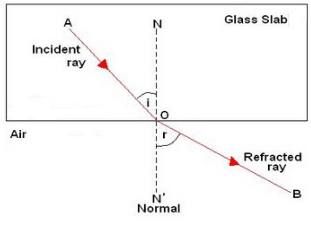
Question 3: A beam of light travelling in a rectangular glass slab emerges into air. Draw a ray diagram indicating the change in its path.
Solution: A ray of light inside the rectangular glass slab is refracted at the second (exit) surface and emerges into the air. The emergent ray is parallel to the incident ray but is shifted sideways (laterally displaced) from the original path due to two refractions at entry and one at exit.
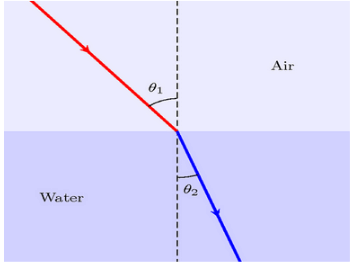
Question 4: A beam of light travelling in air is incident on water. Draw a ray-diagram indicating the change in its path in water.
Solution: On entering water from air, the ray bends towards the normal because water is optically denser than air and light slows down in water. The refracted ray lies closer to the normal than the incident ray.
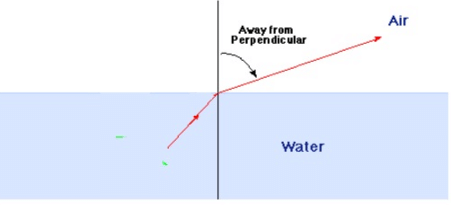
Question 5: A ray of light travelling in water emerges into air. Draw a ray-diagram indicating the change in its path.
Solution: A ray of light travelling from water into air bends away from the normal at the surface because it moves from a denser to a rarer medium and its speed increases on entering air.
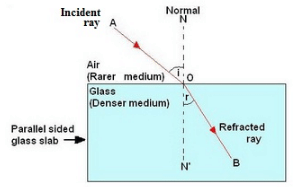
Question 6: A ray of light travelling in air is incident on a parallel-sided glass slab (or rectangular glass slab). Draw a ray-diagram indicating the change in its path in glass.
Solution: The ray refracts towards the normal at the front surface of the slab (air → glass) and refracts away from the normal at the rear surface (glass → air). The emergent ray is parallel to the incident ray but shifted laterally.
Question 7: A ray of light travelling in glass emerges into air. State whether it will bend towards the normal or away from the normal.
Solution: The ray will bend away from the normal because it goes from an optically denser medium (glass) to a rarer medium (air), so its speed increases and the ray moves away from the normal.
Question 8: A ray of light travelling in air enters obliquely into water. Does the ray of light bend towards the normal or away from the normal ? Why ?
Solution: The ray bends towards the normal. This is because water is optically denser than air, so light slows down on entering water and the direction of the ray shifts towards the normal.
Question 9: A ray of light goes from water into air. Will it bend towards the normal or away from the normal ?
Solution: It will bend away from the normal, since the ray moves from the denser medium (water) into the rarer medium (air) and its speed increases.
Question 10: State two effects caused by the refraction of light.
Solution: Two common effects of refraction are:
- A pool of water appears shallower than it really is.
- An object placed under water appears to be raised (its apparent position is higher than its real position).
Question 11: Name the phenomenon due to which a swimming pool appears less deep than it really is.
Solution: This effect is due to refraction of light at the water-air surface, which produces a virtual image of the bottom at a shallower depth.
Question 12: When a ray of light passes from air into glass, is the angle of refraction greater than or less than the angle of incidence ?
Solution: The angle of refraction is less than the angle of incidence because light slows down on entering the optically denser glass, so the refracted ray moves closer to the normal.
Page No:220
Question 13: A ray of light passes from air into a block of glass. Does it bend towards the normal or away from it ?
Solution: It bends towards the normal because glass is optically denser than air and the speed of light decreases in glass.
Question 14: As light rays pass from water into glass, are they refracted towards the normal or away from the normal ?
Solution: They are refracted towards the normal if glass is optically denser than water. In typical cases glass has a higher refractive index than water, so the rays move closer to the normal on entering glass.
Question 15: In which material do you think light rays travel faster-glass or air ?
Solution: Light travels faster in air than in glass because air is optically rarer (lower refractive index) and offers less optical resistance to the propagation of light.
Question 16: Which phenomenon of light makes the water to appear shallower than it really is ?
Solution: Refraction of light is responsible for the apparent shallowness of water; refracted rays make the bottom appear at a higher position than it actually is.
Question 17: State whether the following statement is true or false :
Refraction occurs because light slows down in denser materials.
Solution: True. When light enters an optically denser material, its speed decreases; this change of speed causes the ray to change direction, which we call refraction.
Question 18: Why does a ray of light bend when it travels from one medium to another?
Solution: A ray bends because its speed changes on entering a different medium. The change in speed alters the direction of the wavefronts, producing the observed change in the ray's direction.
Question 19: Fill in the following blanks with suitable words :
(a) Light travelling along a normal is............
(b) Light bends when it passes from water into air. We say that it is...............
Solution: (a) not refracted (or not bent).
(b) refracted.
Question 20: What is meant by 'refraction of light' ? Draw a labelled ray diagram to show the refraction of light.
Solution: Refraction of light is the change in direction of a light ray when it passes obliquely from one transparent medium into another due to change in its speed. The ray diagram shows the incident ray, the normal at the point of incidence, and the refracted ray bent towards or away from the normal depending on relative optical densities.
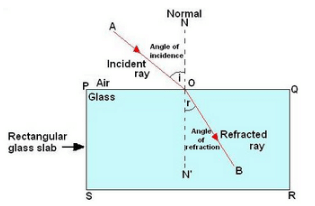
Question 21: A ray of light travelling in air is incident on a rectangular glass block and emerges out into the air from the opposite face. Draw a labelled ray diagram to show the complete path of this ray of light. Mark the two points where the refraction of light takes place. What can you say about the final direction of ray of light ?
Solution:
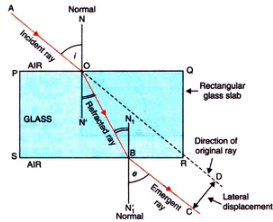
Refraction takes place at the front surface (first point of contact) and the rear surface (second point) of the block. The emergent ray is parallel to the incident ray, so the final direction of the ray is the same as the initial incident direction; however the ray is laterally displaced.
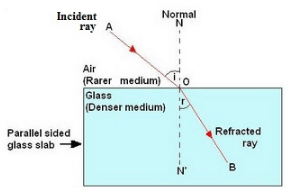
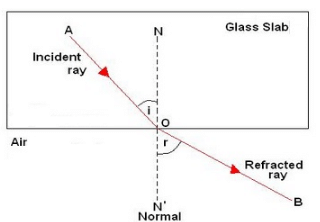
Question 22: Draw a labelled ray diagram to show how a ray of light is refracted when it passes :
(a) from air into an optically denser medium.
(b) from an optically denser medium into air.
Solution: (a) On entering the denser medium the ray bends towards the normal.
(b) On leaving the denser medium into air the ray bends away from the normal.
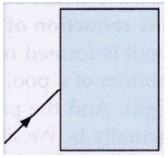
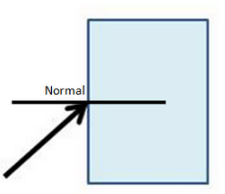
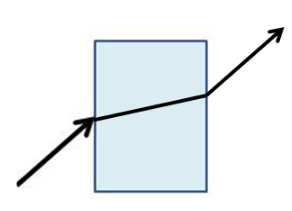
Question 23: The diagram given alongside shows a ray of light entering a rectangular block of glass.
(a) Copy the diagram and draw the normal at the point of entry.
(b) Draw the approximate path of the ray of light through the glass block and out of the other side.
Solution:
(a)
(b)
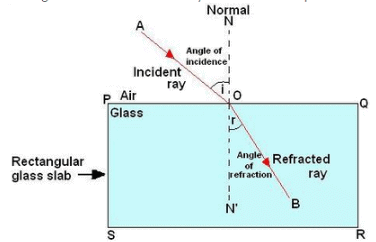
Question 24: What is meant by the 'angle of incidence' and the 'angle of refraction' for a ray of light ? Draw a labelled ray diagram to show the angle of incidence and the angle of refraction for a refracted ray of light.
Solution: The angle of incidence is the angle between the incident ray and the normal at the point of incidence. The angle of refraction is the angle between the refracted ray and the normal at the point of refraction. Both are shown in the labelled diagram.
Question 25: Light travels more quickly through water than through glass.
(a) Which is optically denser : water or glass ?
(b) If a ray of light passes from glass into water, which way will it bend : towards the normal or away from the normal ?
Solution: (a) Glass is optically denser than water (glass has the higher refractive index).
(b) The ray will bend away from the normal when it passes from glass into water, because it is going into a rarer medium and its speed increases.
Question 26: Draw a labelled ray diagram to show how a ray of light passes through a parallel sided glass block :
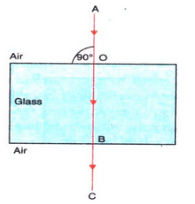
(a) if it hits the glass block at 90° (that is, perpendicular to the glass block)
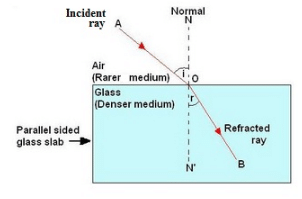
(b) if it hits the glass block at an angle other than 90° (that is, obliquely to the glass block).
Solution: (a) If the ray strikes at 90° to the surface it passes straight through without bending (angle of incidence = 0).
(b) If the ray strikes obliquely it is refracted at the front surface towards the normal and at the rear surface away from the normal; the emergent ray is parallel to the incident ray but laterally displaced.
Question 27: When a light ray passes from air into glass, what happens to its speed ? Draw a diagram to show which way the ray of light bends.
Solution:
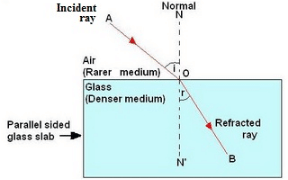
The speed of light decreases on entering glass from air, so the ray bends towards the normal.
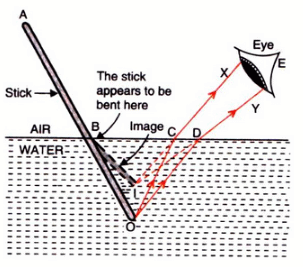
Question 28: (a) Explain why, a stick half immersed in water appears to be bent at the surface. Draw a labelled diagram
to illustrate your answer.
(b) A coin in a glass tumbler appears to rise as the glass tumbler is slowly filled with water. Name the phenomenon responsible for this effect.
Solution: (a) The apparent bending of the stick is due to refraction when light from the submerged part passes into air. Rays from the underwater part bend away from the normal when they emerge into air; when these refracted rays are traced backwards they appear to come from a point higher than the real position. This creates a virtual image and makes the submerged part look shifted, so the stick seems bent.
(b) This effect is due to the refraction of light at the water surface, which makes the coin's apparent position higher than its real position.
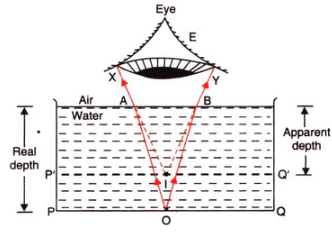
Question 29: (a) With the help of a labelled diagram, explain why a tank full of water appears less deep than it actually is.
(b) Name the phenomenon due to which a pencil partly immersed in water and held obliquely appears to be bent at the water surface.
Solution: (a) Light from the bottom of the tank is refracted away from the normal as it leaves the water and enters air. When these refracted rays reach our eyes, they appear to come from a point nearer the surface. Thus we see a virtual image of the bottom which is closer to us, and the tank appears shallower than it really is.
(b) The phenomenon is refraction of light.
Question 30: (a) With the help of a diagram, show how when light falls obliquely on the side of a rectangular glass slab, the emergent ray is parallel to the incident ray.
(b) Show the lateral displacement of the ray on the diagram.
(c) State two factors on which the lateral displacement of the emergent ray depends.
Solution:
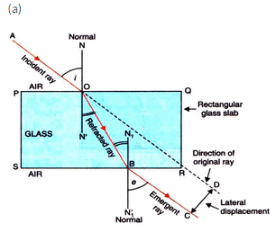
(b) The lateral displacement is the sideways shift between the incident ray and the emergent ray as shown in the diagram.
(c) The lateral displacement depends on:
(i) The angle of incidence.
(ii) The thickness of the glass slab.
(iii) The refractive index of the glass (how optically dense the glass is).
Question 31: Explain with the help of a labelled ray diagram, why a pencil partly immersed in water appears to be bent at the water surface. State whether the bending of pencil will increase or decrease if water is replaced by another liquid which is optically more dense than water.
Solution: A pencil partly in water appears bent because light from the submerged part is refracted at the water-air surface and reaches the eye from a different direction. The refracted rays when extended backwards form a virtual image of the submerged part at a higher position, producing the illusion of bending.
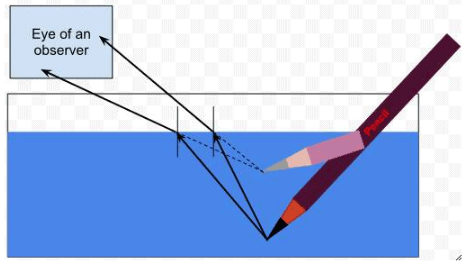
If the water is replaced by a liquid that is optically more dense, the bending (apparent displacement) will increase because a larger change in speed gives a greater change in direction at the surface.
Question 39: Which of the following diagrams shows the ray of light refracted correctly ?
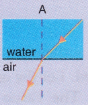
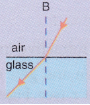
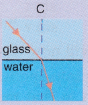
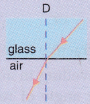
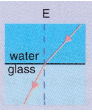
Ans: (E)
Explanation: Diagram E correctly shows the ray bending towards the normal on entering an optically denser medium and bending away from the normal on emerging into a rarer medium. The path inside the block is straight and the emergent ray is in the correct direction relative to the normals at the surfaces.
Question 40: A vertical ray of light strikes the horizontal surface of some water :
(a) What is the angle of incidence ?
(b) What is the angle of refraction ?
Solution: (a) 00 (the ray is along the normal).
(b) 00 (no bending occurs when the incidence is normal to the surface).
Question 41: How is the reflection of light ray from a plane mirror different from the refraction of light ray as it enters a block of glass ?
Solution: In reflection from a plane mirror the angle of reflection equals the angle of incidence and the ray stays in the same medium. In refraction the ray passes into another medium and the angle of refraction is generally different from the angle of incidence because the speed of light changes on entering the new medium.
Question 42: How does the light have to enter the glass :
(a) to produce a large amount of bending ?
(b) for no refraction to happen ?
Solution: (a) To produce a large amount of bending the light should enter obliquely, i.e. at a large angle of incidence relative to the normal.
(b) For no refraction to happen the light must enter perpendicular to the surface (at 90° to the surface), so the angle of incidence is zero.
Question 43: (a) How can you bend light away from the normal ?
(b) How must light travel out of a substance if it is not going to be refracted ?
Solution: (a) Light bends away from the normal when it goes from a denser medium into a rarer medium (for example, from water into air) at an oblique angle.
(b) Light must travel along the normal (i.e. at right angles to the surface) when leaving the substance if it is not to be refracted; in that case the direction does not change.
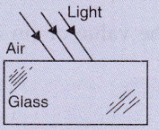
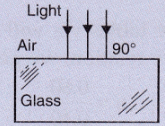
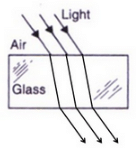
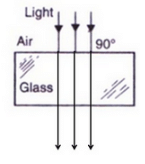
Question 44: Draw and complete the following diagrams to show what happens to the beams of light as they enter the glass block and then leave it :
Solution:
Question 45: Why does a beam of light bend when it enters glass at an angle ? Why does it not bend if it enters the glass at right angles ?
Solution: A beam bends on entering glass at an angle because its speed changes as it goes from one medium to another; this change in speed causes the ray to change direction (refraction). If the beam enters at right angles (normal incidence), there is no change in direction because the angle of incidence is zero and so is the angle of refraction.
FAQs on Lakhmir Singh & Manjit Kaur: Refraction of Light, Solutions- 1
| 1. What is refraction of light? |  |
| 2. How does refraction of light occur? | |
| 3. What are some examples of refraction of light in daily life? | |
| 4. How does refraction of light affect the appearance of objects? | |
| 5. What is the relationship between the angle of incidence and the angle of refraction during refraction of light? | |





