Lakhmir Singh & Manjit Kaur: Refraction of Light, Solutions- 4

Page No:253
Question 23: When an object is placed 10 cm in front of lens A, the image is real, inverted, magnified and formed at a great distance. When the same object is placed 10 cm in front of lens B, the image formed is real, inverted and same size as the object.
(a) What is the focal length of lens A ?
(b) What is the focal length of lens B ?
(c) What is the nature of lens A ?
(d) What is the nature of lens B ?
Solution :
Ans:
(a) The image is formed at a very large distance (effectively at infinity) when the object is placed 10 cm in front of the lens. This happens when the object is at the focal point of a converging lens. Therefore, the focal length of lens A is 10 cm.
(b) An image that is real, inverted and the same size as the object is formed when the object is at a distance equal to twice the focal length (object at 2f gives image at 2f with magnification 1). Since the object distance is 10 cm = 2f, the focal length of lens B is 5 cm.
(c) Lens A is a convex (converging) lens because it produces a real, inverted image at a large distance when the object is at the focal point.
(d) Lens B is also a convex (converging) lens because it produces a real, inverted image of the same size (object at 2f).
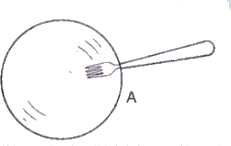
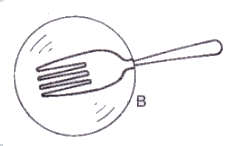
Question 24: When a fork is seen through lenses A and B one by one, it appears as shown in the diagrams. What is the nature of (i) lens A, and (ii) lens B ? G
Solution :
Ans:
(i) Concave lens because of negative magnification.
(ii) Convex lens because of positive magnification.
Question 25: What kind of lens can form :
(a) an inverted magnified image ?
(b) an erect magnified image ?
(c) an inverted diminished image ?
(d) an erect diminished image ?
Solution :
Ans:
(a) Convex lens - when the object is placed between the focus and twice the focal length (but beyond the focus), a convex lens can form an inverted magnified image (object between f and 2f gives image beyond 2f, magnified and inverted).
(b) Convex lens - if the object is placed between the optical centre and the focal point of a convex lens, the lens forms a virtual, erect and magnified image on the same side as the object.
(c) Convex lens - when the object is beyond twice the focal length (u > 2f), the convex lens forms a real, inverted and diminished image (image between f and 2f).
(d) Concave lens - a concave (diverging) lens always forms a virtual, erect and diminished image for any real object placed in front of it.
Lakhmir Singh Physics Class 10 Solutions Page No:255
Question 1: The lens A produces a magnification of, - 0.6 whereas lens B produces a magnification of + 0.6.
(a) What is the nature of lens A ?
(b) What is the nature of lens B ?
Solution :
Ans:
(a) Lens A has magnification m = -0.6. The negative sign shows the image is inverted and since |m| < 1 it is diminished. These are the characteristics of a convex (converging) lens when it forms a real image. Hence lens A is a convex lens.
(b) Lens B has magnification m = +0.6. The positive sign shows the image is erect and, with |m| < 1, diminished. This is typical of a concave (diverging) lens which forms a virtual, erect and diminished image. Hence lens B is a concave lens.
Question 2: A 50 cm tall object is at a very large distance from a diverging lens. A virtual, erect and diminished image of the object is formed at a distance of 20 cm in front of the lens. How much is the focal length of the lens ?
Solution :
Ans:
When an object is effectively at infinity (very large distance), the image formed by a lens is at its focal point. Here the image is formed 20 cm in front of the diverging lens, so the focal length is 20 cm on the same side as the object. For a diverging lens, focal length is taken as negative, so f = -20 cm.
Page No:256
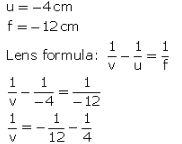
Question 3: An object is placed at a distance of 4 cm from a concave lens of focal length 12 cm. Find the position and nature of the image.
Solution :

Ans:
Use the lens formula in the sign convention used here: 1/f = 1/v + 1/u, taking u and v positive when measured in the usual way and f negative for a concave lens.
Given: u = 4 cm, f = -12 cm.
1/(-12) = 1/v + 1/4
1/v = -1/12 - 1/4 = -1/12 - 3/12 = -4/12 = -1/3
v = -3 cm.
So, the image is formed 3 cm in front of the concave lens (v = -3 cm).
Nature of image: The image is virtual and erect (as v is negative and magnification is positive). The image is diminished because |v| < u.
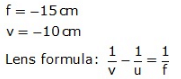
Question 4: A concave lens of focal length 15 cm forms an image 10 cm from the lens. How far is the object placed from the lens ? Draw the ray-diagram.
Solution :
Ans:
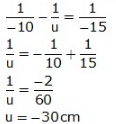
Given: f = -15 cm, v = -10 cm (image in front of lens, virtual). Use 1/f = 1/v + 1/u.
1/(-15) = 1/(-10) + 1/u
-1/15 = -1/10 + 1/u
1/u = -1/15 + 1/10 = (-2 + 3)/30 = 1/30
u = 30 cm.
Hence the object is 30 cm to the left of the concave lens.
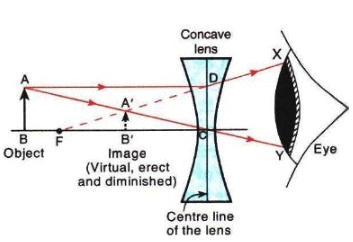
Here, OB = 30cm
OF = 15cm
OB' = 10cm
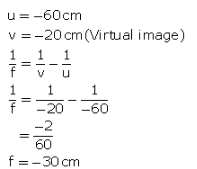
Question 5: An object 60 cm from a lens gives a virtual image at a distance of 20 cm in front of the lens. What is the focal length of the lens ? Is the lens converging or diverging ?
Solution :
Ans:
Given u = 60 cm, image is virtual and in front of the lens so v = -20 cm.
Use 1/f = 1/v + 1/u = 1/(-20) + 1/60 = -1/20 + 1/60 = (-3 + 1)/60 = -2/60 = -1/30.
Hence f = -30 cm. The focal length is negative, so the lens is diverging (concave).
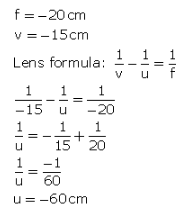
Question 6: A concave lens of 20 cm focal length forms an image 15 cm from the lens. Compute the object distance.
Solution :
Ans:
Given f = -20 cm, v = -15 cm (virtual image in front of lens). Using 1/f = 1/v + 1/u:
1/(-20) = 1/(-15) + 1/u
-1/20 = -1/15 + 1/u
1/u = -1/20 + 1/15 = (-3 + 4)/60 = 1/60
u = 60 cm.
The object is 60 cm to the left of the lens.
Question 7: A concave lens has focal length 15 cm. At what distance should the object from the lens be placed so that it forms an image at 10 cm from the lens ? Also find the magnification produced by the lens.
Solution :
Ans:
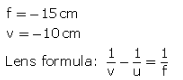
Given f = -15 cm, v = -10 cm. Use 1/f = 1/v + 1/u.
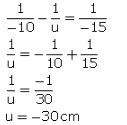
1/(-15) = 1/(-10) + 1/u
-1/15 = -1/10 + 1/u
1/u = -1/15 + 1/10 = (-2 + 3)/30 = 1/30
u = 30 cm.
The object should be placed 30 cm to the left of the lens.
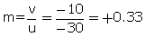
Magnification m = -v/u = -(-10)/30 = 10/30 = 1/3. So the image is erect, virtual and one-third the height of the object.
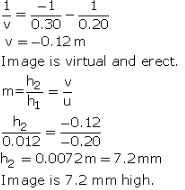
Question 8: Calculate the image distance for an object of height 12 mm at a distance of 0.20 m from a concave lens of focal length 0.30 m, and state the nature and size of the image.
Solution :
Ans:
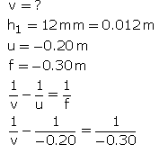
Convert to centimetres for convenience: u = 0.20 m = 20 cm, f = -0.30 m = -30 cm, object height h = 12 mm = 1.2 cm.
Use 1/f = 1/v + 1/u:
1/(-30) = 1/v + 1/20
1/v = -1/30 - 1/20 = (-2 - 3)/60 = -5/60 = -1/12
v = -12 cm.
So the image is formed 12 cm in front of the lens (virtual).
Magnification m = -v/u = -(-12)/20 = 12/20 = 0.6.
Image height h' = m × h = 0.6 × 1.2 cm = 0.72 cm = 7.2 mm.
Nature of image: virtual, erect and diminished (height 7.2 mm).
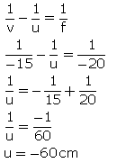
Question 9: A concave lens has a focal length of 20 cm. At what distance from the lens a 5 cm tall object be placed so that it forms an image at 15 cm from the lens ? Also calculate the size of the image formed.
Solution :

v = -15cm (Concave lens forms virtual image)
Ans:
Given f = -20 cm, v = -15 cm. Use 1/f = 1/v + 1/u:
1/(-20) = 1/(-15) + 1/u
-1/20 = -1/15 + 1/u
1/u = -1/20 + 1/15 = (-3 + 4)/60 = 1/60
u = 60 cm.
Object should be placed 60 cm to the left of the lens.
Magnification m = -v/u = -(-15)/60 = 15/60 = 1/4.
Image height = m × object height = 1/4 × 5 cm = 1.25 cm. The image is virtual, erect and diminished.

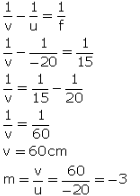
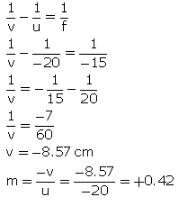
Question 10: An object is placed 20 cm from (a) a converging lens, and (b) a diverging lens, of focal length 15 cm. Calculate the image position and magnification in each case.
Solution :
Ans:
Given u = 20 cm for both cases.
(a) Converging lens: f = +15 cm.
Use 1/f = 1/v + 1/u:
1/15 = 1/v + 1/20 ⇒ 1/v = 1/15 - 1/20 = (4 - 3)/60 = 1/60 ⇒ v = 60 cm.
Magnification m = -v/u = -60/20 = -3. The image is real, inverted and three times larger, formed 60 cm on the other side of the lens.
(b) Diverging lens: f = -15 cm.
1/(-15) = 1/v + 1/20 ⇒ 1/v = -1/15 - 1/20 = (-4 - 3)/60 = -7/60 ⇒ v = -60/7 ≈ -8.57 cm.
Magnification m = -v/u = -(-60/7)/20 = (60/7)/20 = 3/7 ≈ 0.4286. The image is virtual, erect and diminished, located ≈ 8.57 cm in front of the lens.
Question 11: A 2.0 cm tall object is placed 40 cm from a diverging lens of focal length 15 cm. Find the position and size of the image.
Solution :
h1 = 2 cm
u = 40 cm
f = -15cm
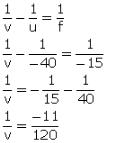
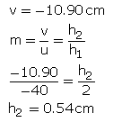
Ans:
Using 1/f = 1/v + 1/u:
1/(-15) = 1/v + 1/40 ⇒ 1/v = -1/15 - 1/40 = (-8 - 3)/120 = -11/120 ⇒ v = -120/11 ≈ -10.91 cm.
Magnification m = -v/u = -(-120/11)/40 = (120/11)/40 = 120/(440) = 0.2727.
Image height = m × 2.0 cm ≈ 0.545 cm ≈ 5.45 mm.
So the image is virtual, erect and about 5.45 mm tall, located ≈10.91 cm in front of the lens.
Question 12: (a) Find the position and size of the virtual image formed when an object 2 cm tall is placed 20 cm from :
(i) a diverging lens of focal length 40 cm.
(ii) a converging lens of focal length 40 cm.
(b) Draw labelled ray diagrams to show the formation of images in cases (i) and (ii)above (The diagrams may not be according to scale).
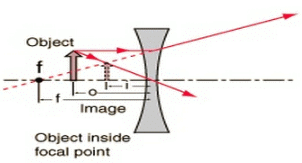
Solution : h1 = 2 cm
u = - 20 cm
f = -40cm (Diverging lens)
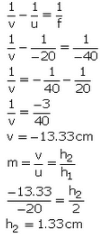
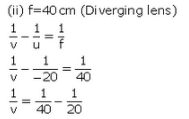
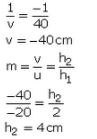
(b) Formation of image in case (I):
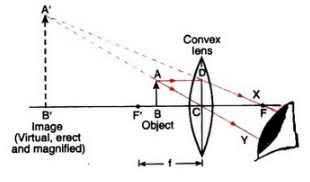
Formation of image in case (ii):
Ans:
We use 1/f = 1/v + 1/u and take u = 20 cm (object distance), h = 2 cm.
(i) Diverging lens, f = -40 cm:
1/(-40) = 1/v + 1/20 ⇒ 1/v = -1/40 - 1/20 = (-1 - 2)/40 = -3/40 ⇒ v = -40/3 ≈ -13.33 cm.
Magnification m = -v/u = -(-40/3)/20 = (40/3)/20 = 2/3 ≈ 0.6667.
Image height = 0.6667 × 2 cm ≈ 1.333 cm. The image is virtual, erect and diminished, located ≈13.33 cm in front of the lens.
(ii) Converging lens, f = +40 cm:
1/40 = 1/v + 1/20 ⇒ 1/v = 1/40 - 1/20 = (1 - 2)/40 = -1/40 ⇒ v = -40 cm.
Magnification m = -v/u = -(-40)/20 = 2. The image is virtual, erect and magnified (twice the height), image height = 2 × 2 cm = 4 cm, and it lies 40 cm in front of the lens.
Question 13: (a) A small object is placed 150 mm away from a diverging lens of focal length 100 mm.
(i) Copy the figure below and draw rays to show how an image is formed by the lens.
(ii) Calculate the distance of the image from the lens by using the lens formula.
(b) The diverging lens in part (a) is replaced by a converging lens also of focal length 100 mm. The object remains in the same position and an image is formed by the converging lens. Compare two properties of this image with those of the image formed by the diverging lens in part (a).
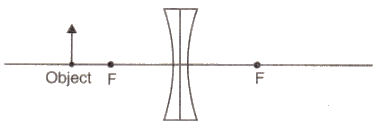
Solution :
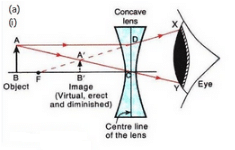
Here, OB = 150 mm
OF = 100 mm
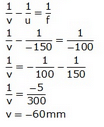
(ii) u = -150 mmm
f = -100 mm
Ans:
Take u = 150 mm and f = -100 mm for the diverging lens. Using 1/f = 1/v + 1/u:
1/(-100) = 1/v + 1/150 ⇒ 1/v = -1/100 - 1/150 = (-3 - 2)/300 = -5/300 = -1/60 ⇒ v = -60 mm.
So the image is 60 mm in front of the lens (virtual).
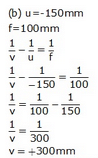
(b) When the diverging lens is replaced by a converging lens of the same focal length (f = +100 mm) with the object at 150 mm, we get:
1/100 = 1/v + 1/150 ⇒ 1/v = 1/100 - 1/150 = (3 - 2)/300 = 1/300 ⇒ v = 300 mm.
Comparison of two properties:
- For the diverging lens the image is virtual, erect and diminished (v = -60 mm).
- For the converging lens the image is real, inverted and magnified (v = +300 mm, magnification = 300/150 = 2).
Page No:257
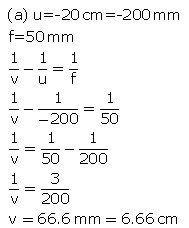
Question 18: A camera fitted with a lens of focal length 50 mm is being used to photograph a flower that is 5 cm in diameter. The flower is placed 20 cm in front of the camera lens.
(a) At what distance from the film should the lens be adjusted to obtain a sharp image of the flower ?
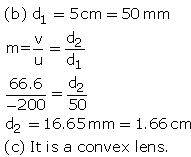
(b) What would be the diameter of the image of the flower on the film ?
(c) What is the nature of camera lens ?
Solution :
Ans:
Given focal length f = 50 mm = 5 cm, object distance u = 20 cm, object diameter = 5 cm.
Use lens formula 1/f = 1/v + 1/u:
1/5 = 1/v + 1/20 ⇒ 1/v = 1/5 - 1/20 = (4 - 1)/20 = 3/20 ⇒ v = 20/3 cm ≈ 6.67 cm.
(a) The film should be placed at v ≈ 6.67 cm behind the lens to obtain a sharp image.
(b) Magnification m = -v/u = -(20/3)/20 = -1/3. Image diameter = |m| × object diameter = (1/3) × 5 cm ≈ 1.67 cm.
(c) A camera uses a converging (convex) lens so that it can form a real image on the film.
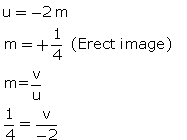
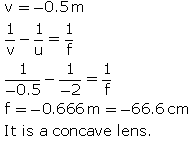
Question 19: An object is 2 m from a lens which forms an erect image one-fourth (exactly) the size of the object. Determine the focal length of the lens. What type of lens is this ?
Solution :
Ans:
Given: u = 2 m = 200 cm, image is erect and one-fourth the size so magnification m = +1/4.
Use relation m = -v/u (sign convention) ⇒ -v/u = 1/4 ⇒ v = -u/4 = -200/4 = -50 cm (negative indicates a virtual image on the same side as the object).
Now use 1/f = 1/v + 1/u = 1/(-50) + 1/200 = (-1 + 0.25)/50 = -0.75/50 = -3/200 ⇒ f = -200/3 cm ≈ -66.67 cm.
The focal length is approximately -66.7 cm and the negative sign shows it is a diverging (concave) lens.
Question 20: An image formed on a screen is three times the size of the object. The object and screen are 80 cm apart when the image is sharply focussed.
(a) State which type of lens is used.
(b) Calculate focal length of the lens.
Solution : (a) Since the image is formed on a screen, it must be a real image.
Hence, the lens should be a convex lens.
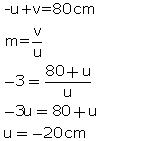
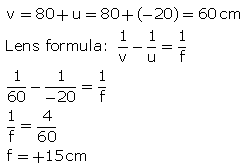
(b) m = -3 (Real and inverted image)
Ans:
(a) A convex (converging) lens is used because a real image is formed on a screen.
(b) Let object distance = u and image distance = v. Given u + v = 80 cm and magnification m = -v/u = -3 ⇒ v = 3u.
So u + 3u = 80 ⇒ 4u = 80 ⇒ u = 20 cm ⇒ v = 60 cm.
Use lens formula 1/f = 1/v + 1/u = 1/60 + 1/20 = (1 + 3)/60 = 4/60 = 1/15 ⇒ f = 15 cm.
Page No:261
Question 1: The lens A has a focal length of 25 cm whereas another lens B has a focal length of 60 cm. Giving reason state, which lens has more power : A or B
Solution :
Ans: Lens A has more power because power P = 1/f (in metres). Lens A has the shorter focal length (25 cm = 0.25 m) so its power P = 1/0.25 = +4 D, which is greater than that of lens B (1/0.60 ≈ +1.67 D).
Question 2: Which causes more bending (or more refraction) of light rays passing through it: a convex lens of long focal length or a convex lens of short focal length ?
Solution :
Ans: A convex lens of short focal length causes more bending of light rays. Shorter focal length means rays are brought to focus more quickly, so the lens has greater power and bends light more strongly.
Question 3: Name the physical quantity whose unit is dioptre.
Solution :
Ans: Power of a lens.
Question 4: Define 1 dioptre power of a lens.
Solution :
Ans: One dioptre is the power of a lens whose focal length is 1 metre (P = 1 m-1).
Question 5: Which typie of lens has (a) a positive power, and (b) a negative power ?
Solution :
Ans:
(a) Positive power - Convex (converging) lens.
(b) Negative power - Concave (diverging) lens.
Question 6: Which of the two has a greater power : a lens of short focal length or a lens of large focal length ?
Solution :
Ans: A lens of short focal length has greater power because P = 1/f.
Question 7: How is the power of a lens related to its focal length ?
Solution :
Ans: Power of a lens P = 1/f where f is the focal length expressed in metres. Power is measured in dioptres (D).
Question 8: Which has more power : a thick convex lens or a thin convex lens, made of the same glass ? Give reason for your choice.
Solution :
Ans: A thick convex lens has more power because its surfaces have greater curvature, producing a shorter focal length and therefore a larger power (P = 1/f).
Question 9: The focal length of a convex lens is 25 cm. What is its power ?
Solution :
Ans: f = 25 cm = 0.25 m.
P = 1/f = 1/0.25 = +4 D.
Question 10: What is the power of a convex lens of focal length 0.5 m ?
Solution :
Ans: f = 0.5 m
P = 1/f = 1/0.5 = +2 D.
Question 11: A converging lens has a focal length of 50 mm. What is the power of the lens ?
Solution :
Ans: f = 50 mm = 0.05 m
P = 1/f = 1/0.05 = +20 D.
Question 12: What is the power of a convex lens whose focal length is 80 cm ?
Solution :
Ans: f = 80 cm = 0.8 m.
P = 1/f = 1/0.8 = +1.25 D.
Question 13: A diverging lens has a focal length of 3 cm. Calculate the power.
Solution :
Ans: f = -3 cm = -0.03 m (negative for diverging lens).
P = 1/f = 1/(-0.03) = -33.33 D (approximately).
Question 14: The power of a lens is + 0.2 D. Calculate its focal length.
Solution :
Ans: P = +0.2 D.
P = 1/f ⇒ f = 1/P = 1/0.2 = +5 m.
Question 15: The power of a lens is, - 2D. What is its focal length ?
Solution :
Ans: P = -2 D.
P = 1/f ⇒ f = 1/P = 1/(-2) = -0.5 m = -50 cm.
Question 16: What is the nature of a lens having a power of + 0.5 D ?
Solution :
Ans: Convex (converging) lens.
Question 17: What is the nature of a lens whose power is, - 4 D ?
Solution :
Ans: Concave (diverging) lens.
Question 18: The optician's prescription for a spectacle lens is marked + 0.5 D. What is the :
(a) nature of spectacle lens ?
(b) focal length of spectacle lens ?
Solution :
Ans:
(a) Convex lens (positive power).
(b) P = +0.5 D ⇒ f = 1/P = 1/0.5 = 2 m.
Question 19: A doctor has prescribed a corrective lens of power, -1.5 D. Find the focal length of the lens. Is the prescribed lens diverging or converging ?
Solution :
Ans: P = -1.5 D.
f = 1/P = 1/(-1.5) = -0.666... m ≈ -0.67 m = -66.7 cm.
Since the focal length is negative, the prescribed lens is diverging (concave).
Page No:262
Question 20: A lens has a focal length of, -10 cm. What is the power of the lens and what is its nature ?
Solution :
Ans: f = -10 cm = -0.1 m.
P = 1/f = 1/(-0.1) = -10 D.
The lens is a concave (diverging) lens.
Question 21: The focal length of a lens is +150 mm. What kind of lens is it and what is its power ?
Solution :
Ans: f = +150 mm = +0.15 m.
It is a convex (converging) lens since f is positive.
P = 1/f = 1/0.15 ≈ +6.67 D.
Question 22: Fill in the following blanks with suitable words :
(a) The reciprocal of the focal length in metres gives you the........... of the lens, which is measured in
(b) For converging lenses, the power is......... while for diverging lenses, the power is.............
Solution :
Ans:
(a) power, dioptres.
(b) positive, negative.
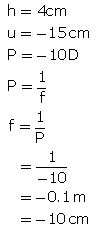
Question 23: An object of height 4 cm is placed at a distance of 15 cm in front of a concave lens of power, -10 dioptres. Find the size of the image.
Solution :
Ans:
Power P = -10 D ⇒ focal length f = 1/P = -0.1 m = -10 cm.
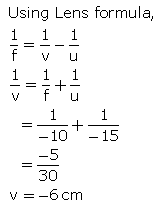
Given u = 15 cm, f = -10 cm. Use 1/f = 1/v + 1/u:
1/(-10) = 1/v + 1/15 ⇒ 1/v = -1/10 - 1/15 = (-3 - 2)/30 = -5/30 = -1/6 ⇒ v = -6 cm.
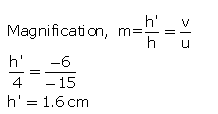
Magnification m = -v/u = -(-6)/15 = 6/15 = 0.4.
Image height = m × object height = 0.4 × 4 cm = 1.6 cm. The image is virtual, erect and 1.6 cm tall.
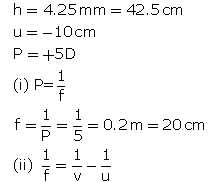
Question 24: An object of height 4.25 mm is placed at a distance of 10 cm from a convex lens of power +5 D. Find (i) focal length of the lens, and (ii) size of the image.
Solution :
Ans:
P = +5 D ⇒ f = 1/P = 1/5 = 0.20 m = 20 cm.
Given u = 10 cm (object distance), f = 20 cm.
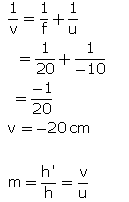
Use 1/f = 1/v + 1/u ⇒ 1/20 = 1/v + 1/10 ⇒ 1/v = 1/20 - 1/10 = (1 - 2)/20 = -1/20 ⇒ v = -20 cm.
Here v is negative, so the image is virtual and on the same side as the object; this happens because the object is within the focal length (u < f).
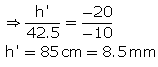
Magnification m = -v/u = -(-20)/10 = 2. The image is erect and magnified by a factor of 2.
Image size = 2 × 4.25 mm = 8.5 mm.
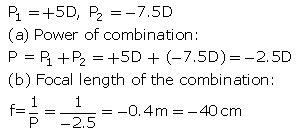
Question 25: A convex lens of power 5 D and a concave lens of power 7.5 D are placed in contact with each other. What is the :
(a) power of this combination of lenses ?
(b) focal length of this combination of lenses ?
Solution :
Ans:
(a) Power of combination P = P₁ + P₂ = +5 D + (-7.5 D) = -2.5 D.
(b) Focal length f = 1/P = 1/(-2.5) = -0.4 m = -40 cm. The combination behaves as a diverging system (negative power).
Question 26: A convex lens of focal length 25 cm and a concave lens of focal length 10 cm are placed in close contact with one another.
(a) What is the power of this combination ?
(b) What is the focal length of this combination ?
(c) Is this combination converging or diverging ?
Solution :
Ans:
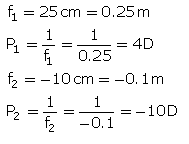
Given f₁ = +25 cm = +0.25 m and f₂ = -10 cm = -0.10 m.
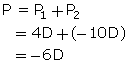
(a) Power of combination P = 1/f₁ + 1/f₂ = +4 D + (-10 D) = -6 D.
(b) Focal length f = 1/P = 1/(-6) ≈ -0.1667 m = -16.67 cm.
(c) The combination has negative focal length and negative power, so it is diverging.

Question 27: The power of a combination of two lenses X and Y is 5 D. If the focal length of lens X be 15 cm :
(a) calculate the focal length of lens Y.
(b) state the nature of lens Y.
Solution :
Ans:
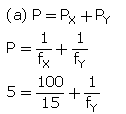
Given total power P = +5 D, focal length of lens X fₓ = 15 cm = 0.15 m ⇒ Pₓ = 1/0.15 ≈ +6.67 D.
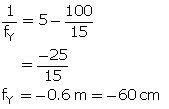
Power of Y, Pᵧ = P - Pₓ = 5 - 6.67 = -1.67 D (approximately).
Focal length of Y, fᵧ = 1/Pᵧ ≈ 1/(-1.67) ≈ -0.60 m = -60 cm.
(b) Lens Y is a concave (diverging) lens since its power is negative.
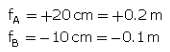
Question 28: Two lenses A and B have focal lengths of + 20 cm and, -10 cm, respectively.
(a) What is the nature of lens A and lens B ?
(b) What is the power of lens A and lens B ?
(c) What is the power of combination if lenses A and B are held close together ?
Solution :
Ans:
(a) Lens A (f = +20 cm) is convex (converging). Lens B (f = -10 cm) is concave (diverging).
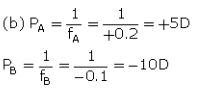
(b) Power of A, Pₐ = 1/0.20 = +5 D. Power of B, P_b = 1/(-0.10) = -10 D.
(c) Power of combination P = Pₐ + P_b = +5 D + (-10 D) = -5 D.
Question 29: (a) What do you understand by the power of a lens ? Name one factor on which the power of a lens depends.
(b) What is the unit of power of a lens ? Define the unit of power of a lens.
(c) A combination of lenses for a camera contains two converging lenses of focal lengths 20 cm and 40 cm and a diverging lens of focal length 50 cm. Find the power and focal length of the combination.
Solution : (a) Power of a lens is a measure of the degree of convergence or divergence of light rays falling in it.
Power of a lens depends on its focal length.
(b) Unit of power of a lens is dioptre.
One dioptre is the power of a lens whose focal length is 1 metre.
Ans:
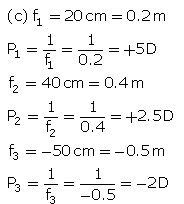
(c) Powers: P₁ = 1/0.20 = +5 D, P₂ = 1/0.40 = +2.5 D, P₃ = 1/0.50 = +2.0 D but the third lens is diverging so its power is -2.0 D.
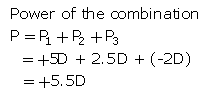
Total power P = 5 + 2.5 + (-2.0) = +5.5 D.
Focal length of combination f = 1/P = 1/5.5 ≈ 0.1818 m = 18.18 cm.

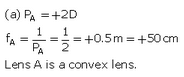
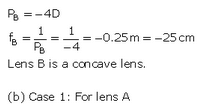
Question 30: (a) Two lenses A and B have power of (i) + 2 D and (ii) - 4 D respectively. What is the nature and focal length of each lens ?
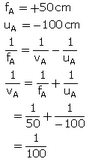
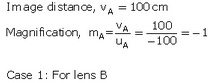
(b) An object is placed at a distance of 100 cm from each of the above lenses A and Calculate (i) image distance, and (ii) magnification, in each of the two cases.
Solution :
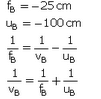
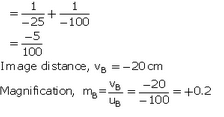
Ans:
(a) Lens A: P = +2 D ⇒ f = 1/2 = 0.5 m = 50 cm. Positive power ⇒ convex (converging) lens.
Lens B: P = -4 D ⇒ f = 1/(-4) = -0.25 m = -25 cm. Negative power ⇒ concave (diverging) lens.
(b) For each lens, object distance u = 100 cm.
Lens A (f = +50 cm): 1/f = 1/v + 1/u ⇒ 1/50 = 1/v + 1/100 ⇒ 1/v = 1/50 - 1/100 = 1/100 ⇒ v = 100 cm. Magnification m = -v/u = -100/100 = -1. The image is real, inverted and same size, formed 100 cm on the other side of the lens.
Lens B (f = -25 cm): 1/(-25) = 1/v + 1/100 ⇒ 1/v = -1/25 - 1/100 = (-4 - 1)/100 = -5/100 = -1/20 ⇒ v = -20 cm. Magnification m = -v/u = -(-20)/100 = 20/100 = 0.2. The image is virtual, erect and one-fifth the size, formed 20 cm in front of the lens.
Page No:263
Question 39: The optical prescription for a pair of spectacles is :
Right eye : - 3.50 D Left eye : - 4.00 D
(a) Are these lenses thinner at the middle or at the edges ?
(b) Which lens has a greater focal length ?
(c) Which is the weaker eye ?
Solution : (a) These lenses have negative powers and hence negative focal lengths, so they are concave lenses.
Concave lenses are thinner in the middle.
(b) Lens of lower power has greater focal length.
So, -3.50 D lens has greater focal length.
(c) Left eye is the weaker one because it needs a lens of greater power for its correction.
Ans:
(a) Concave lenses are thinner at the middle and thicker at the edges.
(b) The lens with smaller magnitude of power has larger focal length. Thus the right eye lens (-3.50 D) has the greater focal length compared with the left eye lens (-4.00 D).
(c) The left eye is the weaker eye because it requires the larger corrective power (-4.00 D).
Question 40: A person got his eyes tested by an optician. The prescription for the spectacle lenses to be made reads :
Left eye : + 2.50 D Right eye : + 2.00 D
(a) State whether these lenses are thicker in the middle or at the edges.
(b) Which lens bends the light rays more strongly ?
(c) State whether these spectacle lenses will converge light rays or diverge light rays.
Solution : (a) These lenses have positive powers and hence positive focal lengths, so they are convex lenses.
Convex lenses are thicker in the middle.
(b) Lens of greater power bends light rays more quickly.
So, +2.50 D lens bends light rays more quickly.
(c) These spectacle lenses will converge the light rays because these are convex lenses.
Ans:
(a) These are convex lenses and therefore thicker in the middle and thinner at the edges.
(b) The +2.50 D lens bends light rays more strongly because it has the greater power.
(c) Convex lenses converge light rays (they bring parallel rays to a focus).
FAQs on Lakhmir Singh & Manjit Kaur: Refraction of Light, Solutions- 4
| 1. What is refraction of light? |  |
| 2. How does refraction of light occur? | |
| 3. What factors affect the amount of refraction of light? | |
| 4. How does refraction of light contribute to the formation of rainbows? | |
| 5. How is the concept of refraction of light used in everyday life? | |




