Lakhmir Singh & Manjit Kaur: How do Organisms Reproduce?, Solutions- 2

Page No - 142
Question 26:
Describe the layering method for the artificial propagation of plants. Illustrate your answer with the help of a labelled diagram. Name any five plants which are propagated by the layering method.
Solution : Layering is a vegetative method of propagation in which a branch of a plant is made to grow roots while it is still attached to the parent plant.
Method:
- A healthy low-growing branch is bent towards the ground.
- A part of the branch is covered with moist soil, leaving the tip exposed.
- Roots develop from the buried portion after some time.
- The rooted branch is then cut off from the parent plant and planted separately.
Uses: This method is helpful when cuttings do not grow easily or when a plant with an already developed root system is required.
Examples: Jasmine, Strawberry, Raspberry, Lemon and Guava.
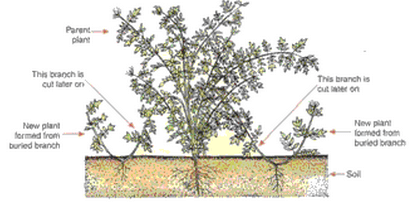 The Propagation of jasmine plant (chameli) by the layering method
 Question 27:
(a) What is meant by the term 'fission' as used in biology ?
(b) How does binary fission differ from multiple fission ?
(c) Name one organism which reproduces by binary fission and another which reproduces by multiple fission.
(d) State whether the above named organisms are animals or plants.
Solution :
(a) Fission is an asexual method of reproduction in which a single organism splits into two or more new organisms.
(b) Differences between binary fission and multiple fission:

(c) Amoeba reproduces by binary fission and Plasmodium reproduces by multiple fission.
(d) Both Amoeba and Plasmodium are unicellular animals (protozoans).
Question 28:
(a) Can you consider cell division as a type of reproduction in unicellular organisms ? Give reason.
(b) What is a clone ? Why do offspring formed by asexual reproduction exhibit remarkable similarity ?
Solution :
(a) Yes. In unicellular organisms the whole organism is a single cell. When that cell divides (cell division), it produces two new cells that grow into independent organisms, so cell division acts as a method of reproduction.
(b) A clone is a group of organisms produced asexually from a single parent and therefore very similar genetically to that parent. Offspring formed by asexual reproduction are remarkably similar because they inherit almost the same genetic material - the parent's DNA is copied and passed on to the progeny. Small differences may arise occasionally because of accidental changes (mutations) during DNA copying, but in general the offspring resemble the parent closely.
Question 29:
(a) The yeast cells fail to multiply in water but they multiply rapidly in sugar solution. Give one reason for it.
(b) Why does bread mould grow profusely on a moist slice of bread but not on a dry slice of bread ?
Solution :
(a) Yeast cells need a source of food (carbohydrates) and energy to grow and divide. Sugar solution provides dissolved sugars that yeast can use as food and energy, so they multiply rapidly. Plain water lacks these nutrients, so yeast cells do not multiply well in water.
(b) Moisture is essential for the growth of bread mould because it allows fungal spores to germinate and the fungal hyphae to spread. A moist slice supplies both the moisture and the nutrients needed, so mould grows profusely. A dry slice lacks sufficient water, so mould does not grow well on it despite the presence of nutrients.
Question 30:
(a) What is a tuber ? Name one stem tuber and one root tuber.
(b) What is name of the organ of propagation present in a tuber ?
(c) Name one commonly used vegetable which is propagated by using tubers.
Solution :
(a) A tuber is a swollen, fleshy underground plant part that stores food and from which new plants can arise. A stem tuber example is Potato; a root tuber example is Sweet potato.
(b) Buds (also called "eyes" in potatoes) are the organ of propagation on the surface of the tuber which acts as the organs of propagation.
(c) Potato is a commonly used vegetable that is propagated using tubers.
Question 31:
(a) What is meant by vegetative propagation ?
(b) Vegetative propagation involves the growth and development of 'something' present in the old part of the plant to form a new plant. What is this 'something' ?
(c) Why do green grass plants spring up in dry fields on their own after the rains ?
Solution :
(a) Vegetative propagation is an asexual method of reproduction in which new plants are produced from vegetative parts of the parent plant such as stems, roots or leaves, without the help of any reproductive organs.
(b) The 'something' is buds. These buds are capable of developing into shoots and roots to form a new plant.
(c) Dry fields often contain old grass stems that bear dormant buds. When rains arrive, these buds become active because of moisture and suitable conditions. The buds grow into new shoots and thus green grass springs up naturally after the rains.
Question 32:
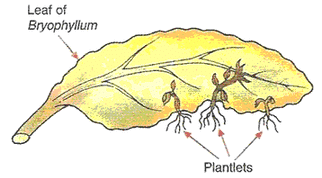
(a) Explain how, new Bryophyllum plants can be produced from the leaves of the old plant ? Illustrate your
answer with the help of a labelled diagram.
(b) How can you grow money plant by vegetative propagation ?
Solution :
(a) Bryophyllum reproduces vegetatively from its leaves. Its leaf margins bear special buds (adventitious buds) which may get detached from the leaves, fall to the ground and then grow to produce a new plant. Thus, a single leaf can give rise to several new plants when conditions are favourable.
(b) A money plant (Pothos) can be grown by stem cuttings. A healthy stem cutting with at least one node and a leaf is taken and its lower end is placed in water or moist soil. Roots form at the node within a few days and the cutting then grows into a new plant.
Question 33:
Match the organisms given in column I with the methods of reproduction/propagation given in column II: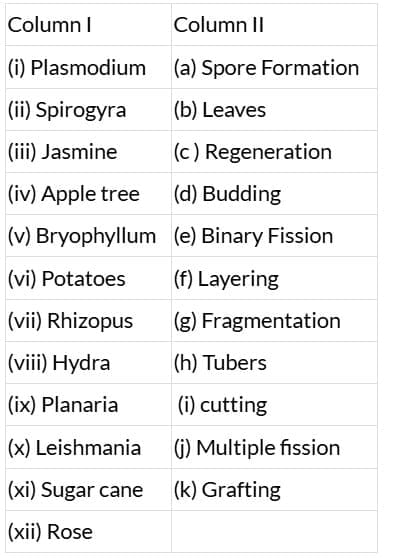
Solution :
(i) - (j) (Plasmodium reproduces by multiple fission.)
(ii) - (g) (Spirogyra reproduces by fragmentation when the filament breaks into pieces and each grows into a new filament.)
(iii) - (f) (Jasmine is commonly propagated by layering.)
(iv) - (k) (Apple trees are often propagated by grafting.)
(v) - (b) (Bryophyllum produces new plants from leaves.)
(vi) - (h) (Potatoes are propagated by tubers.)
(vii) - (a) (Rhizopus reproduces by spore formation.)
(viii) - (d) (Hydra reproduces by budding.)
(ix) - (c) (Planaria regenerates missing parts to form complete animals.)
(x) - (e) (Leishmania reproduces by binary fission.)
(xi) - (i) (Sugar cane is propagated by stem cuttings.)
(xii) - (i) (Rose is commonly propagated by cuttings.)
Question 34:
(a) What is meant by reproduction ?
(b) What are the two general methods of reproduction in organisms ?
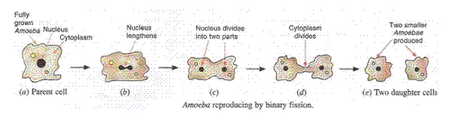
(c) How does an Amoeba reproduce ? Describe the process of reproduction in Amoeba with the help of labelled diagrams of different stages in its reproduction process.
(d) What is the name of the process by which Amoeba reproduces ?
(e) Name two organisms which reproduce by the same asexual process as that of Amoeba.
Solution :
(a) Reproduction is the biological process by which organisms produce new individuals of the same kind.
(b) The two general methods are asexual reproduction and sexual reproduction.
(c) Amoeba reproduces asexually by binary fission. The process can be described in stages:
(i) The amoeba grows and the nucleus becomes elongated.
(ii) The nucleus divides into two nuclei.
(iii) The cytoplasm divides (cytokinesis) so that each nucleus is enclosed in its portion of cytoplasm.
(iv) Two daughter amoebae are formed, each similar to the parent.
(d) The name of the process is binary fission.
(e) Paramecium and Leishmania also reproduce by binary fission.
Question 35:
(a) What is the difference between the two asexual methods of reproduction : fission and fragmentation ?
(b) Name one organism which reproduces by fission and another which reproduces by fragmentation.
(c) What is meant by multiple fission ? Name one organism which reproduces by the process of multiple fission.
(d) Describe the process of reproduction in Hydra with the help of labelled diagrams. What is the name of this process of reproduction ?
(e) Name one unicellular organism which reproduces by the same asexual process as Hydra.
Solution :
(a) Differences between fission and fragmentation: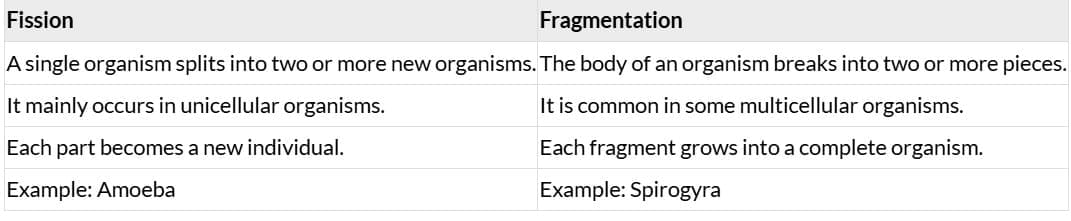 (b) Amoeba reproduces by fission; Spirogyra reproduces by fragmentation.
(c) Multiple fission is a form of fission in which the parent cell divides to produce many daughter cells at the same time. Plasmodium reproduces by multiple fission.
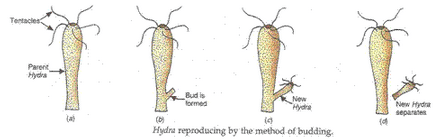
(d) Hydra reproduces by budding. In this process:
(i) A small bud appears on the side of the parent hydra due to repeated cell divisions.
(ii) The bud grows and develops a mouth and tentacles while attached to the parent.
(iii) When fully formed, the young hydra detaches from the parent and becomes an independent organism.
(e) Yeast is a unicellular organism that reproduces by budding, a process similar in principle to the budding of hydra.
Page No - 143
Question 36:
(a) Name the method by which bread mould (Rhizopus fungus) reproduces. Is this method sexual or asexual ?
(b) What is yeast ? Describe the process of reproduction in yeast with the help of labelled diagrams.
(c) Name a tiny fresh-water animal which reproduces by the same method as that of yeast ? What is this method known as ?
(d) Name two marine organisms which also reproduce by the same method as yeast but form colonies.
Solution :
(a) Bread mould (Rhizopus) reproduces by spore formation, which is an asexual method of reproduction.
(b) Yeast is a tiny, unicellular organism (a fungus). Yeast reproduces mainly by budding. The process is:
(i) A small outgrowth or bud forms on the parent cell.
(ii) The nucleus of the parent divides and one nucleus moves into the bud.
(iii) The bud grows, matures and finally detaches to form a new yeast cell.
(c) Hydra is a tiny fresh-water animal that also reproduces by budding; this method is called budding.
(d) Many marine organisms such as sponge and corals reproduce by budding or similar asexual processes and form colonies.
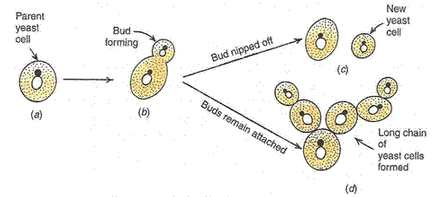 Yeast reproducing by the method of budding
Question 37:
(a) What is meant by 'grafting' as a means of propagation in plants ?
(b) Define 'stock' and 'scion'.
(c) Describe the grafting method for the artificial propagation of plants with the help of labelled diagrams.
(d) Name two fruit trees which are usually propagated by grafting method.
(e) State two advantages of grafting method of artificial propagation of plants.
(f) What is the difference between the cuttings method and grafting method for the artificial propagation of plants ?
Solution :
(a) Grafting is a method of artificial propagation in which a stem or bud of one plant (the scion) is joined to the stem or root system of another plant (the stock) so that they grow together as a single plant.
(b) Stock: The plant which provides the root system (and sometimes part of the stem) is called the stock.
Scion: The stem or bud taken from the plant with the desired above-ground characters (flowers, fruit) is called the scion.
(c) Steps in simple grafting:
(i) Select a healthy stock and a compatible scion with a few buds.
(ii) Make matching cuts on the stock and the scion so that the cut surfaces fit closely.
(iii) Join the scion on to the stock so that the cambial regions are in contact (this helps proper union).
(iv) Tie the graft union firmly and protect it from drying out until the tissues fuse and grow together.
(d) Apple and pear trees are commonly propagated by grafting to maintain desired fruit quality and tree form.
(e) Advantages of grafting:
(i) It allows the desirable characteristics of two plants to be combined - for example, good roots from one plant and superior fruits from another.
(ii) It enables propagation of varieties that do not come true from seed or that are sterile, and it can be used to produce fruit trees more quickly than by growing from seed.
(f) Difference between cuttings and grafting: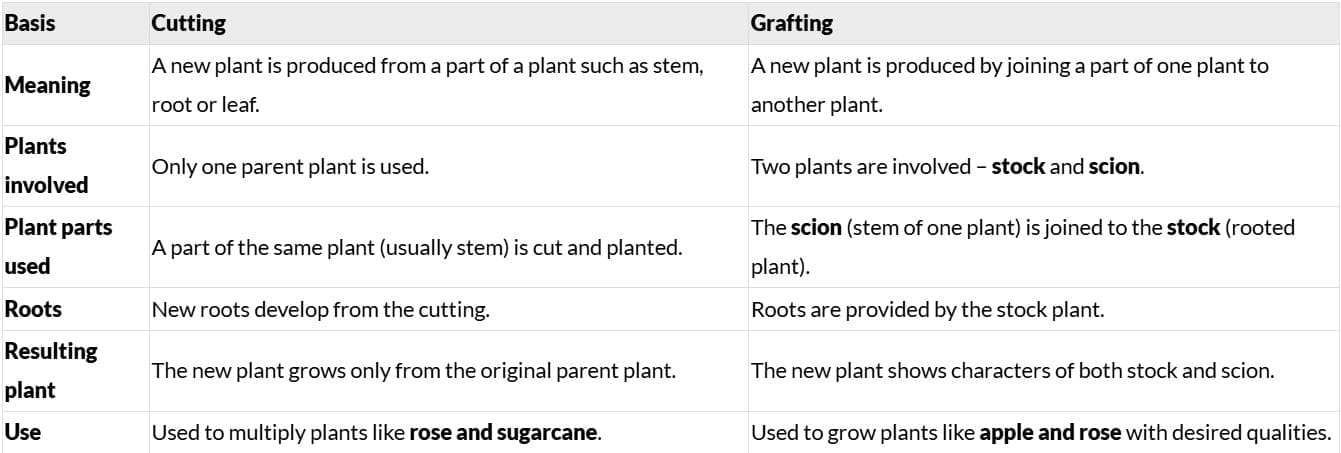
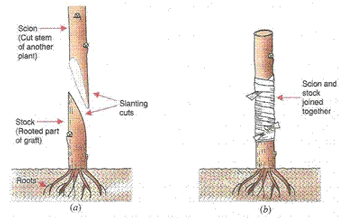 The grafting method for the artificial propagation of plants (or trees)
Question 38:
(a) What is tissue culture ?
(b) Name any four types of ornamental plants which are being produced by tissue culture technique.
(c) What is the importance of DNA copying in reproduction ? Explain with an example.
(d) How does reproduction help in providing stability to populations of species ?
(e) Why is variation during reproduction beneficial to the species but not necessarily for the individual ?
Solution :
(a) Tissue culture is a technique in which new plants are produced from a small piece of plant tissue or cells taken from the growing tips or other parts of a plant, using a suitable sterile growth medium and controlled conditions.
(b) Examples of ornamental plants commonly produced by tissue culture include orchids, dahlia, carnation and chrysanthemum.
(c) Importance of DNA copying in reproduction:
(i) DNA carries the genetic information that determines the characteristics of an organism. During reproduction, DNA is copied so that the offspring receive genetic information from the parent(s).
(ii) Accurate copying of DNA ensures that offspring resemble their parents. Occasional errors (mutations) during DNA copying introduce small variations; for example, offspring produced asexually are usually very similar to their parent but may show slight differences due to such mutations.
(d) Reproduction maintains and replenishes the number of individuals in a population. By producing new individuals and introducing small variations, reproduction helps populations adapt to changing conditions and thus provides stability to the species over time.
(e) Variation is beneficial for a species because it increases the chances that some individuals will survive if the environment changes. For the species this is an advantage because it prevents total loss. However, a particular variation may not be helpful for an individual - it might even reduce that individual's fitness. Thus, variation is useful at the population or species level, though not every variation benefits each individual.
Question 39:
(a) What is a 'cutting' in respect of plants for propagation purposes ?
(b) What care should be taken while making a cutting from a plant ?
(c) Describe the cuttings method for the artificial propagation of plants. Illustrate your answer with the help of labelled diagrams.
(d) Name any two plants which are usually propagated by the cuttings method.
Solution :
(a) A cutting is a small piece of a plant (usually a stem, root or leaf) removed and used to produce a new plant.
(b) The care that should be taken while making a cutting:
(i) Use a healthy, disease-free parent plant.
(ii) Take cuttings with one or more buds or nodes, because roots and shoots form from nodes.
(iii) Make a clean cut with a sharp tool to reduce damage and infection.
(c) Cuttings method:
(i) Select and cut a suitable piece of the parent plant that has at least one bud or node.
(ii) Insert the lower end of the cutting into moist soil or water so that the node is covered.
(iii) Maintain moisture and suitable temperature; after some days the cutting develops roots and shoots and grows into a new plant.
(d) Rose and Bougainvillea are commonly propagated by the cutting method.
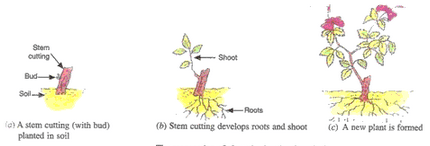
The propagation of plant by 'cutting' method
FAQs on Lakhmir Singh & Manjit Kaur: How do Organisms Reproduce?, Solutions- 2
| 1. How do organisms reproduce? |  |
| 2. What is the difference between sexual and asexual reproduction? | |
| 3. What are the advantages of sexual reproduction? | |
| 4. What are the different methods of asexual reproduction? | |
| 5. How does asexual reproduction contribute to the survival of organisms? | |




