JEE Advanced (Fill in the Blanks): Matrices & Determinants

Fill in the Blanks
Q. 1. 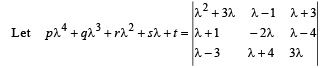 be an identity in λ , where p, q, r, s and t are constants.
Then, the value of t is ................. (1981 - 2 Marks)
Ans. t = 0
Solution. As given equation is an identity in λ, it must be true for all values of λ.
∴ For λ = 0 also. Putting λ = 0 we get 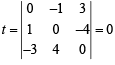
Q. 2. The solution set of the equation 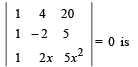 .................. (1981 - 2 Marks)
Ans. x = -1, 2
Solution. Given equation is, 
Clearly on expanding the det. we will get a quadratic equation in x.
∴ It has 2 roots. We observe that R3 becomes identical to R1 if x = 2. thus at x = 2 ⇒ Δ = 0
∴ x = 2 is a root of given eq.
Similarly R3 becomes identical to R2 if x = - 1. thus at x = - 1 Δ D = 0
∴ x = - 1 is a root of given eq.
Hence equation has roots as -1 and 2.
Q. 3. A determinant is chosen at random from the set of all determinants of order 2 with elements 0 or 1 only. The probability that the value of determinant chosen is positive is .................. (1982 - 2 Marks)
Ans. 3/16
Solution. With 0 and 1 as elements there are 2 × 2 × 2 × 2 = 16 determinants of order 2 × 2 out of which only 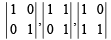 are the three det whose value is +ve.
∴ Req. prob. = 3/16
Q. 4. Given that x = -9 is a root of  the other two roots are ................. and .............. (1983 - 2 Marks)
Ans. 2, 7
Solution.

Operating R1 → R1 + R2 + R3 we get
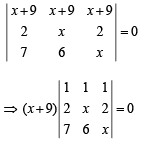
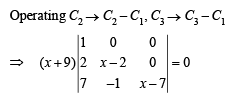
Expanding along R1
⇒(x + 9) (x - 2) (x - 7) = 0
⇒ x = - 9, 2, 7
∴ Other roots are 2 and 7.
Q. 5. The system of equations

Will have a non-zero solution if real values of l are given by .................. (1984 - 2 Marks)
Ans. λ = 0
Solution. The given homogeneous system of equations will have non zero solution if D = 0
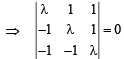
⇒ λ (λ2 + 1) - 1 (-λ + 1) + 1 (1 + λ) = 0 ⇒ λ3 + 3λ = 0
⇒ λ (λ2 + 3) = 0, but λ2 + 3 ≠ 0 for real λ ⇒ λ = 0
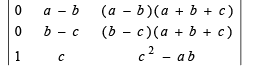
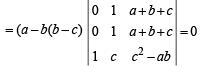
Q. 6. The value of the determinant 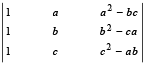 is .................. (1988 - 2 Marks)
Ans. 0
Solution.
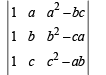
Operating R1→ R1 - R2; R2→ R2 - R3
Q. 7. For positive numbers x, y and z, the numerical value of the determinant 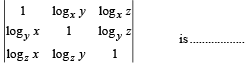 (1993 - 2 Marks)
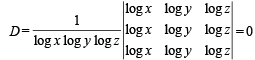
Ans. 0
Solution. Given x, y, z and + ve numbers, then value of
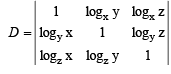
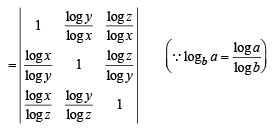
Taking 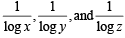 common from R1, R2 and R3 respectively
True / False
Q. 1. The determinants 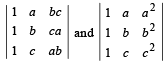 are not identically equal. (1983 - 1 Mark)
Ans. F
Solutions.
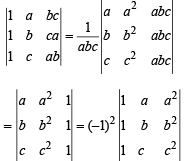
[C1 ⇔ C3 and then C2 ⇔ C3]
∴ Equal. Hence statement is F.
Q. 2. If 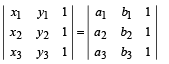 then the two triangles with vertices (x1 , y1), (x2 , y2), (x3 , y3), and (a1 , b1), (a2 , b2), (a3 , b3) must be congruent. (1985 - 1 Mark)
Ans. F
Solutions.
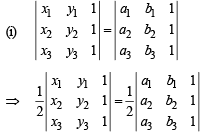
Ar (Δ1) = Ar (D2)
Where Δ1 is the area of triangle with vertices (x1, y1), (x2, y2) and (x3, y3); and Δ2 is the area of triangle with ; vertices (a1, b1), (a2, b2) and (a3, b3). But two D's of same area may not be congruent.
∴ Given statement is false.




