JEE Advanced (Subjective Type Questions): Matrices & Determinants

Q.1. For what value of k do the following system of equations possess a non trivial (i.e., not all zero) solution over the set of rationals Q?
x + ky + 3z = 0
3x + ky - 2z = 0
2x + 3y - 4z = 0
For that value of k, find all the solutions for the system. (1979)
Ans. 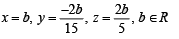
Solution. We should have,
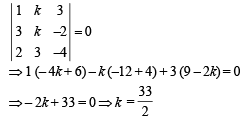
Substituting  and putting x = b, where b ∈ Q, we get the system as
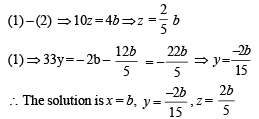
33y + 6z = - 2b ...(1)
33y - 4z = - 6b ...(2)
3y - 4z = - 2b ...(3)
Q.2. Let a, b, c be positive and not all equal. Show that the value of the determinant 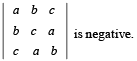 (1981 - 4 Marks)
Solution. The given det, on expanding along R1, we get
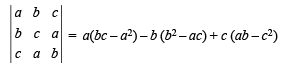
= 3abc - a3 - b3 - c3 = - (a3 + b3 + c3 - 3abc)
= - (a + b + c) [a2 + b2 + c2 - ab - bc - ca]
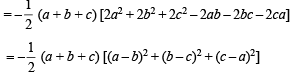
As a, b, c > 0
∴ a + b + c > 0
Also a ≠ b ≠ c
∴ (a - b)2 + (b - c)2 + (c - a)2 > 0
Hence the given determinant is - ve.
Q.3. Without expanding a determinant at any stage, show that
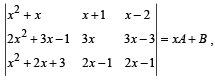 where A and B are determinants of order 3 not involving x. (1982 - 5 Marks)
Solution.
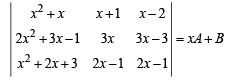
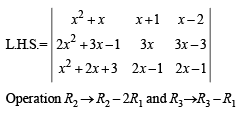
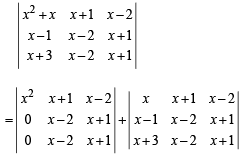
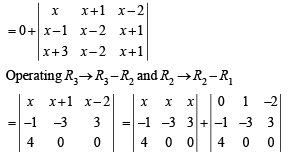
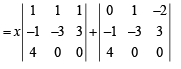
= xA + B = R.H. S
Hence Proved.
Q.4. Show that 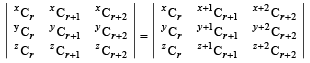 (1985 - 2 Marks)
Solution. On L.H.S.= D, applying operations C2→ C2 + C1 and C3→ C3 + C2 and using nCr + nCr+1 = n+1Cr+1, we get
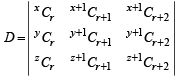
Operating C3 + C2 and using the same result, we get
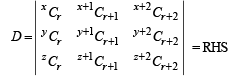
Hence proved
Q.5. Consider the system of linear equations in x, y, z :
(sin 3θ) x - y + z = 0
(cos 2θ) x + 4y + 3z = 0
2x + 7y + 7z = 0
Find the values of θ for which this system has nontrivial solutions. (1986 - 5 Marks)
Ans. nπ or nπ + (-1)n π / 6, n ∈ Z
Solution. The system will have a non-trivial solution if
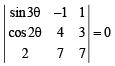
Expanding along C1, we get
⇒ (28 - 21) sin 3θ - (- 7 - 7) cos 2θ + 2 (- 3 - 4) = 0
⇒ 7 sin 3θ + 14 cos 2θ - 14 = 0
⇒ sin 3θ+ 2 cos 2θ - 2 = 0
⇒ 3 sin - 4 sin 3θ + 2 (1 - 2 sin2θ) - 2 = 0
⇒ 4 sin3θ + 4 sin 2θ - 3 sin θ = 0
⇒ sin θ (2 sinθ - 1) (2 sin θ + 3) = 0
sin θ = 0 or sin θ = 1/2 (sin θ = - 3/2 not possible)
⇒ θ = nπ or θ = nπ + (-1)n π/6, n ∈ Z.
Q.6. 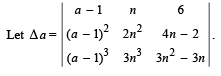 Show that
 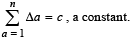 (1989 - 5 Marks)
Solution. We have
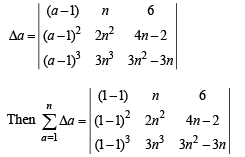
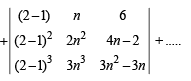
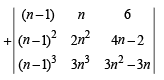
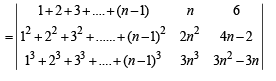
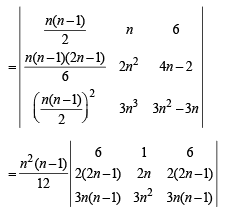
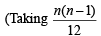 common from C1 and n from C2)
= 0 (as C1 and C3 are identical)
Thus, 
Q.7. Let the three digit numbers A 28, 3B9, and 62 C, where A, B, and C are integers between 0 and 9, be divisible by a fixed integer k. Show that the determinant  is divisible by k. (1990 - 4 Marks)
Solution. Given that A, B, C are integers between 0 and 9 and the three digit numbers A28, 3B9 and 62C are divisible by a fixed integer k.
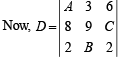
On operating R2 → R2 + 10 R3 + 100 R1, we get
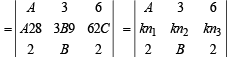
[As per question A28, 3B9 and 62C are divisible by k, therefore,

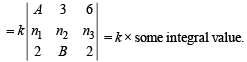
⇒ D is divisible by k.
Q.8. If a ≠ p, b ≠ q, c ≠ r and  Then find the value of
 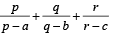 (1991 - 4 Marks)
Solution.
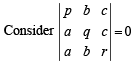
Operating R1→ R1- R2 and R2 → R2 - R3 we get
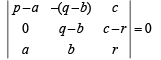
Taking (p - q), (q - b) and (r - c) common from C1, C2 and C3 resp, we get
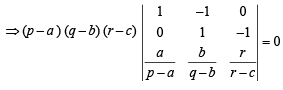

As given that p ≠ a, q ≠ b, r ≠ c
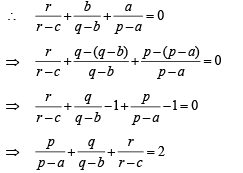
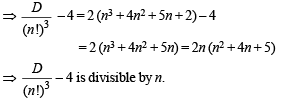
Q.9. For a fixed positive integer n, if 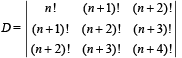 then show that
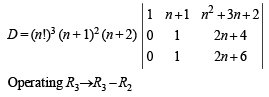
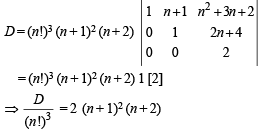
  is divisible by n. (1992 - 4 Marks)
Solution.
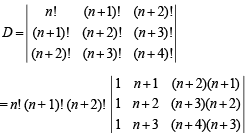
Operating R2 → R2 - R1 and R3 → R3 - R2, we get
Q.10. Let λ and α be real. Find the set of all values of λ for which the system of linear equations (1993 - 5 Marks)
λx + (sin α) y+ (cos α) z = 0 , x + (cos α) y + (sin α) z = 0 , - x + (sin α) y - (cos α) z = 0 has a non-trivial solution. For λ = 1, find all values of α.
Solution. Given that λ, α ∈ R and system of linear equations
λx + (sin α) y + (cos α)z = 0
x + (cos α) y + (sin α) z = 0
- x (sin α) y - (cos α) z = 0
has a non trivial solution, therefore D = 0
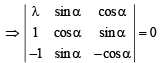
⇒ λ (- cos2 α - sin2α) - sin α (- cos α + sin α) + cos α(sin α + cos α) = 0
⇒ - λ + sin a cos α - sin2 α + sin α cosα + cos2α = 0
⇒ λ = cos2α - sin2α + 2 sina cos α
⇒ λ = cos 2α + sin 2α
For l = 1, cos 2α + sin 2α = 1
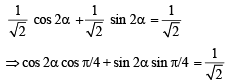
⇒ cos (2α - π/4) = cos p/4
⇒ 2α - π/4 = 2nπ ± π/4 ⇒ 2a = 2πr + π/4 + π/4; 2nπ - π/4 + π/4
⇒ α = nπ + p/4 or nπ
Q.11. For all values of A, B, C and P, Q, R show that (1994 - 4 Marks)
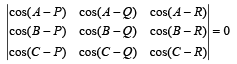
Solution. L.H.S.
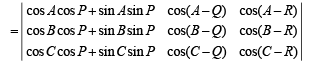
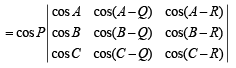
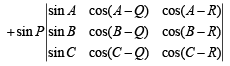
Operating; C2→ C2 - C1 (cos Q); C3→ C3 - C1 (cos R) on first determinant and C2→ C2 - (sin Q)C1 and C3→ C3 - (sin R)C1 on second determinant, we get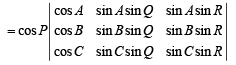
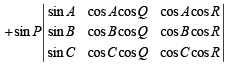
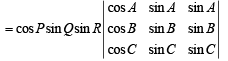
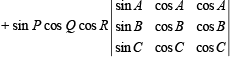
= 0 + 0 [Both determinants become zero as C2 ≡ C3]
= 0 = R.H.S.
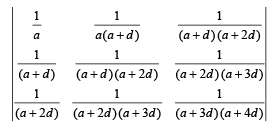
Q.12. Let a > 0, d > 0. Find the value of the determinant (1996 - 5 Marks)
Ans. 
Solution. Let us denote the given determinant by Δ Taking
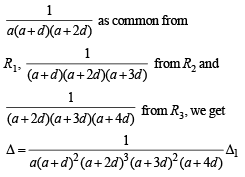
where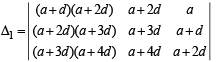
Applying R3 → R3 - R2 and R2 → R2 - R1, we get
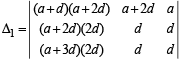
Applying R3 → R3 - R2, we get
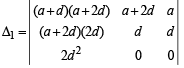
Expanding along R3, we get


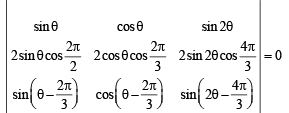
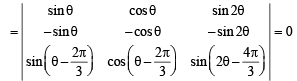
Q.13. Prove that for all values of θ, (2000 - 3 Marks)
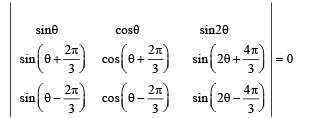
Solution. R2 → R2 + R3,
Q.14. If matrix  where a, b, c are real positivenumbers, abc = 1 and ATA = I, then find the value of a3 + b3 + c3. (2003 - 2 Marks)
Ans. 4
Solution. Given that ATA = I
⇒ |ATA| = |AT| |A| = |A| |A| = 1 [∵ | I | = I]
⇒ |A|2 = 1 ....(1)
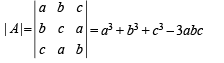
From given matrix 
 ....(2)
∴ (a3 + b3 + c3 - 3abc)2 = 1 (From (1) and (2)]
⇒ a3 + b3 + c3 - 3abc = 1 or - 1
But for a3, b3, c3 using AM > GM

∴ We must have a3 + b3 + c3 - 3abc = 1
⇒ a3 + b3 + c3 = 1 + 3 × 1 = 4 [Using abc = 1]
Q.15. If M is a 3 × 3 matrix, where det M = 1 and MMT = I, where 'I' is an identity matrix, prove that det (M - I) = 0. (2004 - 2 Marks)
Solution. We are given that MMT = I where M is a square matrix of order 3 and det. M = 1.
Consider det (M - I) = det (M - M MT) [Given MMT = I]
= det [M (I - MT)]
= (det M) (det (I - MT)) [∴|AB| = |A| |B|]
= - (det M) (det (MT - I))
= - 1 [det (MT - I)][Q det (M) = 1]
= - det (M - I)
[∴ det (MT - I) = det [(M - I)T] = det (M - I)]
⇒ 2 det (M - I) = 0 ⇒ det (M - I) = 0
Hence Proved
Q.16.  and AX = U has infinitely many solutions, prove that BX = V has no unique solution. Also show that if afd ≠ 0, then BX = V has no solution. (2004 - 4 Marks)
Solution. Given that,
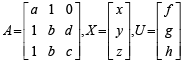
and AX = U has infinite many solutions.
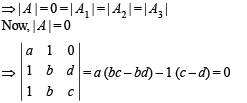
⇒ (ab - 1) (c - d) = 0
⇒ ab = 1 or c = d ..........(1)
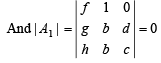
⇒ f (bc - bd) - 1 (gc - hd) = 0
⇒ f b (c - d) = gc - hd ...........(2)
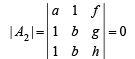
⇒ a (gc - hd) - f (c - d) = 0 ⇒ a (gc - hd) = f (c - d)
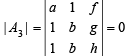
⇒ a(bh - bg) - 1(h - g) + f (b - b) = 0
⇒ ab (h - g) - (h - g) = 0
⇒ ab = 1 or h = g .........(3) Taking c = d
⇒ h = g and ab ≠ 1 (from (1), (2) and (3))
Now taking BX = V
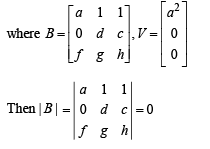
[∵In vew of c = d and g = h, C2 and C3 are identical]
⇒ BX = V has no unique solution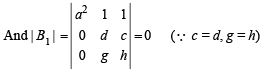
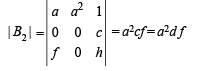 (∵ c = d)
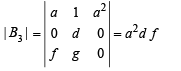
⇒ If adf ≠ 0 then | B2 | = | B3 | ≠ 0
Hence no solution exist.




