Lakhmir Singh & Manjit Kaur: Work and Energy, Solutions- 2

Page 162
Solution 1
The commercial unit of energy is kilowatt-hour.
Solution 2
One kilowatt-hour is the amount of electrical energy consumed when an electrical appliance having power of 1 kilowatt is used for 1 hour.
Solution 3
Megawatt and kilowatt are the units of power bigger than watt.
Solution 4
1 watt is the power of an appliance which does work at the rate of 1 joule per second.
Solution 5
1 horse power = 746 watt
Solution 6
Power has watt as its physical unit
Solution 7
1 watt
Solution 8
Work done = 1200 J
Time taken = 2 minutes = 2 x 60 = 120 s

Solution 9
One kilowatt = 3.6 x 10⁶ J
Solution 10
a) Power
b) Electrical Energy
Solution 11
1 kW-h of electrical energy is commonly known as unit of electricity.
Solution 12
A cell converts chemical energy into electrical energy.
Solution 13
Electric motor
Solution 14
a) Electric generator
b) Cell
c) Electric iron
d) Solar cell
e) Electric bulb
Solution 15
a) Speaker
b) Steam engine
c) Car engine
d) Gas stove
e) Solar water heater
Solution 16
a) Work
b) Joule ; second
c) kWh
d) conservation; transformed; created; destroyed
e) kinetic; potential
Page 163
Solution 17
Force, F = 400 N
Distance, s = 60 m
Time taken, t = 1 minute = 60 s
Work done, W = F x s = 400 x 60

Solution 18
At a hydroelectric power station, the potential energy of water is transformed into kinetic energy and then into electrical energy.
Solution 19
At a coal-based thermal power station, the chemical energy of coal is transformed into heat energy, whhich is further converted into kinetic energy and electrical energy.
Solution 20
Weight of the man = 500 N
Weight of the load = 100 N
Total weight = 600 N
Height of stairs = 4 m
Time taken = 5 s
Work done = mg x h = weight X h = 600 x 4

Solution 21
Power = 3 kW
Time = 20 s

Work done = power x time = 3 x 20 kWs = 60 kJ
Solution 22
Energy consumed = 600 kJ
Time taken = 5 minutes = 300 s

Solution 23
Power = 100 W
a) time = 1 s
energy = power x time = 100 J
b) time = 1 minute = 60 s
energy = power x time= 100 x 60 = 6 kJ
Solution 24
Power of 1 fan = 120 W
Power of 5 fans = 5 x 120 = 600 W = 0.6 kW
Time = 4 hours
Electrical energy = 0.6 x 4 = 2.4 kWh
Solution 25
A radio first converts electrical energy into kinetic energy and then into sound energy
Solution 26
In an electric bulb, electrical energy is first converted into heat energy and then into light energy
Solution 27
Fan, washing machine, mixer grinder, water pump, hair dryer use electric motor
Solution 28
i) chemical energy to electrical energy
ii) electrical energy to heat and light energy
Solution 29
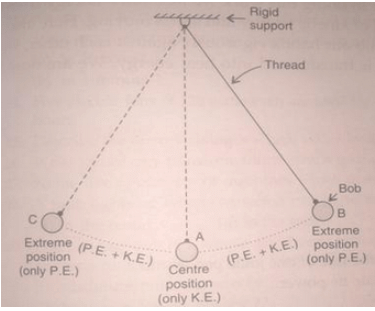
i) Maximum potential energy is present in the bob at point C as at point C bob is at maximum height.
ii) Maximum kinetic energy is present in the bob at point A as at point A bob is at maximum speed
Solution 30
Weight of the car = 20000 N= 20 kN
Speed = 8 m/s
Distance s= 120 m
Time = 100 s
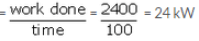
a)Work done W = f x s = 20 x 120 = 2400 kJ
b) Power
Solution 31
a)The change of one form of energy into another form of energy is known as transformation of energy, e.g. in a cell chemical energy is transformed into
electrical energy
b) a. When a ball is thrown upwards its kinetic energy gradually converts into potential energy and potential energy
becomes maximum at the maximum height attained by the ball
b. When a stone is dropped from the roof of the building its potential energy gradually converts into kinetic energy and kinetic energy becomes maximum when the stone is just above the ground
Solution 32
a) Law of conservation of energy states that whenever energy changes from one form to another form, the total amount of energy remains constant. Energy can
never be created nor destroyed, it transforms from one form to another. For example, when electrical energy is converted into light energy in an electric
bulb, then some energy is wasted as heat during conversion but the total energy remains the same.
b) Initially the pendulum is at rest. The bob is pulled to one side to position B to give it potential energy due to higher position of B and then released, the bob
starts swinging
i. When the bob is at position B, it has potential energy but no kinetic energy
ii. As the bob starts moving down from position B to A, its potential energy starts decreasing and kinetic energy starts increasing
iii. When the bob is at position A, it has maximum kinetic energy and zero potential energy
iv. As the bob starts moving down from position A to C, its kinetic energy starts decreasing and potential energy starts increasing
v. On reaching the extreme position C, the bob stops for a very small instant of time and bob maximum potential energy and zero kinetic energy.
Therefore at extreme positions B and C bob has only potential energy and at A it has only kinetic energy and at other intermediate positions bob has both kinetic
and potential energy. Thus the total energy of the pendulum is same for any instant of time (conserved)
Solution 33
a) The unit kWh stands for kilowatt-hour. One kilowatt-hour is the amount of electrical energy consumed when an electrical appliance having power of 1 kilowatt is used for 1 hour. It represents the amount of electrical energy consumed in 1 hour.
b) Power = 1000 W = 1 kW
Time = 60 minutes = 1 hour
Energy(kWh) = 1 x 1 = 1 kWh
Solution 34
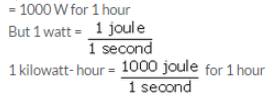
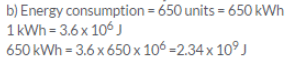
a) 1 kilowatt-hour = 1 kW for 1 hour = 1000 W for 1 hour

Solution 35
a) Power is the rate of doing work.

Si unit of power is watt(w)
(b) Mass of the body = 40 kg
Mass of the box = 20 kg
total Mass = 60 kg
Height h = 15m
g= 10m/s2
time taken =25s
woek done = m x g x h = 60 x 15 x 10 = 9000 J

Page 164
Solution 46
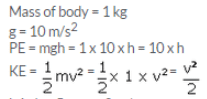
Mass of body = 1 kg
g = 10 m/s2
I. At h= 5m; v= 0 m/s
PE = 10 x 5 = 50 J
KE = 0 J
at total Energy = PE+KE = 50 J
ii. at h = 3.2 m; v =10 m/s
PE = 0 J
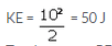
total Energy = PE+KE = 50 J
The total energy in all three cases is constant . this prove the law of conservation of energy
Solution 47
Since from point A total energy = PE + KE = 80 J
And according to the law of conservation of energy Total energy remains constant
a) PE = 0
Total energy = PE + KE = 80 J
KE = 80 J PE = 80 J
b) At point B KE = 48 J
Total energy = PE + KE = 80 J
PE = 80 J KE = 80 - 48 = 32 J
c) Law of conservation of energy
Page 165
Solution 48
No. of steps = 28
Height of each step = 28 cm
Total height = 20 x 28 = 560 cm = 5.6 m
Mass of student = 55 kg
g = 9.8 m/s2
time = 5.4 s
Work done = m x g x h = 55 x 9.8 x 5.6 = 3018.4 J

Solution 49
Weight of box = 100 N
Height = 1.5 m
work done = m x g x h = 100 x 1.5 = 150 J
potential energy = m x g x h= 100 x 1.5 = 150 J
iii. weight of 4 boxes = 400 N
time = 1 minute = 60 s
work done = 400 x 1.5 = 600 J

Solution 50
a) Electrical energy to sound energy
b) Sound energy to electrical energy
c) Electrical energy to light (and heat) energy
d) Chemical energy to electrical energy to light
energy(and heat energy)
FAQs on Lakhmir Singh & Manjit Kaur: Work and Energy, Solutions- 2
| 1. What is work and energy? |  |
| 2. How is work calculated? | |
| 3. What is the unit of work and energy? | |
| 4. What are the different types of energy? | |
| 5. How is energy transformed from one form to another? | |




