Adjective - 1


What is an Adjective?
An adjective is a word that describes, identifies or gives more information about a noun or a pronoun. Adjectives tell us about the kind, number, amount or specific identity of the noun they modify. For example, in the sentence Harish is a clever boy, the word clever is an adjective because it tells us what kind of boy Harish is.
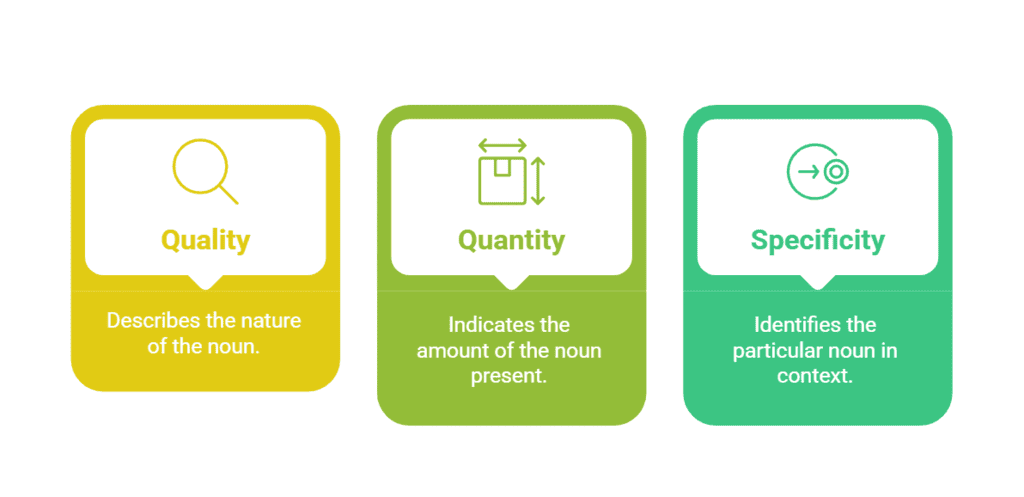
- Quality: What kind of noun it is (e.g., clever, honest, large).
- Quantity: How much or how many (e.g., some, ten, a little).
- Specificity: Which particular one is meant (e.g., this, that).
Adjectives can also tell us about comparisons, positions and other details of nouns. They may come before the noun they describe (attributive position) or after a linking verb (predicative position).
Kinds of Adjectives
Adjectives are classified by the kind of information they give. Below are the common kinds with simple explanations and examples.
Adjectives of Quality
Adjectives of quality describe the nature, quality or characteristic of a person or thing.
- The Ganges is the holy river.
- Kolkata is a large city.
- He is an honest man.
Adjectives of Quantity
Adjectives of quantity show how much or how little of something is meant.
- He drank much milk.
- I want some paper.
- I drank a little milk.
- It did not cause any pain.
- Jones got the whole property.
Adjectives of Number
Adjectives of number tell how many or in what order. They include definite and indefinite numerals, cardinals and ordinals.
- Definite numerals: four, fourteenth, nine, ninth.
- Indefinite numerals: all, few, many, some.
- Cardinal numbers: one, two, three (show how many).
- Ordinal numbers: first, second, third (show order).
Demonstrative Adjectives
Demonstrative adjectives point out which person or thing is meant.
- This book is mine.
- That book is yours.
- These trees are tall.
- Those trees are short.
Distributive Adjectives
Distributive adjectives refer to members of a group separately, one by one or each of the group.
- Each, every, either, neither.
Emphasising Adjectives
Emphasising words like "very" are adverbs, not adjectives. They intensify adjectives.
Example: He is a very tall man.
Here, tall is the adjective and very is an adverb.
Interrogative Adjectives
Interrogative adjectives are used with nouns to ask questions.
- Which book do you want?
- What colour do you prefer?
Possessive Adjectives
Possessive adjectives show ownership or possession. They are formed from pronouns but act as adjectives before nouns.
- My car is parked outside.
- Their house is beautiful.
Proper Adjectives
Proper adjectives are derived from proper nouns and describe origin or related qualities.
- Indian cuisine is famous worldwide.
- French wines are renowned.
Relative Adjectives
Relative adjectives are words like "whose" when they describe a noun.
Example: I met a boy whose father is a doctor.
Exclamatory Adjectives
Exclamatory adjectives are used to express strong feeling or surprise about a noun.
"What" is an exclamatory adjective when used before a noun.
Example: What a beautiful sunset!
Degrees of Comparison
Some adjectives can show comparison. There are three degrees of comparison: positive, comparative and superlative.
Positive degree names a quality: small. Comparative degree compares two things: smaller. Superlative degree shows the highest degree among three or more: smallest.
- One-syllable adjectives: add -er for comparative and -est for superlative. Example: big, bigger, biggest.
- Two-syllable adjectives: some take -er/-est (e.g., narrow, narrower, narrowest), many use more/most (e.g., beautiful, more beautiful, most beautiful).
- Adjectives of three or more syllables: use more/most. Example: intelligent, more intelligent, most intelligent.
- Irregular forms: good, better, best; bad, worse, worst; little, less, least; many/much, more, most.
Position of Adjectives
Adjectives commonly appear in two positions.
- Attributive position: before the noun they describe. Example: a clever boy, three red apples.
- Predicative position: after a linking verb (be, seem, feel, look, become). Example: He is clever, The apples look ripe.
Order of Multiple Adjectives
When more than one adjective modifies a noun, they usually follow a natural order. A commonly taught order is:
- Quantity/Number → Opinion/Quality → Size → Age → Shape → Colour → Origin → Material → Purpose → Noun.
Example: three (number) lovely (opinion) large (size) old (age) round (shape) brown (colour) Indian (origin) wooden (material) dining (purpose) tables (noun). In everyday speech we use shorter combinations, for example: two large wooden boxes.
Adjectives Used as Nouns
Some adjectives can stand for a group of people when used with the definite article the. Examples: the rich, the young, the unknown. In such cases the adjective represents a class of people or things.
Common Points and Mistakes
Bear in mind the following when using adjectives:
- Do not confuse adjectives with adverbs. Adjectives modify nouns or pronouns; adverbs modify verbs, adjectives or other adverbs. Example: She is a quick runner (adjective quick describes runner) vs She runs quickly (adverb quickly modifies runs).
- Use the correct comparative and superlative forms: good, better, best (not gooder or goodest).
- When two things are compared, use the comparative: Ravi is taller than Amit. When three or more are compared, use the superlative: Rekha is the tallest in the class.
- Keep the adjective order natural and avoid stacking too many adjectives in daily use; it makes sentences heavy.
Usage Tips and Simple Practice
To practise, try these activities:
- Identify the adjective and the noun it describes in short sentences: The small cat slept → small describes cat.
- Turn positive degree adjectives into comparative and superlative: happy → happier → happiest.
- Choose correct adjective forms in common errors: less people should be fewer people when countable; less water is correct for uncountable.
Adjectives are essential in making speech and writing clear and colourful. Learning their kinds, positions and comparison forms helps students write precise sentences and understand meaning better.
FAQs on Adjective - 1
| 1. What are some common adjectives in the English language? |  |
| 2. How do adjectives modify nouns in a sentence? | |
| 3. Can adjectives have different forms for comparative and superlative degrees? | |
| 4. What is the difference between attributive and predicative adjectives? | |
| 5. How can adjectives be used to create vivid descriptions in writing? | |





