Conjunction - 2 | English Grammar Basic - Class 10 PDF Download
Some Examples on Conjunction
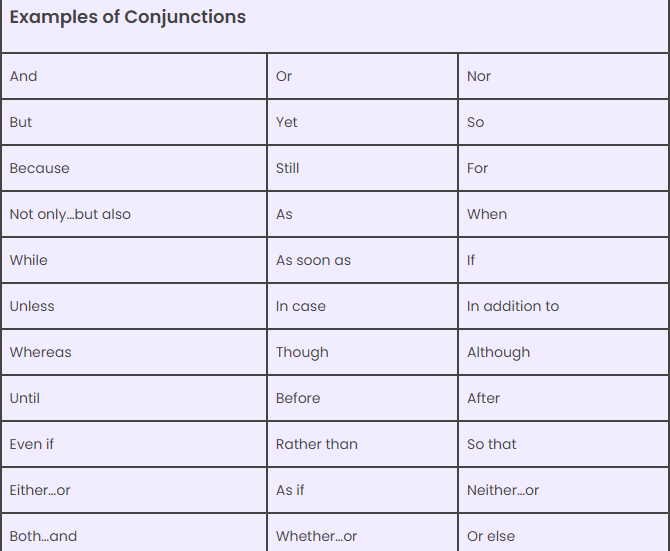
Examples of conjunctions in sentence:
1. One of the busiest cities of India is Kolkata, one another is Mumbai and the other is Delhi. — wrong
One of the busiest cities of India is Kolkata, another is Mumbai and the other is Delhi. — correct
2. Cricket has become so popular a game that even young boys are talking about. — wrong
Cricket has become so popular as a game that even young boys are talking about it. — correct
3. I do not know that she is going to meet Mohan because, I have not consulted her since yesterday. — wrong
I do not know whether she is going to meet Mohan because, I have not consulted her since yesterday. — correct
4. Nothing can be predicted for cricket that this team is going to win the match. — wrong
Nothing can be predicted for cricket but this team is going to win the match. — correct
5. Such boys of our class will be rewarded by the principal that have obtained good marks. — wrong
Such boys of our class will be rewarded by the principal as have obtained good marks. — correct
6. Hardly Mohan had gone to Kolkata when his mother came and was asking about him. — wrong
Hardly has Mohan had gone to Kolkata when his mother came and was asking about him. — correct
7. The accused persons were found guilty so that they were punished by the magistrate. — wrong
The accused persons were found guilty therefore, they were punished by the magistrate. — correct
Check Your Understanding of Conjunctions
Fill in the blanks with the most appropriate conjunctions in the following sentences:
1. Deepak ________ Santhosh are best friends.
2. Make sure you work hard ______ you will not be able to score good marks.
3. _______ Anna does not cook much, she loves baking.
4. Let me know ______ you will be able to make it to the party.
5. I have to go home now ______ I really wish I could stay for some more time.
6. I am not well _______ I decided to take a day off from work.
7. _________ you work out regularly, you will not see any results.
8. He had no money, _____he was prepared to help me
9. I could not find the place ___________ I lost the map.
10. ________ I was walking on the street, I found a wounded dog.
Answers:
1. Deepak and Santhosh are best friends.
2. Make sure you work hard or you will not be able to score good marks.
3. Although Anna does not cook much, she loves baking.
4. Let me know if you will be able to make it to the party.
5. I have to go home now but I really wish I could stay for some more time.
6. I am not well, so I decided to take a day off from work.
7. Unless you work out regularly, you will not see any results.
8. He had no money, yet he was prepared to help me.
9. I could not find the place since/because I lost the map.
10. While I was walking on the street, I found a wounded dog.
|
20 videos|110 docs|18 tests
|
FAQs on Conjunction - 2 - English Grammar Basic - Class 10
| 1. What are some common conjunctions used in the English language? |  |
| 2. How do conjunctions help in connecting words, phrases, or clauses in a sentence? | |
| 3. Can a sentence have multiple conjunctions? | |
| 4. What is the difference between coordinating and subordinating conjunctions? | |
| 5. How can one improve their use of conjunctions in writing? | |

|
4.75/5 Rating |

|
Dec 22, 2024 Last updated |

|
Explore Courses for Class 10 exam
|

|
shortcuts and tricks
,study material
,practice quizzes
,MCQs
,Extra Questions
,Exam
,Previous Year Questions with Solutions
,Conjunction - 2 | English Grammar Basic - Class 10
,past year papers
,video lectures
,Conjunction - 2 | English Grammar Basic - Class 10
,Sample Paper
,mock tests for examination
,Important questions
,ppt
,Viva Questions
,Conjunction - 2 | English Grammar Basic - Class 10
,Semester Notes
,Free
,Summary
,Objective type Questions
;




Conjunction - 2 Free PDF Download
Importance of Conjunction - 2
Conjunction - 2 Notes
Conjunction - 2 Class 10 Questions
Study Conjunction - 2 on the App
|
© EduRev
|
Education Revolution
|


|


