Voice

Understanding Voice
Voice is the form of a verb which shows whether what is denoted by the subject does something or has something done to it. The voice of a verb tells whether the subject of the sentence performs the action or receives the action.
Subject, Verb and Object
To grasp the concept of voice, we need to understand three basic terms:
- Subject: The doer of the action.
- Verb: The action performed by the subject.
- Object: The receiver of the action performed by the subject.
Now, let's explore the different types of voice in detail.
Types of Voice
- Active Voice: The subject performs the action. The sentence emphasises who or what does the action.
- Passive Voice: The subject receives the action. The sentence emphasises the action or the receiver of the action rather than the doer.
How to Identify Subject, Verb and Object
Consider these two sentences to see how active and passive forms relate to the same action.
- Raghav sold his old car. (Active voice)
- His old car was sold by Raghav. (Passive voice)
Q. What is the action being performed in both sentences?
Selling = Verb
Q. Who is selling?
Raghav = Subject
Q. What is being sold?
Old car = Object
- No matter whether the sentence begins with "Raghav" or "His old car", the performer of the action of selling is Raghav. Therefore, Raghav is the subject.
- The sentence beginning with the subject "Raghav" (Raghav sold his old car) is in the active voice; the sentence beginning with "His old car" (His old car was sold by Raghav) is in the passive voice.
- If you can identify who performs the action, it becomes easy to decide whether the sentence should be in the active or passive voice.
Active Voice: A verb is in the active voice when the person or thing denoted by the subject is the doer of the action (when the subject acts or is active).
Passive Voice: A verb is in the passive voice when the person or thing denoted by the subject is the receiver of the action (when the subject is passive/acted upon).
Change of Voice - General Rules
When changing a sentence from active to passive, follow these general rules:
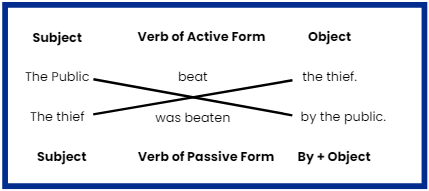
- The object of the active verb becomes the subject of the passive verb.
- The subject of the active verb becomes the object of the passive verb and is usually introduced by the preposition by. In some contexts to or with may be used.
- The passive form uses the past participle (the third form) of the main verb.
- An appropriate form of the auxiliary verb be is placed before the past participle; other helping verbs remain in their appropriate places.
- The tense and the meaning of the original sentence must be preserved; change only the verb form as required to make the passive structure correct.
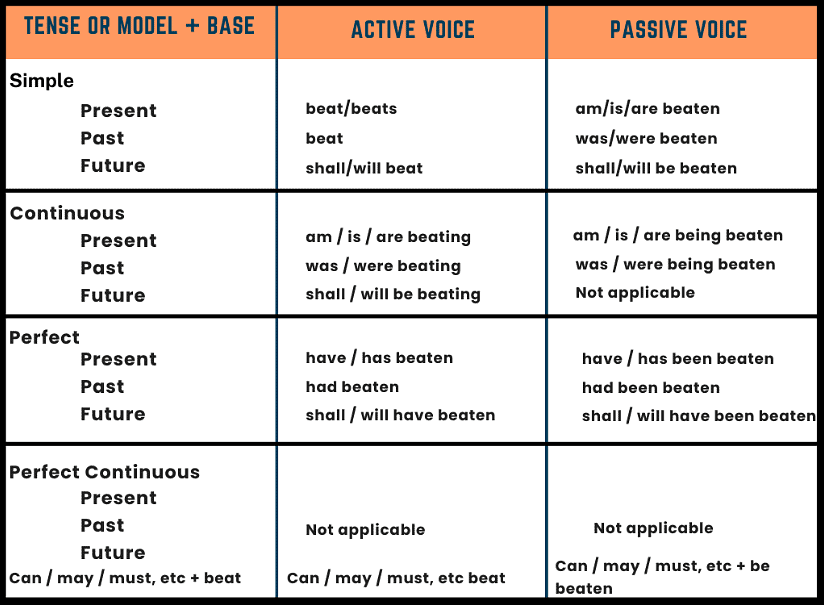
- Verb form changes depending on tense (for example, am/is/are + V3 for simple present, was/were + V3 for simple past).
Change of Persons
When changing the voice, pronouns and person forms often change. For example:
- I → he / she
- We → they
- My / our → his / their (possessive changes accordingly)
- Me / us → him / them (as object after a passive formation)
Always check pronouns after converting to passive and change them so the sentence remains grammatically correct.
Change of Verb According to Tense
Transformation of Active Voice into Passive Voice
1. Present Tense
(a) Simple Present Tense
Active: S + V1 + O
Passive: O + am/ is/ are + V3 + by + S
Examples:
- I bake a cake today. (Active voice)
A cake is baked by me today. (Passive voice) - NDTV launches gadgets360.com soon. (Active voice)
Gadgets360.com is launched soon by NDTV. (Passive voice) - Anushka and Neha learn Salsa. (Active voice)
Salsa is learnt by Anushka and Neha. (Passive voice) - The archaeologists study the fossils. (Active voice)
The fossils are studied by the archaeologists. (Passive voice)
(b) Present Continuous Tense
Active: S + am/ is/ are + V1 + ing + O
Passive: O + am/ is/ are + being + V3 + by + S
Examples:
- Rishabh is painting the portrait of a lady. (Active voice)
The portrait of a lady is being painted by Rishabh. (Passive voice) - The police are investigating the matter. (Active voice)
The matter is being investigated by the police. (Passive voice) - She is preparing the list of guests for the party. (Active voice)
The list of guests for the party is being prepared by her. (Passive voice) - Indian scientists are developing the technology against data hacking. (Active voice)
The technology against data hacking is being developed by Indian scientists. (Passive voice) - The secretary of the manager is preparing the agenda of the meeting. (Active voice)
The agenda of the meeting is being prepared by the secretary of the manager. (Passive voice)
(c) Present Perfect Tense
Active: S + has/ have + V3 + O
Passive: O + has/ have + been + V3 + by + S
Examples:
- Ovi has changed the channel on TV. (Active voice)
The channel on TV has been changed by Ovi. (Passive voice) - Anurag Basu has made a few very good movies. (Active voice)
A few very good movies have been made by Anurag Basu. (Passive voice) - They have auctioned 'Shabnam Villa'. (Active voice)
'Shabnam Villa' has been auctioned by them. (Passive voice) - Nitika and Vihaan have revealed their secrets. (Active voice)
Their secrets have been revealed by Nitika and Vihaan. (Passive voice) - This book has incorporated all the important topics. (Active voice)
All the important topics have been incorporated by this book. (Passive voice)
2. Past Tense
(a) Simple Past Tense
Active: S + V2 + O
Passive: O + was/ were + V3 + by + S
Examples:
- We submitted the assignments last week. (Active voice)
The assignments were submitted last week by us. (Passive voice) - Sakshi cracked GRE at the very first attempt. (Active voice)
GRE was cracked at the very first attempt by Sakshi. (Passive voice) - India won last Hockey World Cup many years back. (Active voice)
Last Hockey World Cup was won many years back by India. (Passive voice) - Vansh grabbed four prizes at the Inter School competitions. (Active voice)
Four prizes were grabbed by Vansh at the Inter-school competition. (Passive voice) - My father purchased this car in the year 1997. (Active voice)
This car was purchased in the year 1997 by my father. (Passive voice)
(b) Past Continuous Tense
Active: S + was/ were + V1 + ing + O
Passive: O + was/ were + being + V3 + by + S
Examples:
- He was practising Hinduism. (Active voice)
Hinduism was being practised by him. (Passive voice) - Sumi was counting stars in the sky. (Active voice)
Stars in the sky were being counted by Sumi. (Passive voice) - They were flying kites. (Active voice)
Kites were being flown by them. (Passive voice) - Sejal and Mahima were planting trees in the garden. (Active voice)
Trees were being planted in the garden by Sejal and Mahima. (Passive voice) - Radha was searching something in the cupboard. (Active voice)
Something was being searched in the cupboard by Radha. (Passive voice)
(c) Past Perfect Tense
Active: S + had + V3 + O
Passive: O + had been + V3 + by + S
Examples:
- I had already done this. (Active voice)
This had already been done by me. (Passive voice) - He had tolerated much before coming to this city. (Active voice)
Much had been tolerated by him before coming to this city. (Passive voice) - Sahil had sent the invitation letter. (Active voice)
The invitation letter had been sent by Sahil. (Passive voice) - Noorjahan had learnt many recipes of Chinese food. (Active voice)
Many recipes of Chinese food had been learnt by Noorjahan. (Passive voice) - Rudra had not accepted the offer. (Active voice)
The offer had not been accepted by Rudra. (Passive voice)
3. Future Tense
(a) Simple Future Tense
Active: S + shall/ will + V1 + O
Passive: O + shall/ will + be + V3 + by + S
Examples:
- He will manipulate her. (Active voice)
She will be manipulated by him. (Passive voice) - We will find out a solution. (Active voice)
A solution will be found out by us. (Passive voice) - Trespassers shall not use this road. (Active voice)
This road shall not be used by trespassers. (Passive voice) - God will endow him with the power of speech one day. (Active voice)
He will be endowed with the power of speech by God one day. (Passive voice) - The boss will not entertain his lame excuses. (Active voice)
His lame excuses will not be entertained by the boss. (Passive voice)
(b) Future Perfect Tense
Active: S + shall/ will have + V3 + O
Passive: O + shall/ will have + been + V3 + by + S
Examples:
- Mother will have prepared a delicious lunch. (Active voice)
Delicious lunch will have been prepared by mother. (Passive voice) - You will have won the game. (Active voice)
The game will have been won by you. (Passive voice) - India will have eradicated illiteracy by next year. (Active voice)
Illiteracy will have been eradicated by next year by India. (Passive voice) - Shanu will have eaten up all the chocolates. (Active voice)
All the chocolates will have been eaten up by Shanu. (Passive voice) - Miheer will have surprised her. (Active voice)
She will have been surprised by Miheer. (Passive voice)
Practice Guidelines
When converting sentences between active and passive, follow this sequence in your mind:
- Find the subject, verb and object in the active sentence.
- Decide which element you want to emphasise in the passive form (the original object usually becomes the subject).
- Choose the correct auxiliary be form to match the tense and number of the new subject.
- Use the past participle (V3) of the main verb.
- Include the agent only if it is necessary.
- Adjust pronouns and make sure the sentence is grammatical and clear.
FAQs on Voice
| 1. What is the subject, verb, and object in a sentence? |  |
| 2. What are the different types of voice in grammar? | |
| 3. How do you change a sentence from active voice to passive voice? | |
| 4. Can you give an example of transforming a sentence from active voice to passive voice? | |
| 5. What is the importance of using active and passive voice in writing? | |





