RD Sharma Solutions (Part - 2) - Ex-14.2, Lines and Angles, Class 7, Math

Question 13:
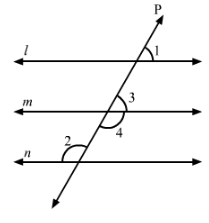
In Fig., if l || m || n and ∠1 = 60°, find ∠2.
Answer 13:
In the given figure, l || m || n and ∠1 = 60°.
Thus, we have:
∠3=∠1=60° (Corresponding angle)
Now,
∠3+∠4=180° (Linear pair)
∠4=180°-∠3=180°-60°=120°
∠2=∠4=120° (Alternate interior angles)
Question 14:
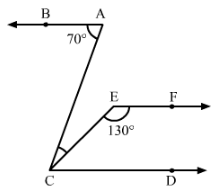
In Fig., if AB || CD and CD || EF, find ∠ACE.
Answer 14:
In the given figure, AB || CD and CD || EF.
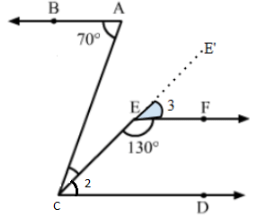
Extend line CE to E'.
Thus, we have:
∠BAC=∠ACD=70° (Alternate angles)
Now,
∠3+∠CEF=180° (Linear pair)
⇒∠3=180°-∠CEF=180°-130°=50°
Since CD||EF, then
∠2=∠3=50° (Corresponding angles)
∠ACE=∠ACD-∠2=70°-50°=20°
Question 15:
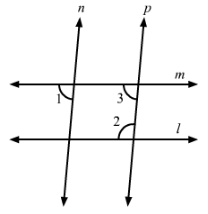
In Fig., if l || m, n || p and ∠1 = 85°, find ∠2.
Answer 15:
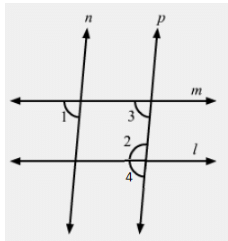
In the given figure, l || m, n || p and ∠1 = 85°.
Now, let ∠4 be the adjacent angle of ∠2.
Thus, we have:
∠3=∠1=85° (Corresponding angles)
∠3+∠2=180° (Sum of interior angles on the same side of the transversal)
∴∠2=180°-∠3=180°-85°=95°
Question 16:
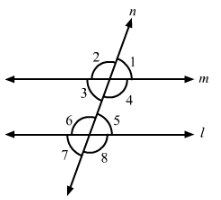
In Fig., a transversal n cuts two lines l and m. If ∠1 = 70° and ∠7 = 80°, is l || m?
Answer 16:
We know that if the alternate exterior angles of two lines are equal, then the lines are parallel.
In the given figure, ∠1 and ∠7∠1 and ∠7 are alternate exterior angles, but they are not equal.
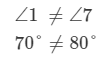
Therefore, lines l and m are not parallel.
Question 17:
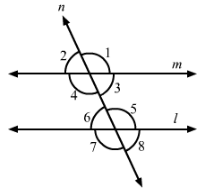
In Fig., a transversal n cuts two lines l and m such that ∠2 = 65° and ∠8 = 65°. Are the lines parallel?
Answer 17:
∠2 = ∠3 = 65° (Vertically opposite angles)
∠8 = ∠6 = 65° (Vertically opposite angles)
∴ ∠3 = ∠6
⇒ l || m (Two lines are parallel if the alternate angles formed with the transversal are equal)
Question 18:
In Fig., show that AB || EF.
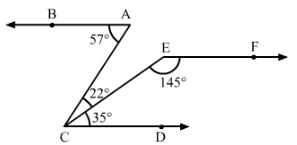
Answer 18:
Extend line CE to E'.
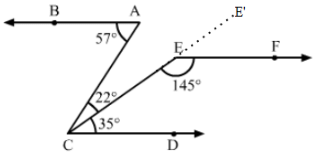
∠BAC=57°=22°+35°=∠ACE+∠ECD
∴ AB||CD
Here, ∠E'EF+∠FEC=180° (Linear pair)
⇒∠E'EF=180°-∠FEC=180°-145°=35°=∠ECD
∴EF||CD
Thus,
AB||CD ||EF
Question 19:
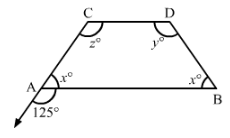
In Fig., AB || CD. Find the values of x, y, z.
Answer 19:
∠x+125°=180° (Linear pair)
∴∠x=180°-125°=55°
∠z=125° (Corresponding angles)
∠x+∠z=180° (Sum of adjacent interior angles is 180°180°)
∠x+125°=180°
⇒∠x=180°-125°=55°
∠x+∠y=180° (Sum of adjacent interior angles is 180°180°)
55°+∠y=180°
⇒∠y=180°-55°=125°
Question 20:
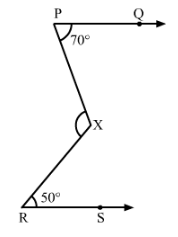
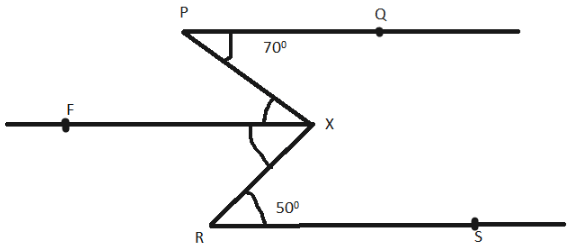
In Fig., find out ∠PXR, if PQ || RS.
Answer 20:
Draw a line parallel to PQ passing through X.
Here,
∠PQX=∠PXF=70° and ∠SRX=∠RXF=50° (Alternate interior angles)
∵ PQ || RS || XF
∴ ∠PXR=∠PXF+∠FXR=70°+50°=120°
Question 21:
In Fig., we have
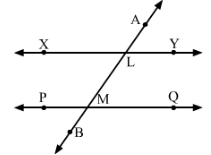
(i) ∠MLY = 2 ∠LMQ, find ∠LMQ.
(ii) ∠XLM = (2x - 10)° and ∠LMQ = x + 30°, find x.
(iii) ∠XLM = ∠PML, find ∠ALY
(iv) ∠ALY = (2x - 15)°, and ∠LMQ = (x + 40)°, find x
Answer 21:
(i)
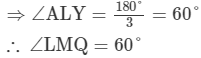
∠LMQ=∠ALY (Corresponding angles)
∴∠MLY+ ∠ALY=180° (Linear pair)
⇒2∠ALY+∠ALY=180°
⇒3∠ALY=180°
(ii)
∠XLM=∠LMQ (Alternate interior angles)
⇒(2x-10)°=(x+30)°
⇒2x-x=30°+10°
⇒x=40°
(iii)
∠ALX=∠LMP (Corresponding angles)
∠ALX+∠XLM=180° (Linear pair)
∠XLM=∠LMP (Given)
∴∠LMP+∠LMP=180°
⇒2∠LMP=180°

XLM=∠LMP=90°
∠ALY=∠XLM (Vertically opposite angles)
∴∠ALY=90°
(iv)
∠ALY=∠LMQ (Corresponding angles)
∴(2x-15)°=(x+40)°
⇒2x-x=40°+15°
⇒x=55°
Question 22:
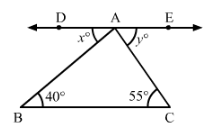
In Fig., DE || BC. Find the values of x and y.
Answer 22:
∠ABC = ∠DAB (Alternate interior angles)
∴ x=40°∴ x=40°
∠ACB = ∠EAC (Alternate interior angles)
∴ y=55°
Question 23:
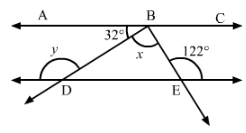
In Fig., line AC || line DE and ∠ABD = 32°. Find out the angles x and y if ∠E = 122°.
Answer 23:
∠BDE=∠ABD=32° (Alternate interior angles)
⇒∠BDE+y=180° (Linear pair)
⇒32°+y=180°
⇒y=180°-32°=148°
∠ABE=∠E=122° (Alternate interior angle)
∠ABD+∠DBE=122°
32°+x=122°
x=122°-32°=90°
Question 24:
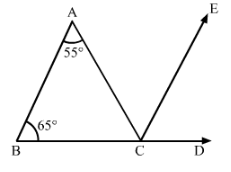
In Fig., side BC of ∆ABC has been produced to D and CE || BA. If ∠ABC = 65°, ∠BAC = 55°, find ∠ACE, ∠ECD and ∠ACD.
Answer 24:
∠ABC = ∠ECD = 55° (Corresponding angles)
∠BAC = ∠ACE = 65° (Alternate interior angles)
Now, ∠ACD = ∠ACE + ∠ECD
⇒ ∠ACD = 55° + 65° = 120°
Question 25:
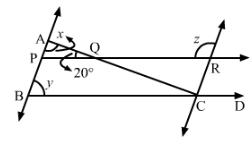
In Fig., line CA ⊥ AB || line CR and line PR || line BD. Find ∠x, ∠y and ∠z.
Answer 25:
Since CA ⊥ AB,
∴∠x=90°∴∠x=90°
We know that the sum of all the angles of triangle is 180°.
In ΔAPQ,
∠QAP+∠APQ+∠PQA=180°
⇒90°+∠APQ+20°=180°
⇒110°+∠APQ=180°
⇒∠APQ=180°-110°=70
∠PBC = ∠APQ = 70° (Corresponding angles)
Since ∠PRC+∠z=180° (Linear pair)
∠PRC+∠z=180° Linear pair
∴∠z=180°-70°=110° [∠APQ=∠PRC (Alternate interior angles)]
Question 26:
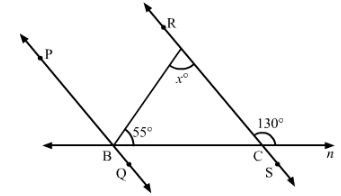
In Fig., PQ || RS. Find the value of x.
Answer 26:
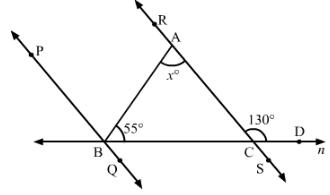
∠RCD+∠RCB=180° (Linear pair)
⇒∠RCB=180°-130°=50°
In △ABC,
∠BAC+∠ABC+∠BCA=180° (Angle sum property)
⇒∠BAC=180°-55°-50°=75°
Question 27:
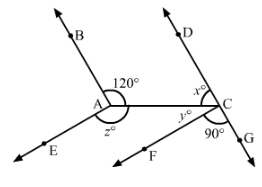
In Fig., AB || CD and AE || CF; ∠FCG = 90° and ∠BAC = 120°. Find the values of x, y and z.
Answer 27:
∠BAC = ∠ACG = 120° (Alternate interior angle)
∴ ∠ACF + ∠FCG = 120°
⇒ ∠ACF = 120° - 90° = 30°
∠DCA + ∠ACG = 180° (Linear pair)
⇒∠x = 180° - 120° = 60°
∠BAC + ∠BAE + ∠EAC = 360°
∠CAE = 360° - 120° - (60° + 30°) = 150° (∠BAE = ∠DCF)
FAQs on RD Sharma Solutions (Part - 2) - Ex-14.2, Lines and Angles, Class 7, Math
| 1. What are the different types of angles? |  |
| 2. How can I determine if two lines are parallel? | |
| 3. What is the difference between vertical angles and adjacent angles? | |
| 4. How can I calculate the measure of an angle using a protractor? | |
| 5. What is the relationship between alternate interior angles and corresponding angles? | |




