JEE Exam  >  JEE Notes  >  Crack with 35 Years of Previous Year Solved Papers  >  Integer Answer Type Questions: Structure of Atom | JEE Advanced

Integer Answer Type Questions: Structure of Atom - JEE Advanced

Q.1. The work function φ of some metals is listed below. The number of metals which will show photoelectric effect when light of 300 nm wavelength falls on the metal is (2011)

Integer Answer Type Questions: Structure of Atom | JEE Advanced

Ans. Sol. (4)
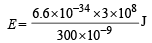
Energy associated with incident photon =Integer Answer Type Questions: Structure of Atom | JEE Advanced

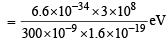
Integer Answer Type Questions: Structure of Atom | JEE Advanced

Integer Answer Type Questions: Structure of Atom | JEE Advanced = 4.16 eV

Photoelectric effect can take place only when Ephoton > φ

Thus, number of metals showing photoelectric effect will be 4 (i.e. Li, Na, K and Mg).

Q.2. The maximum number of electrons that can have principal quantum number, n = 3, and spin quantum msInteger Answer Type Questions: Structure of Atom | JEE Advanced is (2011)

Ans. Sol. (9)
Maximum number of electrons (n2) when n = 3 = 32 = 9

∴ Number of orbitals = 9

∴ Number of electrons with ms =-Integer Answer Type Questions: Structure of Atom | JEE Advancedwill be 9.


Q.3. The atomic masses of 'He' and 'Ne' are 4 and 20 a.m.u., respectively. The value of the de Broglie wavelength of 'He' gas at -73°C is "M" times that of the de Broglie wavelength of 'Ne' at 727°C 'M' is  (JEE Adv. 2013)

Ans. Sol. (5) Since,

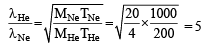
Integer Answer Type Questions: Structure of Atom | JEE Advanced

Integer Answer Type Questions: Structure of Atom | JEE Advanced

For two gases,

Integer Answer Type Questions: Structure of Atom | JEE Advanced


Q.4. In an atom, the total number of electrons having quantum numbers n = 4, |m1| = 1 and m= -Integer Answer Type Questions: Structure of Atom | JEE Advancedis (JEE Adv. 2014)

Ans. Sol. (6) |mi| =1 means mcan be +1 and -1.
So, for n = 4, six orbitals are possible and each has 1 electron with s = -Integer Answer Type Questions: Structure of Atom | JEE Advanced. So total number of electrons = 6.


Q.5. Not considering the electronic spin, the degeneracy of the second excited state (n = 3) of H atom is 9, while the degeneracy of the second excited state of H- is (JEE Adv. 2015)

Ans. Sol. (3) Ground state configuration:
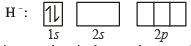
Integer Answer Type Questions: Structure of Atom | JEE Advanced

in second excited state, electron will jump from 1s to 2p, so degeneracy of second excited state of His 3.

The document Integer Answer Type Questions: Structure of Atom | JEE Advanced is a part of the JEE Course Crack JEE with 35 Years of Previous Year Solved Papers.
All you need of JEE at this link: JEE

FAQs on Integer Answer Type Questions: Structure of Atom - JEE Advanced

1. What is the structure of an atom?
Ans. An atom consists of a central nucleus containing protons and neutrons, surrounded by a cloud of electrons. The protons and neutrons are located in the nucleus, while the electrons occupy energy levels or shells around the nucleus.
2. How are protons, neutrons, and electrons arranged in an atom?
Ans. Protons and neutrons are located in the nucleus of an atom, with protons having a positive charge and neutrons having no charge. Electrons are arranged in energy levels or shells around the nucleus, with each shell having a maximum number of electrons it can hold.
3. What are the properties of protons, neutrons, and electrons?
Ans. Protons have a positive charge and a mass of approximately 1 atomic mass unit (amu), neutrons have no charge and a mass of approximately 1 amu, and electrons have a negative charge and a negligible mass compared to protons and neutrons.
4. How does the number of protons, neutrons, and electrons determine the identity of an atom?
Ans. The number of protons in an atom determines its atomic number, which defines the element. The number of neutrons can vary within an element, resulting in different isotopes. The number of electrons is equal to the number of protons in a neutral atom, but it can change in ions.
5. What is the significance of the energy levels or shells in an atom?
Ans. The energy levels or shells in an atom represent the different energy states that electrons can occupy. Electrons tend to occupy the lowest energy level available, and higher energy levels are filled only when the lower ones are filled. The arrangement of electrons in these shells determines the chemical properties and reactivity of an atom.
Explore Courses for JEE exam
Get EduRev Notes directly in your Google search
Related Searches
video lectures, mock tests for examination, pdf , Integer Answer Type Questions: Structure of Atom | JEE Advanced, MCQs, Previous Year Questions with Solutions, Viva Questions, Summary, Free, Objective type Questions, ppt, Extra Questions, Integer Answer Type Questions: Structure of Atom | JEE Advanced, Sample Paper, Important questions, Integer Answer Type Questions: Structure of Atom | JEE Advanced, past year papers, practice quizzes, Exam, shortcuts and tricks, study material, Semester Notes;