JEE Exam  >  JEE Notes  >  Crack with 35 Years of Previous Year Solved Papers  >  Matrix-Match Type Questions: Carbohydrates, Amino Acids, Polymers & Miscellaneous | JEE Advanced

Matrix-Match Type Questions: Carbohydrates, Amino Acids, Polymers & Miscellaneous - JEE Advanced

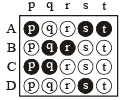
Each question contains statements given in two columns, which have to be matched. The statements in Column-I are labelled A, B, C and D, while the statements in Column-II are labelled p, q, r, s and t. Any given statement in Column-I can have correct matching with ONE OR MORE statement(s) in Column-II. The appropriate bubbles corresponding to the answers to these questions have to be darkened as illustrated in the following example :
Matrix-Match Type Questions: Carbohydrates, Amino Acids, Polymers & Miscellaneous | JEE Advanced

If the correct matches are A-p, s and t; B-q and r; C-p and q; and D-s then the correct darkening of bubbles will look like the given.

Q.1. Match the chemical substances in Column I with type of polymers/type of bonds in Column II.             (2007) 

Column I                                              Column II
 (A) cellulose                                     (p) Natural polymer
 (B) nylon-6, 6                                   (q) Synthetic polymer
 (C) protein                                       (r) Amide linkage
 (D) sucrose                                     (s) Glycoside linkage

Ans. 

Sol. (A) : (p) an d(s) Cellulose is a natural polymer and has a C1 - C4 b-glycosidic linkage.
(B) : (q) and (r) Nylon -6, 6 is a syn thetic polymer of hexamethylenediamine and adipic acid and has amide linkages.
(C) : (p) and (r) Proteins are natural polymers of a amino acids joined by amide linkages (peptide bonds).
(D) : (s) Sucrose is a disaccharide of a-D glucose and b-D-fructose and has an a, b-glycosidic linkage.


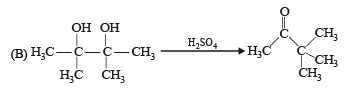
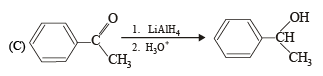
Q.2. Match the reaction in Column I with appropriate options in Column II. (2010)


Column-I
Column-II
Matrix-Match Type Questions: Carbohydrates, Amino Acids, Polymers & Miscellaneous | JEE Advanced 
(p) Racemic mixture
Matrix-Match Type Questions: Carbohydrates, Amino Acids, Polymers & Miscellaneous | JEE Advanced 
(q) Addition reaction
Matrix-Match Type Questions: Carbohydrates, Amino Acids, Polymers & Miscellaneous | JEE Advanced 
(r) Substitution reaction
Matrix-Match Type Questions: Carbohydrates, Amino Acids, Polymers & Miscellaneous | JEE Advanced 
(s) Coupling reaction


                                                                                                                                                       (t) Carbocation intermediate

Ans.  (A) - r,s ; (B) - t ; (C) - p,q ; (D) - r

Sol. (A) - (r), (s) ; (B) - (t) ; (C) - (p), (q) ; (D) - (r)

The document Matrix-Match Type Questions: Carbohydrates, Amino Acids, Polymers & Miscellaneous | JEE Advanced is a part of the JEE Course Crack JEE with 35 Years of Previous Year Solved Papers.
All you need of JEE at this link: JEE

FAQs on Matrix-Match Type Questions: Carbohydrates, Amino Acids, Polymers & Miscellaneous - JEE Advanced

1. What are carbohydrates and why are they important for the body?
Carbohydrates are organic compounds made up of carbon, hydrogen, and oxygen atoms. They are an essential source of energy for the body and play a crucial role in various biological processes. Carbohydrates are broken down into glucose, which is used by cells to produce ATP, the main energy currency of the body. Additionally, carbohydrates also contribute to the structure of nucleic acids and cell membranes.
2. How are amino acids different from carbohydrates?
Amino acids are the building blocks of proteins, whereas carbohydrates are a source of energy. While both amino acids and carbohydrates contain carbon, hydrogen, and oxygen atoms, amino acids also contain nitrogen. Amino acids are linked together through peptide bonds to form proteins, which have diverse functions in the body such as enzymatic activity, structural support, and cell signaling.
3. What are polymers? How are they related to carbohydrates and amino acids?
Polymers are large molecules composed of repeating subunits called monomers. Both carbohydrates and proteins (formed by amino acids) are examples of polymers. Carbohydrates form polysaccharides, which are long chains of monosaccharide monomers, while proteins are formed by polypeptides, which consist of amino acid monomers linked by peptide bonds. Polymers play a crucial role in the structure and function of biological molecules.
4. Can you provide examples of carbohydrates and their functions in the body?
Some examples of carbohydrates include glucose, fructose, and starch. Glucose is the primary source of energy for cells and is involved in various metabolic processes. Fructose is commonly found in fruits and is converted to glucose in the liver. Starch is a complex carbohydrate found in plants and serves as a long-term energy storage molecule. Carbohydrates also contribute to cell recognition and communication.
5. What are some miscellaneous facts about carbohydrates and amino acids?
Carbohydrates can be classified as simple or complex, depending on their chemical structure. Simple carbohydrates, such as sugars, are quickly digested and provide a rapid source of energy. On the other hand, complex carbohydrates, like fiber and starch, are digested more slowly and provide sustained energy. Amino acids, on the other hand, are classified as essential or non-essential based on whether they can be synthesized by the body or need to be obtained through the diet. There are 20 different amino acids, each with unique properties and functions in the body.
Explore Courses for JEE exam
Get EduRev Notes directly in your Google search
Related Searches
mock tests for examination, study material, practice quizzes, pdf , Important questions, Polymers & Miscellaneous | JEE Advanced, Polymers & Miscellaneous | JEE Advanced, past year papers, Polymers & Miscellaneous | JEE Advanced, Free, Previous Year Questions with Solutions, shortcuts and tricks, Matrix-Match Type Questions: Carbohydrates, Summary, Semester Notes, Matrix-Match Type Questions: Carbohydrates, Extra Questions, Viva Questions, Sample Paper, Matrix-Match Type Questions: Carbohydrates, MCQs, Amino Acids, ppt, video lectures, Objective type Questions, Amino Acids, Exam, Amino Acids;