JEE Exam  >  JEE Notes  >  Crack with 35 Years of Previous Year Solved Papers  >  Integer Answer Type Questions: Aldehydes, Ketones & Carboxylic Acids | JEE Advanced

Integer Answer Type Questions: Aldehydes, Ketones & Carboxylic Acids - JEE Advanced

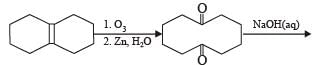
Q.1. In the scheme given below, the total number of intramolecular aldol condensation products formed from 'Y' is

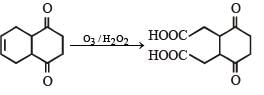
Integer Answer Type Questions: Aldehydes, Ketones & Carboxylic Acids | JEE Advanced

Ans. 1

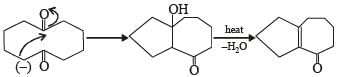
Solution. Integer Answer Type Questions: Aldehydes, Ketones & Carboxylic Acids | JEE AdvancedInteger Answer Type Questions: Aldehydes, Ketones & Carboxylic Acids | JEE Advanced

The number of intra molecular aldol condensation products (α, β -unsaturated carbonyl compound formed from Y is 1.


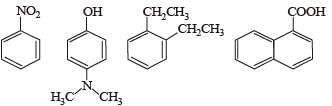
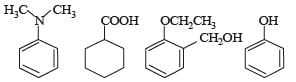
Q.2. Amongst the following, the total number of compounds soluble in aqueous NaOH is
Integer Answer Type Questions: Aldehydes, Ketones & Carboxylic Acids | JEE Advanced

Ans. 4

Solution. All carboxylic acids and phenols are soluble in aqueous NaOH. Four compounds are soluble in aqueous NaOH.


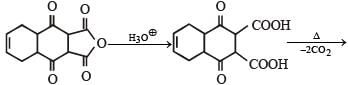
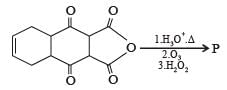
Q.3. The total number of carboxylic acid groups in the product P is       
Integer Answer Type Questions: Aldehydes, Ketones & Carboxylic Acids | JEE Advanced

Ans. 2

Solution. Integer Answer Type Questions: Aldehydes, Ketones & Carboxylic Acids | JEE AdvancedInteger Answer Type Questions: Aldehydes, Ketones & Carboxylic Acids | JEE Advanced

No. of -COOH group is '2'


Q.4. Consider all possible isomeric ketones, including stereoisomers of MW = 100. All these isomers are independently reacted with NaBH4 (NOTE: stereoisomers are also reacted separately). The total number of ketones that give a racemic product(s) is/are 

Ans. 5

Solution. General molecular formula for ketones is CnH2nO

∴ CnH2nO = 100 or 12n + 2n + 16 = 100, n = 6

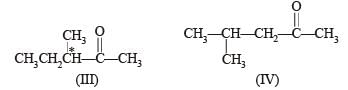
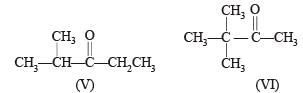
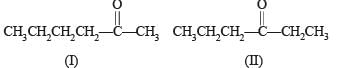
Possible isomeric ketones with 6 carbon atoms are
Integer Answer Type Questions: Aldehydes, Ketones & Carboxylic Acids | JEE Advanced

Note that only isomer III has a chiral carbon so on reduction with NaBH4 it will give diastereomeric alcohols, while all other five isomers will give racemic mixture.


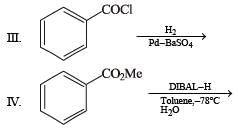
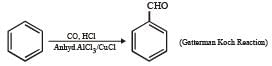
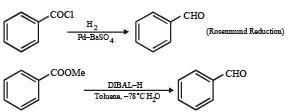
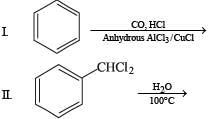
Q.5. Among the following, the number of reaction (s) that produce(s) benzaldehyde is
Integer Answer Type Questions: Aldehydes, Ketones & Carboxylic Acids | JEE Advanced

Ans. 4

Solution.

Integer Answer Type Questions: Aldehydes, Ketones & Carboxylic Acids | JEE Advanced

The document Integer Answer Type Questions: Aldehydes, Ketones & Carboxylic Acids | JEE Advanced is a part of the JEE Course Crack JEE with 35 Years of Previous Year Solved Papers.
All you need of JEE at this link: JEE

FAQs on Integer Answer Type Questions: Aldehydes, Ketones & Carboxylic Acids - JEE Advanced

1. What are aldehydes and ketones?
Ans. Aldehydes and ketones are organic compounds that contain a carbonyl group, which is a carbon atom double-bonded to an oxygen atom. In aldehydes, the carbonyl group is located at the end of the carbon chain, while in ketones, it is positioned within the carbon chain.
2. How is the presence of an aldehyde or a ketone identified?
Ans. The presence of an aldehyde or a ketone can be identified through certain chemical tests. For example, Tollens' test is used to detect aldehydes, where the aldehyde is oxidized to a carboxylic acid and a silver mirror is formed. On the other hand, ketones do not give a positive Tollens' test.
3. What are carboxylic acids?
Ans. Carboxylic acids are organic compounds that contain a carboxyl group, which consists of a carbonyl group (C=O) and a hydroxyl group (OH) attached to the same carbon atom. These compounds are characterized by their acidic properties due to the presence of the carboxyl group.
4. How can carboxylic acids be prepared?
Ans. Carboxylic acids can be prepared through various methods. One common method is the oxidation of primary alcohols or aldehydes using oxidizing agents like potassium permanganate or chromic acid. Another method is the hydrolysis of nitriles, which are organic compounds containing a cyano group (C≡N), in the presence of an acid or a base.
5. What are the uses of aldehydes, ketones, and carboxylic acids?
Ans. Aldehydes, ketones, and carboxylic acids have various applications in different industries. Some common uses include: - Aldehydes are used in the production of resins, plastics, and solvents. - Ketones are used as solvents, in the production of pharmaceuticals and perfumes, and as intermediates in organic synthesis. - Carboxylic acids are used in the production of pharmaceuticals, soaps, detergents, and food additives. They are also used as a precursor for the synthesis of esters.
Explore Courses for JEE exam
Get EduRev Notes directly in your Google search
Related Searches
Ketones & Carboxylic Acids | JEE Advanced, Exam, Important questions, Objective type Questions, Ketones & Carboxylic Acids | JEE Advanced, video lectures, Free, Ketones & Carboxylic Acids | JEE Advanced, Semester Notes, study material, ppt, Integer Answer Type Questions: Aldehydes, Previous Year Questions with Solutions, Extra Questions, mock tests for examination, pdf , practice quizzes, Viva Questions, past year papers, Sample Paper, Integer Answer Type Questions: Aldehydes, Integer Answer Type Questions: Aldehydes, Summary, shortcuts and tricks, MCQs;