JEE Advanced (Fill in the Blanks): Motion

Fill in the Blanks
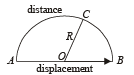
Q.1. A particle moves in a circle of radius R. In half the period of revolution its displacement is ____________and distance covered is ________. (1983 - 2 Marks)
Ans. 2R, πR
Solution.
For uniform circular motion the angle swept in half the period is π radians.
The distance (arc length) covered = R × (angle in radians) = R × π = πR.
The displacement is the straight-line distance between the two diametrically opposite points = diameter = 2R.
Q.2. Four persons K, L, M, N are initially at the four corners of a square of side d. Each person now moves with a uniform speed v in such a way that K always moves directly towards L, L directly towards M, M directly towards N, and N directly towards K. The four persons will meet at a time .............. (1984- 2 Marks)
Ans. d/v
Solution.
At any instant each person moves with speed v towards the next person along the side of the square.
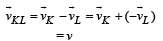
The velocity of L has no component along KL because L's direction is perpendicular to KL (L moves towards M).
Therefore the closing speed of K towards L along KL is v (only K contributes a component along KL).
Initial separation along KL is d, so time to reduce separation to zero = separation / closing speed = d / v.

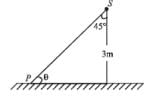
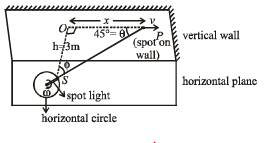
Q.3. Spotlight S rotates in a horizontal plane with constant angular velocity of 0.1 radian/second. The spot of light P moves along the wall at a distance of 3 m. The velocity of the spot P when q = 45° (see fig.) is ................. m/s (1987 - 2 Marks)
Solution.
Let x be the displacement of the spot along the wall measured from the point nearest to S, and let φ be the angle the beam makes with the perpendicular to the wall.
From geometry x = 3 tan φ.
Differentiate with respect to time: dx/dt = 3 sec^2 φ · dφ/dt.
Given angular speed of spotlight dφ/dt = 0.1 rad/s and φ = 45°, sec^2 45° = 2.
Therefore v = dx/dt = 3 × 2 × 0.1 = 0.6 m/s.


B True/False
Q.1. Two balls of different masses are thrown vertically upwards with the same speed. They pass through the point of projection in their downward motion with the same speed (Neglect air resistance). (1983 - 2 Marks)
Ans. T
Solution.
Use energy conservation or kinematics which are independent of mass.
From energy conservation: initial kinetic energy ½ m u^2 converts to potential energy and then back; the speed on returning to the initial height is the same as launch speed.
From kinematics: v^2 = u^2 + 2a s, with s = 0 between the two equal heights gives v^2 = u^2.
Hence both balls pass through the point of projection with the same speed u, independent of mass.
Q.2. A projectile fired from the ground follows a parabolic path. The speed of the projectile is minimum at the top of its path. (1984 - 2 Marks)
Ans. T
Solution.
The horizontal component of velocity vx remains constant throughout the flight (no horizontal acceleration, neglecting air resistance).
At the top of the trajectory the vertical component vy = 0, so the speed equals |vx| there.
At any other point vy is non-zero and thus the magnitude of velocity √(vx^2 + vy^2) is larger than |vx|.
Therefore the speed is minimum at the top of the path.
Q.3. Two identical trains are moving on rails along the equator on the earth in opposite directions with the same speed. They will exert the same pressure on the rails. (1985 - 3 Marks)
Ans. F
Solution.
For circular motion about Earth's axis the required centripetal acceleration depends on the total speed with respect to an inertial frame (Earth's rotation ± train speed).
Let V_total be the tangential speed measured in an inertial frame; then the inward radial force required is m V_total^2 / R.
Radial equilibrium (weight mg acting inward, normal reaction N acting outward) gives mg - N = m V_total^2 / R.
Hence N = mg - m V_total^2 / R.
A train moving east (same direction as Earth's rotation) has a larger V_total than a train moving west (opposite direction), so the normal reaction N (and therefore pressure on the rails) differs slightly for the two trains.
Thus the statement that they exert the same pressure is false.
Concepts and Short Notes (Relevant to the above problems)
Uniform circular motion and displacement over intervals. The arc length s for an angle θ (in radians) is s = Rθ. The straight-line displacement between two points on the circle is the chord length; for an angle θ the chord length = 2R sin(θ/2). For θ = π, chord = 2R and arc = πR.
Pursuit problems (constant speed, instantaneous direction towards neighbour). In symmetric pursuit problems on regular polygons each pursuer's velocity often has components perpendicular or parallel to lines joining pursuer and quarry; use relative velocity along the line of separation to find closing speed. Symmetry simplifies many pursuit problems to a single first-order equation for separation.
Spot on a wall due to rotating beam. If a beam rotates with angular velocity ω and the beam makes angle φ (measured suitably) to a reference, position on a distant line or wall often follows a trigonometric relation (x = L tan φ, or x = L sin φ etc.). Differentiation gives dx/dt in terms of dφ/dt = ω and trig functions of φ.
Projectile motion speed variation. Horizontal component of velocity remains constant (neglect air drag), vertical component changes under gravity. Kinetic energy and speed reach minimum when vertical component is zero, i.e., the top of the trajectory.
Rotation of Earth and perceived normal force. Objects on the rotating Earth require centripetal acceleration pointing towards the axis. Any additional tangential speed (for example due to a moving train) changes the required centripetal acceleration and thus slightly changes the normal reaction and pressure exerted on the surface.
Units and notation. Use SI units: length in metres (m), time in seconds (s), angular quantities in radians (rad), linear speed in m/s. Use g ≈ 9.8 m/s^2 where required unless a symbolic expression is requested.
Summary (optional). The solved items above illustrate use of basic kinematics, energy conservation, geometry, and reference-frame reasoning to answer typical short questions: compute displacements and distances in circular motion; use relative velocity and symmetry in pursuit problems; relate angular speed to linear speed via trigonometric differentiation; recognise where speed is extremal in projectile motion; and account for Earth's rotation when comparing normal forces for moving objects on the surface.