To simplify 2⁄3 + (-4⁄5) + 7⁄15 + (-11⁄20), we first need to find the LCM (least common multiple) ) for the fractions. The denominators are 3, 5, 15, and 20.
The LCM of 3, 5, 15, and 20 is 60.
Now we express each fraction with a denominator of 60:
2⁄3 = 40⁄60
-4⁄5 = -48⁄60
7⁄15 = 28⁄60
-11⁄20 = -33⁄60
Now, add the fractions:
40⁄60 + -48⁄60 + 28⁄60 + -33⁄60
Simplifying:
(40 - 48 + 28 - 33) / 60 = -13⁄60
Thus, the simplified result is: B: −13⁄60
Report a problem
MULTIPLE CHOICE QUESTION
Try yourself: Which of the following is the identity element under addition?
A
1
B
- 1
C
0
D
None of these
Correct Answer: C
The identity element under addition is the number that, when added to any other number, leaves that number unchanged. In other words, for any number x, the identity element e satisfies:
x + e = x
The number that satisfies this property is 0, since:
x + 0 = x
Thus, the correct answer is: C: 0
Report a problem
MULTIPLE CHOICE QUESTION
Try yourself: Which of the following rational numbers is in the standard form?
A
1/2
B
10/4
C
20/30
D
None of these
Correct Answer: A
Both the numerator and denominator have no common divisor other than 1.
Also, both the numerator and denominator is positive
1/2 cannot be simplified further
Therefore, 1/2 is in standard form
Report a problem
MULTIPLE CHOICE QUESTION
Try yourself: Which of the following is neither positive nor a negative rational number?
A
1
B
0
C
Such a rational number does not exist.
D
None of the above.
Correct Answer: B
The only rational number that is neither positive nor negative is 0, as it does not have a sign.
Thus, the correct answer is:
B: 0.
Report a problem
MULTIPLE CHOICE QUESTION
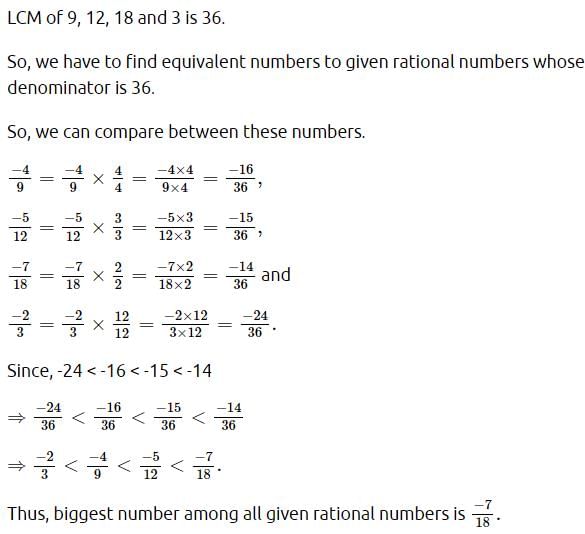
Try yourself: Which of the rational numbers-4/9 , -5/12 , -7/18 , -2/3 is the greatest?
A
-7/18
B
-4/9
C
- 2/3
D
-5/12
Correct Answer: A
Report a problem
MULTIPLE CHOICE QUESTION
Try yourself: Which of the following is the product of 7/8 and -2/21?
A
1/12
B
-1/12
C
-16/63
D
-147/16
Correct Answer: B
To find the product of 7⁄8 and -2⁄21, we multiply the numerators and denominators:
7⁄8 × -2⁄21 = 7 × -2⁄8 × 21 = -14⁄168
Now simplify -14⁄168:
-14⁄168 = -14 ÷ 14⁄168 ÷ 14 = -1⁄12
Thus, the correct answer is: B: −1⁄12
Report a problem
MULTIPLE CHOICE QUESTION
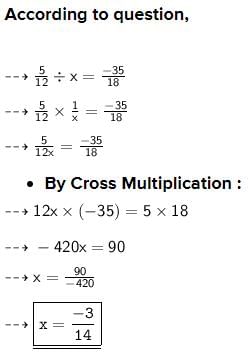
Try yourself: Fill in the blanks: 5/12 ÷ (_____) = -35/18
A
-21/36
B
-12/19
C
-5/18
D
-3/14
Correct Answer: D
Report a problem
MULTIPLE CHOICE QUESTION
Try yourself: The sum of two rational numbers is -7. If one of the numbers is –15/19, the other number is _____
1. How do I identify whether a number is rational or irrational in CBSE Class 8 maths?
Ans. A rational number can be expressed as p/q where p and q are integers and q ≠ 0, while irrational numbers cannot be written in this form. Rational numbers include integers, fractions, and terminating or repeating decimals. For example, 3/4, -5, and 0.333... are rational, but √2 and π are irrational. Students can refer to flashcards and mind maps on EduRev to practise identifying rational versus irrational numbers quickly.
2. What's the difference between positive and negative rational numbers with examples?
Ans. Positive rational numbers have both numerator and denominator with the same sign (like 3/4 or -5/-2), while negative rational numbers have opposite signs (like -3/4 or 5/-2). The sign of the entire fraction depends on whether the signs match or differ. Understanding this distinction helps students solve MCQ questions correctly and grasp the properties of rational number operations.
3. Why do we need to find the standard form of a rational number for exams?
Ans. Standard form (or lowest terms) means the numerator and denominator share no common factors except 1, making answers consistent and comparable. Examiners expect standard form because it eliminates ambiguity-6/8 and 3/4 represent the same rational number, but only 3/4 is in standard form. This skill is essential for MCQ accuracy and demonstrates conceptual clarity in rational number representation.
4. How do I add and subtract rational numbers with different denominators quickly?
Ans. Find the least common multiple (LCM) of the denominators, convert each fraction, then add or subtract numerators. For example, 1/3 + 1/4 becomes 4/12 + 3/12 = 7/12. This method prevents calculation errors in multiple-choice questions. Practising with worksheets and MCQ solutions strengthens speed and confidence during timed exams.
5. What are the key properties of rational numbers I need to remember for Class 8 MCQs?
Ans. Key properties include closure (sum, difference, product of rationals are rational), commutativity (a+b = b+a), associativity, distributivity, and the existence of additive and multiplicative identities (0 and 1). These properties form the foundation for solving rational number problems efficiently. Use EduRev's detailed notes, PPTs, and MCQ tests to master these properties systematically before your exams.
study material, past year papers, Exam, MCQ (with Solutions): Rational Numbers, practice quizzes, Semester Notes, video lectures, Free, Previous Year Questions with Solutions, pdf , Viva Questions, MCQs, shortcuts and tricks, Important questions, Sample Paper, MCQ (with Solutions): Rational Numbers, ppt, mock tests for examination, Objective type Questions, MCQ (with Solutions): Rational Numbers, Extra Questions, Summary;